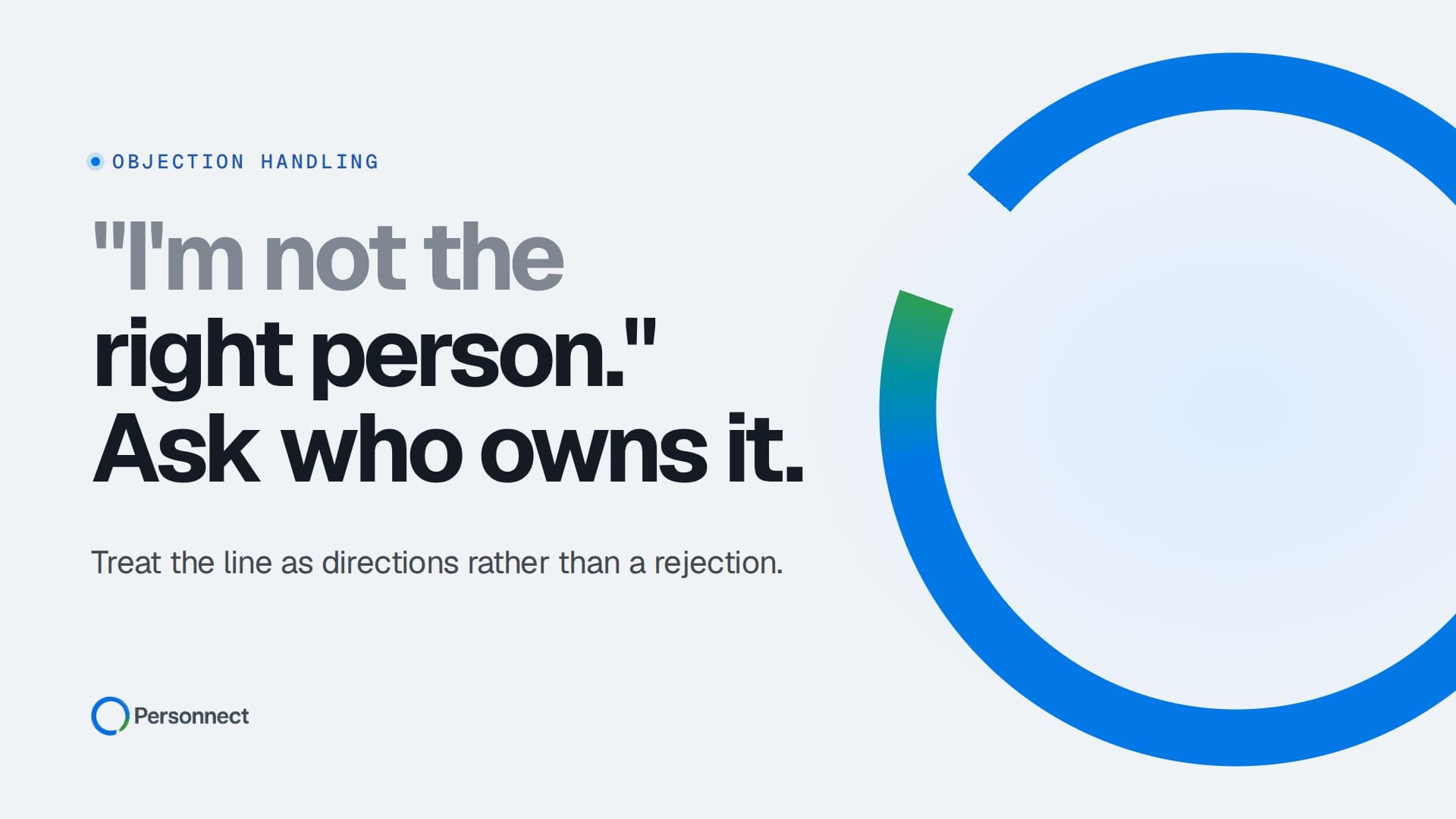
When a prospect says "I'm not the right person," you've reached someone who knows the building better than your list does, so treat the line as directions rather than a rejection. Find out whether they're deflecting or really in the wrong seat, ask who owns the problem and whether you can mention their name, then log what you learned so nobody on your team dials that same wrong contact next quarter. Gong Labs counts "Not my responsibility" among the dismissive objections, a group that makes up 49.5% of everything prospects push back with on cold calls (Gong Labs, 2024).
Key Takeaways
- "I'm not the right person" is either a reflex deflection or an accurate correction, and one follow-up question usually tells you which.
- The strongest response is a referral ask: who owns this, who would you ask, and may I say we spoke.
- With around 13 people involved in a typical B2B purchase, the person who answered can usually point you somewhere useful.
- Log the referral name, the corrected role and the old contact's real job, or the same wrong dial happens again next quarter.
- Most wrong-person calls start upstream, with stale titles and lists built on the wrong role, so check titles before the session starts.
Why do prospects say "I'm not the right person"?
Prospects say it for three reasons: the title on your list is out of date, the list targeted a role that doesn't own the problem, or the person owns it and wants you gone. Job movement alone guarantees a steady supply of the first two. Median tenure with a current employer was 4.1 years in January 2026 (U.S. Bureau of Labor Statistics, 2026).
Is the title on your list out of date?
Often, yes. Tenure is much shorter for younger workers: the median for people aged 25 to 34 was 3.0 years, against 9.6 years for those aged 55 to 64 (BLS, 2026). Managers and directors in that younger group are exactly who SDRs call about tools and process. Promotions and internal moves change titles too, and none of that shows up in a contact record until someone checks. The wider math of data decay is covered in our post on the compounding cost of bad phone data.
Was the list built on the wrong role?
Sometimes the data is accurate and the targeting is off. A list pulled on "VP of Sales" for a product that really belongs to sales operations will connect you with the right people at the wrong desk all day. Buying is spread out: on average 13 people inside a company are involved in a buying decision, and 89% of purchases involve two or more departments (Forrester, 2024). A title filter that picks one of those 13 can easily pick the wrong one.
Or is the prospect just deflecting?
Plenty of the time, the person on the phone owns the problem and doesn't want a cold call. Gong groups "Not my responsibility" with "Not interested" and "Send me some information" as knee-jerk reactions, and the top five objections account for 74% of all objections reps hear (Gong Labs, 2024). A deflection is cheap to say and ends the call fast, which is the whole point for a busy person.
How can you tell a deflection from a real wrong-person answer?
Ask one specific question and listen to how fast and how precisely they answer. A person who really isn't the owner usually knows who is, and says so with a name or a team. A person who is deflecting stays vague, because naming someone keeps the conversation going. A few signals help you sort the two in seconds.
| They say | Likely | Your move |
|---|---|---|
| "That's Priya in ops" | Real | Confirm and ask to mention them |
| "Not me, sorry" | Unclear | Ask who would handle it |
| "Send me something" | Deflection | Ask one question first |
| "I moved teams" | Stale data | Ask who took over |
| "We don't do that" | Fit issue | Ask how it's handled today |
Watch for title clues as well. If you called a Director of Revenue Operations about pipeline reporting and they say it's not theirs, that's worth a gentle second look, because the role usually touches it. If you called an office manager about security software, believe them. The quickest test is the "who" question: real answers come with a name, and deflections come with "I don't know, just email the general inbox."
When it's a deflection, don't argue the point. Say something like: "Fair enough. Before I let you go, how does your team handle pipeline reporting today?" If they answer in detail, you've learned they're closer to it than they claimed, and you now have a reason to keep talking. If they can't answer, they probably really aren't the owner, and you move to the referral.
What should you say when the "I'm not the right person" objection comes up?
Say thank you, then ask for a referral in plain words. The goal of the reply is to leave with a name, a reason that person cares, and permission to say you spoke. Each of the talk tracks below takes under 20 seconds, and none of them asks the prospect to do any work beyond answering. Use the objection handling habits you already have: acknowledge, ask, then confirm.
Ask who owns it
"Thanks for telling me, that saves us both time. Who on your team looks after outbound calling these days, is that someone in sales ops or on the sales floor?" Offering two options makes the question easier to answer than an open "who should I talk to?" and it shows you've done some homework on how teams like theirs are built.
Ask who they would ask
When they say they don't know, try the version that makes them the expert: "If you had a question about how your SDRs get their lists, who would you walk over to?" People are far more comfortable naming a colleague they'd go to themselves than nominating someone as "the decision maker." It turns a judgment call into a simple fact about their office.
Ask permission to use their name
Once you have a name, ask before you use it: "Would you mind if I mentioned we spoke? I'll keep it short and I won't say you recommended us." That last part matters. You're not claiming an endorsement, only that a colleague pointed you their way. Most people say yes, and the ones who say no have still given you the name.
When they truly don't know
Some people really can't help, especially in large companies. Ask for the function instead: "No problem. Is there a team name I should look for, like revenue operations or sales enablement?" Then thank them and end the call cleanly. A polite exit keeps the door open if you need them later, and they may well be part of that 13-person buying group anyway.
On a parallel dialer like Personnect, the rep is connected the moment a person answers, with the contact's details on screen. That means the title you're calling about is in front of you when they say it isn't theirs, so you can ask "you're listed as Director of Sales Operations, has that changed?" instead of guessing.
How do you open the call to the person they referred you to?
Lead with the colleague's name and the reason, then ask a question. The referral earns you a few extra seconds of attention, and that time is worth a lot: Gong found successful cold calls average 5 minutes 50 seconds, while unsuccessful ones end around 3 minutes 14 seconds (Gong Labs). Staying on the line is half the battle.
A clean opener sounds like this: "Hi Priya, this is Sam from Northwind. I spoke with Daniel on your sales team earlier, and he said you look after how the SDRs get their call lists. Do you have a minute for me to explain why I called?" It's short, it names the source, and it hands them a choice. Notice that it doesn't say Daniel recommended anything. It only says what Daniel told you.
Buyers are more open to this than many reps assume. In RAIN Group research, 82% of buyers said they accept meetings with sellers who reach out to them, and 71% want to talk to sellers early in the sales process (RAIN Group Center for Sales Research). A warm handoff from inside their own company gives you a better start than a cold open on a stranger.
If the new contact says they aren't the owner either, run the same play one more time, then stop. Two hops is a useful map of the account. Three or more usually means the problem you solve isn't a priority there right now, and that's worth knowing too. A short cold call script generator can help you draft and practice these openers before a session.
What should you log after a wrong person cold call?
Log four things: the referral name and role, the original contact's actual role or status, whether you have permission to use the referrer's name, and the outcome of the next attempt. Without that record, the call taught one rep one fact that disappears at the end of the day. With it, the whole team's list gets a little better.
| Field | Example |
|---|---|
| Referral | Priya Shah, Sales Ops |
| Old contact | Moved to partnerships |
| Name OK? | Yes |
| Next step | Call Thursday |
Update the original contact too. If they changed roles, change the title in the CRM. If they left, mark them gone so nobody dials them again. If they own something adjacent, note it, because they could become a useful second voice in that decision maker group later on.
Typing all of this after every call is where the habit breaks down. In Personnect, the summary, transcript and outcome of every call are logged and synced to HubSpot or Salesforce, so the referral name the prospect gave you is captured in the record instead of on a sticky note.
Review the wrong-person logs weekly. If the same title keeps producing "not me," the list rule is wrong, not the reps. Change the target role and watch whether the referral rate drops.
How do you prevent wrong-person calls before you dial?
Check titles and roles before the session, not during it. Two habits do most of the work: confirm each contact still holds the title on your list, and make sure that title owns the problem you solve. Fewer wrong-person calls also mean fewer awkward openers and more time spent with the people who can actually buy.
Start with role mapping. Write down which teams touch your product, who signs, who uses it and who blocks it. Then build lists from that map rather than from a single job title. Ask your account executives which titles showed up in recent closed deals, since those are the people who really own the problem.
Then check the contacts themselves. With Personnect lead enrichment, Michael, the assistant built into Personnect, checks each lead's title, company and phone number before anyone dials, and every lead comes back enriched, stale or retired, at 15 cents a lead. Stale and retired leads can come off the list before a rep spends a call on them.
Keep feeding what you learn on calls back into targeting. Every "I'm not the right person" that ends with a name is a free correction to your role map. Teams that treat those corrections as data should see their wrong-person calls shrink over time.
What does a good wrong-person call leave behind?
A good wrong-person call leaves you with a name, a reason to call that person, and a cleaner list than you started with. The prospect who said "I'm not the right person" either told you something true about their company or tested whether you'd go away. In both cases, one calm question sorts it out. Thank them, ask who owns the problem, ask who they'd ask if they don't know, and get permission before you mention their name. Then write it all down. The referral call gets a warmer opening, the old record gets fixed, and the pattern in your logs tells you whether your list is aimed at the wrong role. Over a few weeks, this objection stops feeling like a wall and starts working like a free source of account intelligence.
Frequently Asked Questions
Is "I'm not the right person" a real objection or a brush-off?
It can be either. Gong classifies "Not my responsibility" as a dismissive objection, alongside "Not interested" and "Send me some information" (Gong Labs, 2024). Ask who handles the problem: a quick, specific name usually means it's real, while a vague answer often means a brush-off.
How do you ask for a referral on a cold call without being pushy?
Keep it to one question and make it easy to answer. "Who would you ask about this?" works better than "Who's the decision maker?" because it asks for a fact, not a judgment. Then ask permission to mention them, and promise you won't claim they recommended you.
Should you mention the referrer's name on the next call?
Yes, if they agreed. Open with their name and what they told you, and nothing more. Don't stretch it into an endorsement. If they declined, call the new contact without the name and use the role they gave you to shape your opener instead.
Do calls nobody answers still help clean up a wrong-person list?
They do in Personnect. Unanswered calls still verify your contacts as part of calling, so a session cleans the list a little even when no one picks up. Pair that with checking titles before the session and fewer of your connected calls end with "I'm not the right person."
Sources
- Gong Labs gong.io/resources/labs/we-found-the-top-objections-across-300m-cold-calls-heres-how-to-handle-them-all
- U.S. Bureau of Labor Statistics bls.gov/news.release/tenure.nr0.htm
- Forrester forrester.com/press-newsroom/forrester-the-state-of-business-buying-2024
- Gong Labs gong.io/cold-calling
- RAIN Group Center for Sales Research rainsalestraining.com/sales-training-programs/sales-prospecting