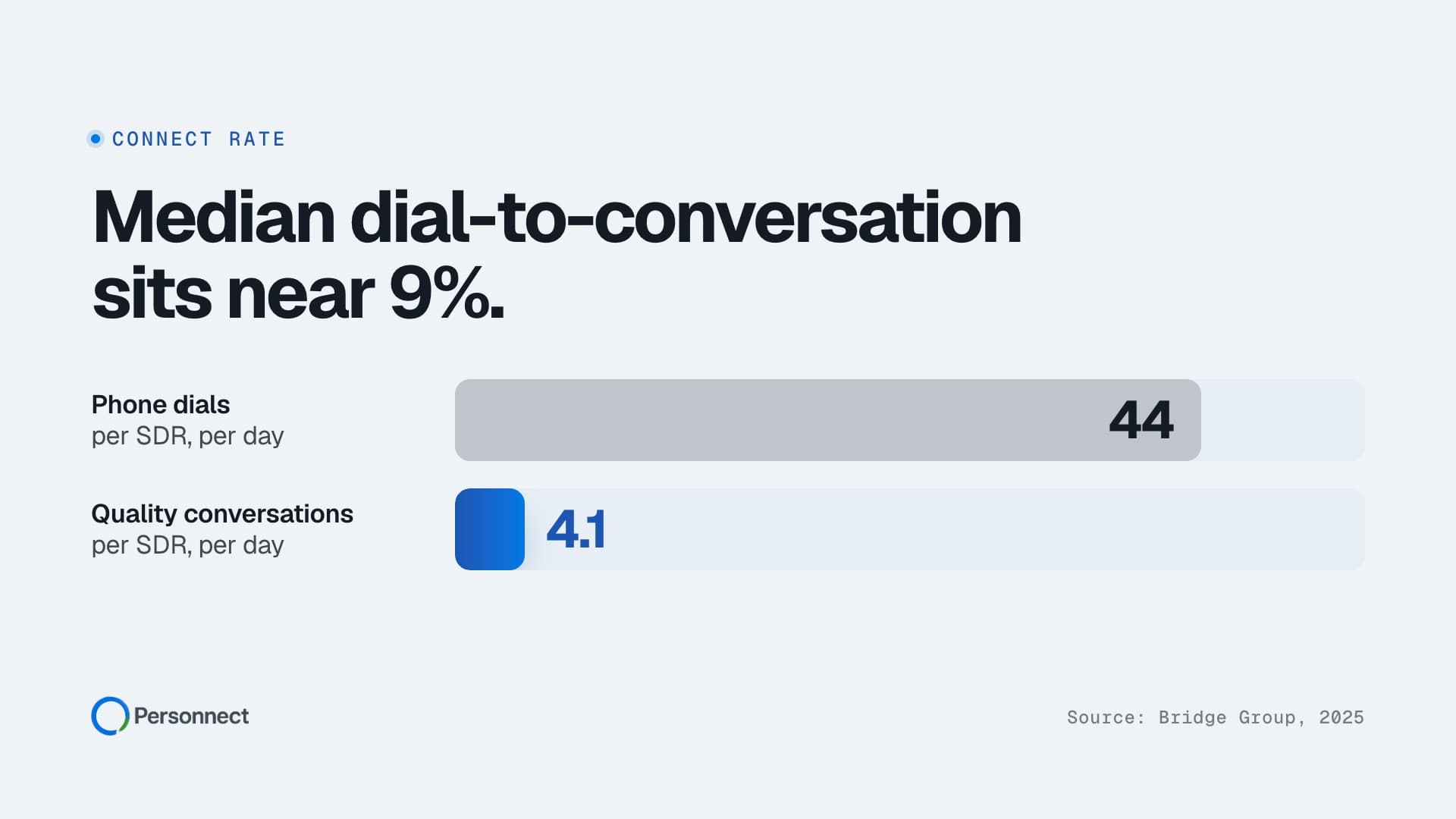
A full-time SDR should plan on 40 to 60 cold calls a day, and an SDR on a phone-first team sits near the top of that range. The survey median is 44 dials and 4.1 quality conversations a day, while phone-first teams average 56 dials and 4.6 conversations (The Bridge Group, 2025). Account executives, account managers and founders who call need far fewer dials, because calling is one part of their week. Every one of those numbers only means something next to the conversations it produces.
Key Takeaways
- SDRs land between 28 and 56 dials a day depending on how phone-heavy the team is, with 44 as the survey median.
- AEs, account managers and founders work in smaller ranges, roughly 10 to 40 dials on the days they prospect.
- Set the target in conversations per day, then let your dial-to-conversation ratio decide the dial count.
- About one dial in ten turns into a real conversation in the published data, and a meeting can take more than 200 dials.
- Rising dial volume without rising conversations points to a list or number problem, so fix that before you ask for more effort.
What do the benchmarks say for each sales role?
The published data is strongest for SDRs and thin for everyone else. Bridge Group's 2025 survey of 351 B2B companies found a median of 112 total activities per SDR per day, split into 44 phone dials, 41 emails, 19 LinkedIn touches and 8 texts or other actions (The Bridge Group, 2025). For other roles, the ranges below come from how their week is built.
| Role | Dials | Conversations | Basis |
|---|---|---|---|
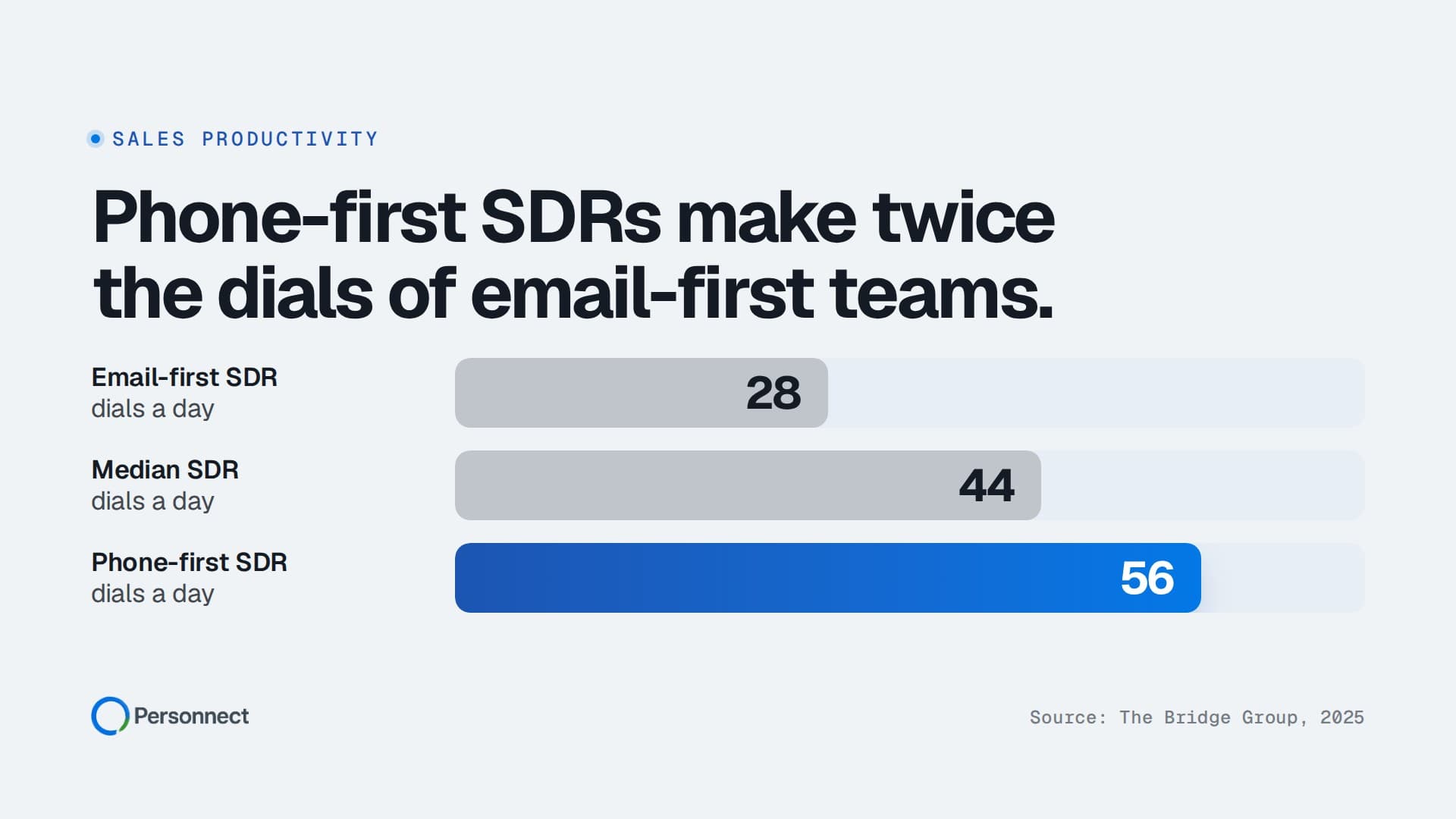
| SDR, median | 44 | 4.1 | Survey |
| SDR, phone-first | 56 | 4.6 | Survey |
| SDR, email-first | 28 | 3.4 | Survey |
| AE, self-sourcing | 15 to 30 | 1 to 3 | Estimate |
| Account manager | 10 to 25 | 2 to 4 | Estimate |
| Founder | 20 to 40 | 2 to 4 | Estimate |
The three SDR rows are medians and averages from the Bridge Group study. The other three rows are our working ranges, built from the time each role can spare for the phone, and they should be read that way. No large public survey reports daily dials for account executives or founders, and any blog that quotes a precise figure for them is usually repeating someone else's guess.
Why do SDR numbers spread so widely?
Team design explains most of the gap. Bridge Group found that phone-first SDR teams average twice the dials of email-first teams, 56 against 28 a day (The Bridge Group, 2025). The phone-first group also holds more conversations, though the lift is far smaller than the gap in dials: 4.6 a day against 3.4.
That ratio is worth a second look. Doubling the dials bought about 35% more conversations. Email-first reps probably call a shorter, warmer list, contacts who already opened something, so more of their calls land. Phone-first reps work colder lists at higher volume. Neither model is wrong, but comparing their dial counts directly tells a manager very little.
How should you read an SDR quota next to those numbers?
The meeting quota is the number that actually decides the dial target. The same survey puts the global median monthly quota at 10 Stage 0 meetings held, down 40% since 2018, and only 60% of SDRs hit quota, the lowest share in the study's history (The Bridge Group, 2025). A lower bar that fewer reps clear suggests effort alone isn't the constraint.
If you want the definition of the role itself, the SDR glossary entry covers what separates it from a BDR or an AE.
Why is a dial count meaningless on its own?
A dial count describes effort, while a conversation count describes output. Two reps can each log 50 dials and end the day with one conversation or with seven, depending on the list, the time of day and the numbers they call from. A target written only in dials rewards the first rep as much as the second.
The published ratios make the point concrete. In Cognism's 2024 calling data, 55,701 dials produced 9,247 connected calls, 5,265 conversations and 254 booked meetings (Cognism, 2024). That works out to about one conversation for every 10.6 dials and roughly 219 dials for each meeting. Bridge Group's SDR median lands close by, at about one quality conversation per 10.7 dials.
So the useful daily target is conversations. Dials follow from it once you know your own dial-to-conversation ratio. If your team needs six conversations a day and converts one dial in ten, the dial target is about 60. If list cleanup moves that ratio to one in seven, the same six conversations take about 42 dials, and nobody had to work harder.
What happens when the conversation rate falls?
The dial target climbs fast. Cognism's 2025 report found that its success rate, measured as meetings booked per conversation, fell to almost half of the previous year's 4.82% (Cognism, 2025). Gong's research team puts the average cold-call success rate even lower, "as low as 1.48%", and notes that the average hides a wide gap between callers (Gong, 2018). The two studies don't define success the same way, and that difference alone can move a benchmark by a factor of three.
For a manager, the lesson is to measure your own funnel instead of borrowing a ratio. A benchmark tells you whether you're in a sensible range. Your CRM tells you what your reps actually need.
How do you work backward from a meeting target to a daily dial number?
Start with meetings, convert to conversations, then convert to dials. Using Bridge Group's median quota of 10 meetings a month and Cognism's 2024 rate of 4.82% meetings per conversation, a rep needs roughly 207 conversations a month to source every meeting by phone (Cognism, 2024). Over 21 working days, that's about 10 conversations a day.
| Step | Ratio | Daily result |
|---|---|---|
| Meetings needed | 10 a month | 0.5 |
| Conversations | 4.8% book | 10 |
| Dials | 1 in 10.6 talk | 106 |
That's more than double the median SDR's 44 daily dials. Most teams don't expect the phone to carry the whole quota, since email and LinkedIn book meetings too. And many teams set dial targets from habit rather than from this arithmetic, which is how a rep ends up hitting the activity number every day and still missing quota.
Run the same math with your own three inputs. Most CRMs can give you meetings per conversation and conversations per dial for the last quarter in a few minutes.
Does calling the same person more often change the math?
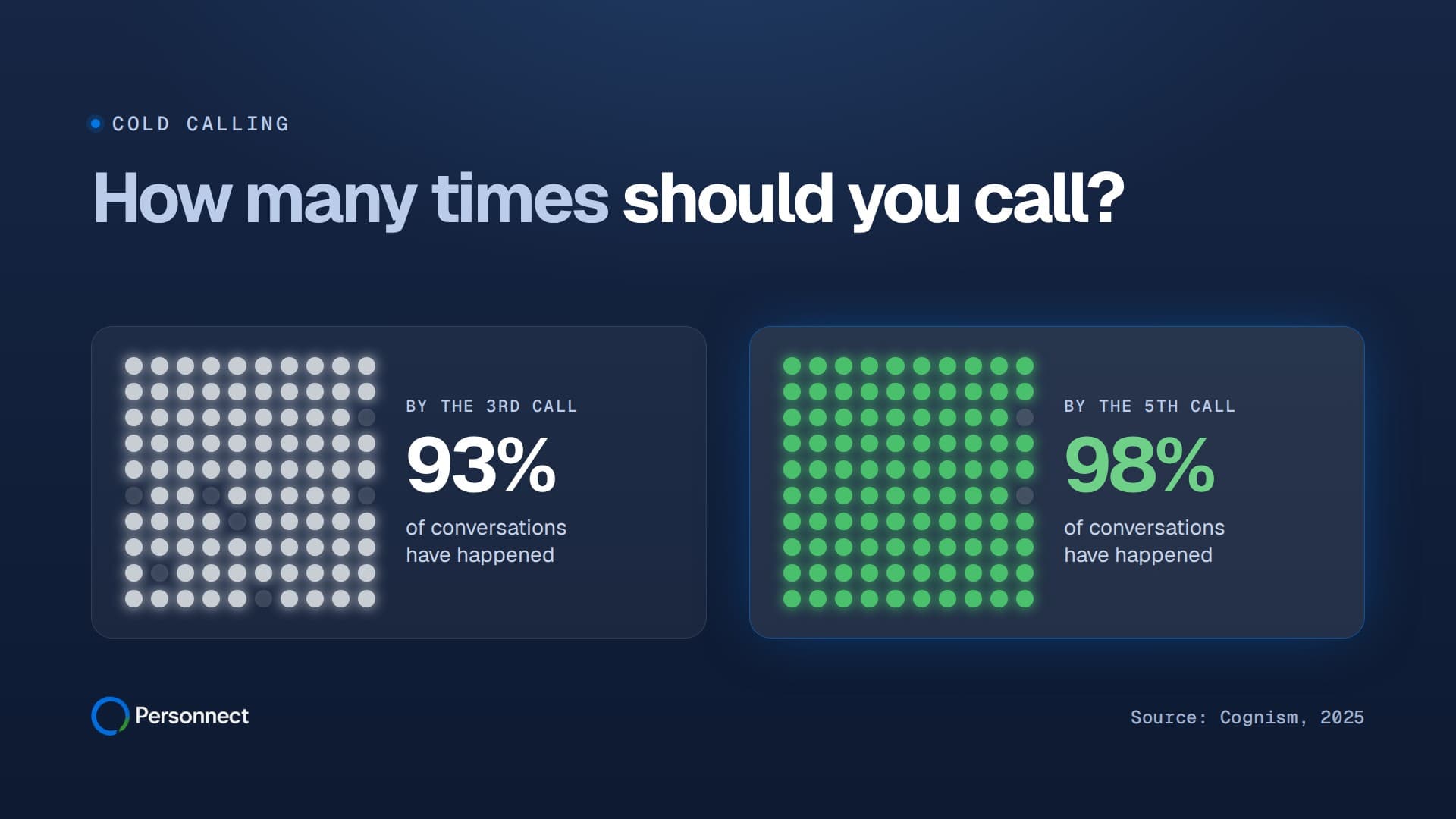
Yes, because repeat attempts on the same contact pay off less each time. Cognism found conversations dropped 73% between the first and second call to a contact and another 60% from the second to the third, and that five attempts captured 98.6% of all the conversations it recorded (Cognism, 2025). A team that fills its daily dial count with seventh and eighth attempts will see its ratio sink. Our post on how many times to call a prospect goes deeper on spacing.
How much of a rep's day do these calls actually take?
Less than most managers think. Gong found that successful cold calls average 5 minutes 50 seconds and unsuccessful ones 3 minutes 14 seconds (Gong). At the SDR median of 4.1 conversations a day, that's somewhere between 13 and 24 minutes of actual talking.
The rest of the calling time goes to ringing, voicemail greetings, wrong numbers and the gaps between calls. That's the part a dialer can shrink. Salesforce's research found reps spend just 28% of their week selling, with deal management and data entry taking much of the rest (Salesforce, 2022). A daily dial target that eats three hours to produce 20 minutes of conversation is mostly paying for waiting.
This is where the dialing model changes the benchmark. A parallel dialer such as Personnect calls up to five lines at once per rep and connects the rep the moment a person answers, with the contact's details already on screen. Voicemail is detected and skipped, so reps aren't listening to greetings. The dial count rises sharply, but the number a manager tracks stays the same: conversations per day.
Should dial targets change with a faster dialer?
The conversation target should go up, and the dial target becomes a capacity figure rather than a goal. Personnect, for example, puts single-rep capacity at roughly 500 dials a day. Nobody needs to chase that number as a quota. What changes is that a rep can now reach the conversation count the backward math asked for, inside a block or two, instead of falling short at 44 dials. For block structure, see how top SDR teams structure calling blocks.
How many calls should an account executive make per day?
An AE who sources some of their own pipeline should aim for one short calling block on prospecting days, which usually means 15 to 30 dials. AEs carry demos, follow-ups and deal work, and Bridge Group's 2026 AE study found ramp time at a record 6.2 months and only 48% of AEs at quota (The Bridge Group, 2026). Their phone time is scarce, so it should go to the best-fit accounts.
Our advice is to set AE calling as a weekly conversation goal rather than a daily dial count. Ten to fifteen self-sourced conversations a week is realistic for an AE with an SDR partner, more for one without. On days with three demos, the right number of cold calls may be zero.
What about account managers?
Account managers mostly call people who already know them, so their dial-to-conversation ratio is far better than an SDR's. Bridge Group found that 38% of AEs now own renewal and expansion, alone or shared, nearly double the share in 2024 (The Bridge Group, 2026). As that work shifts onto AEs, the account manager's calls blend into the same calendar. Ten to 25 dials a day to existing accounts can produce two to four real conversations, and the target should be written as conversations with each key account per quarter.
How many cold calls should a founder make each day?
A founder doing sales alone should protect two or three calling blocks a week rather than a daily quota, at 20 to 40 dials a block. Founders are full-cycle sellers: they prospect, run the demo and close. A daily target competes with hiring, product and fundraising, and it usually loses.
Founders can also change the pitch the same afternoon based on what they hear on the phone, which a rep working from a script usually can't. RAIN Group found it takes an average of 8 touchpoints to get an initial meeting with a new prospect, while top performers average 5 (RAIN Group). Better targeting and a sharper message cut the touch count, and founders control both.
Cost matters at this stage too. Seat-based tools charge for a founder who calls two afternoons a week the same as for a full-time SDR. Personnect charges 8.5 cents per answered minute with no seat fees, so a part-time caller pays for the minutes they actually talk and nothing for the weeks they don't call.
When should a manager raise or lower the daily target?
Raise the dial target only when the conversation rate holds steady at higher volume. If dials go up 30% and conversations go up about 30%, the list and the numbers are healthy and the extra effort is paying. If dials go up and conversations stay flat, more volume won't help.
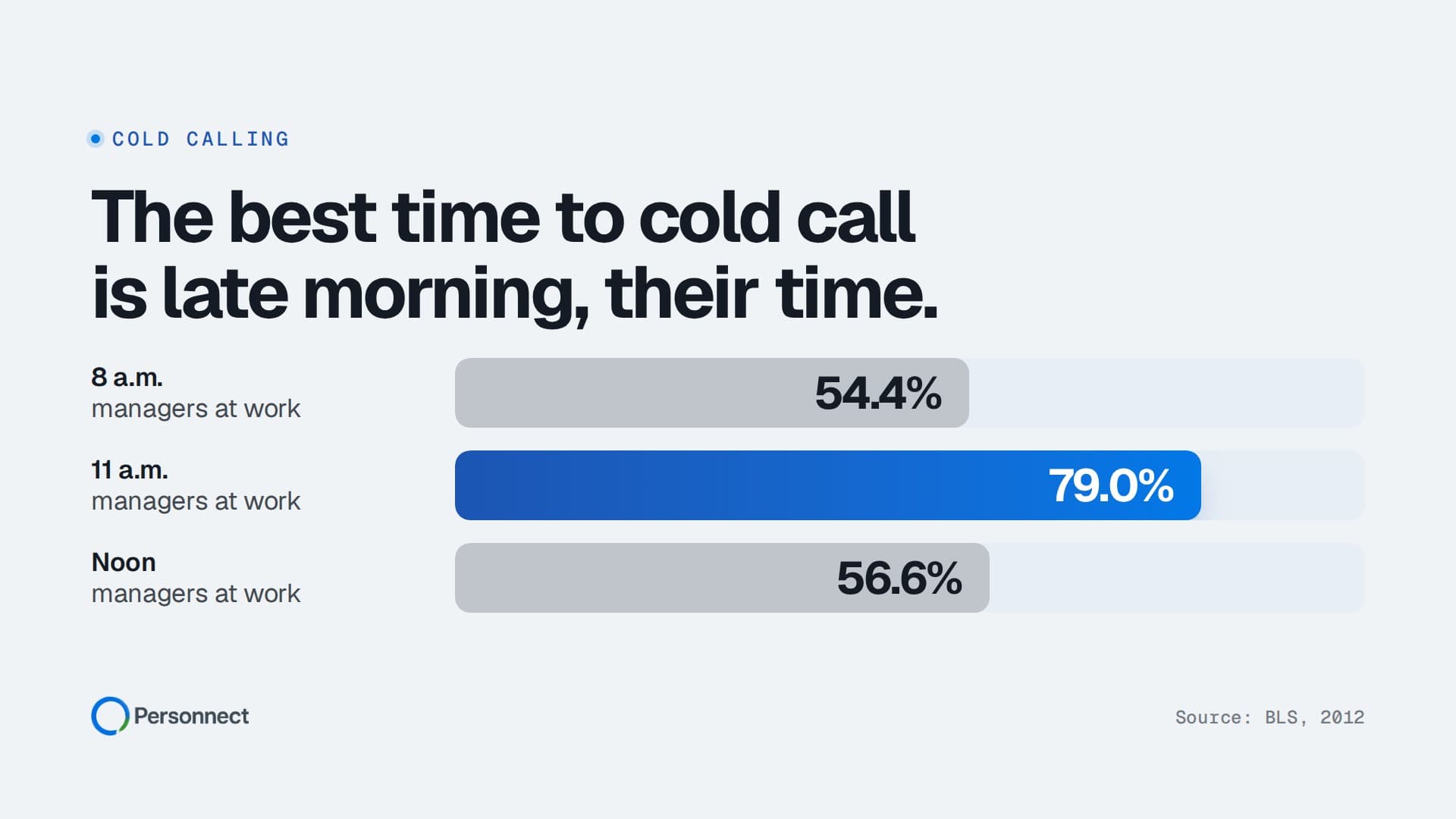
Flat conversations usually point to one of three causes: stale contact data, numbers being flagged before anyone picks up, or calling at the wrong hours for the prospect's time zone. Each shows up in the funnel before it shows up in quota. Our guide to what a good connect rate for cold calling is breaks down which stage of the funnel each cause hits.
Lower the target when a rep is new. Bridge Group puts average SDR ramp at 3.0 months (The Bridge Group, 2025), and during that stretch a new rep learns more from 25 well-prepared dials than from 60 rushed ones.
Where should your team's number land?
Pick a daily conversation goal first, then derive the dial count from your own ratio. For a full-time SDR, the published medians suggest 4 to 5 quality conversations a day from 44 to 56 dials, and the backward math from a 10-meeting quota suggests many teams need more conversations than that. AEs, account managers and founders should work from weekly conversation goals that fit around their other work. Review the dial-to-conversation ratio every month, because it moves with list quality, call timing and number reputation far more than with effort. When the ratio improves, you can hold the dial count and raise the conversation goal. When it falls, fix the inputs before you ask anyone to dial harder.
Frequently Asked Questions
Is 100 cold calls a day realistic for an SDR?
On a single-line dialer, 100 dials a day is hard to sustain alongside email and LinkedIn work, since the survey median is 44. It becomes realistic with a faster dialer, but the better question is whether 100 dials produce the conversations your quota needs at your current ratio.
How many conversations per day should an SDR have?
Four to five quality conversations a day is the published median range, with phone-first teams averaging 4.6 (The Bridge Group, 2025). If your meeting math says you need ten, you either need more dials or a better dial-to-conversation ratio.
Do unanswered calls count toward a rep's productivity?
They count as activity, and they can still be useful. In Personnect, unanswered calls still verify your contacts, so a no-answer adds to list quality, and voicemail is skipped so it doesn't eat talk time. Judge the rep on conversations and meetings, though, not on unanswered dials.
Should dial targets be the same for every rep?
No. A rep working a cold, phone-first list needs more dials than one calling warm follow-ups, as the 56 against 28 gap in Bridge Group's data shows (The Bridge Group, 2025). Give every rep the same conversation goal and let each one's ratio set their dial count.
Sources
- The Bridge Group bridgegroupinc.com/research/2025-sdr-models-metrics-report-the-bridge-group
- Cognism cognism.com/state-of-cold-calling
- Cognism cognism.com/cold-calling-report-2025
- Gong gong.io/resources/labs/is-cold-calling-dead
- Gong gong.io/cold-calling
- Salesforce salesforce.com/news/stories/sales-research-2023
- The Bridge Group bridgegroupinc.com/research/2026-ae-models-motions-metrics
- RAIN Group rainsalestraining.com/blog/how-many-touches-does-it-take-to-make-a-sale