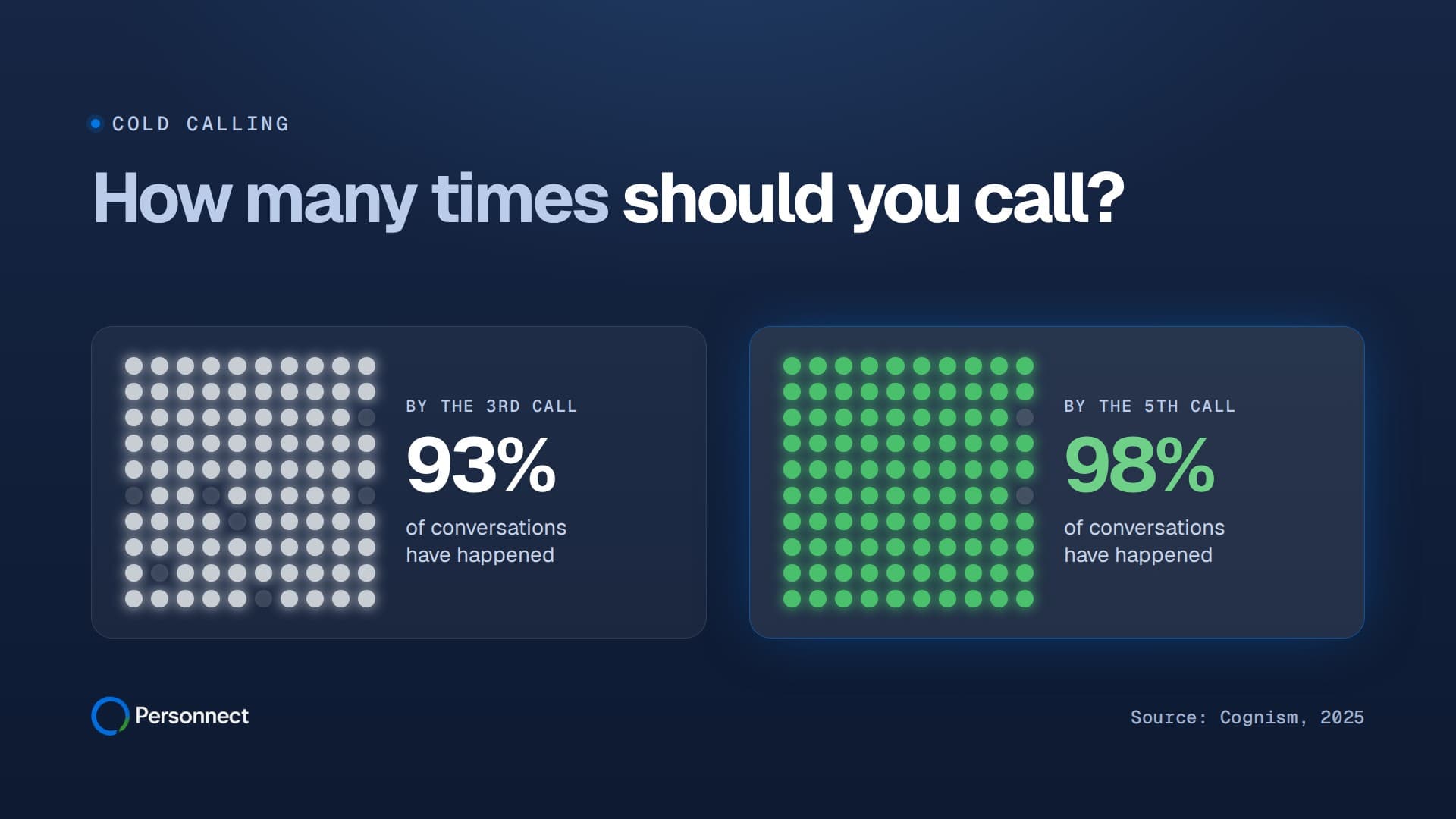
Call a prospect three to five times, spread over roughly two to three weeks, and then stop dialing that number. Cognism's cold calling data shows 93% of conversations happen by the third attempt and more than 98% by the fifth (Cognism, 2025), so a sixth call mostly buys you a lower chance at the same person.
Key Takeaways
- Plan three to five call attempts per prospect over two to three weeks; nearly all conversations happen inside that window.
- Space attempts across different days and times of day, and lean on the 10 a.m. to 11 a.m. and 2 p.m. to 3 p.m. windows in the prospect's own time zone.
- Calls work best inside a wider sequence of about eight touches that mixes phone, email and social.
- Stop when you hit the attempt limit, get a clear no, or learn the number is wrong, then park the contact and come back with a new reason.
- Count attempts per prospect in your CRM, not dials per day, or you can't tell persistence from repetition.
How many call attempts does it actually take to reach someone?
Most prospects who will ever pick up do it early. In Cognism's 2026 report, reps needed an average of 1.55 calls to reach a prospect, down from 2.9 the year before (Cognism, 2026). The same report says people who are likely to answer an unfamiliar number tend to do so on the very first call.
That sounds like you only need one or two tries. You don't. The 1.55 figure describes the prospects who were reached, and it says nothing about the ones who never answered at all. To see the full picture you need a second number: how many dials it takes to get any conversation.
Gong Labs and 30 Minutes to President's Club analyzed more than 300 million cold calls. The average rep connected with 5.4% of prospects, which works out to about 19 dials per conversation, while top-quartile reps connected with 13.3%, closer to 8 dials (Gong, 2024).
Put the two together and a clear pattern shows up. A slice of your list answers fast. Another slice answers only after a few tries at different times. The rest won't pick up no matter how often you ring, because the number is wrong, the person has left, or they screen every unknown caller. Your attempt limit exists to separate the second group from the third without burning weeks on it.
Why "just keep calling" is the wrong instinct
Persistence gets praised in every sales training, and it should. But persistence on the phone has a ceiling. If 98% of conversations have happened by attempt five, attempts six through ten are fishing in a nearly empty pond. That time is better spent on a fresh contact at the same account or on a different channel with the same person.
Why do so few conversations happen after the third call?
The drop-off is steep because each attempt filters your list. After three tries at different times, you've already reached most people who take cold calls at all. Cognism found that 93% of conversations happen by attempt three (Cognism, 2025), which leaves only a sliver for attempts four and five.
Think about who is left after three unanswered calls. Some are travelling or heads-down on a project, and a call next week will catch them. Some have a number in your list that rings a desk phone nobody sits at anymore. Some see your caller ID, don't recognize it, and let it go to voicemail every time.
Only the first group benefits from more dials. The second group needs better data. The third needs a reason to recognize you, which usually comes from an email or a LinkedIn touch before the next call.
Callbacks also matter here. Cognism reports a 26.85% chance of reaching a prospect on a callback (Cognism, 2025). That's a strong argument for leaving one clear, short voicemail somewhere in your sequence, and for making sure the number you call from actually rings back to your team.
How should you space call attempts over two to three weeks?
Spread them out. Attempts bunched into one afternoon hit the same meeting, the same commute or the same habit of ignoring the phone. Vary the day of the week and the time of day so each attempt has a different shot at the prospect's calendar.
Time of day still helps. Cognism's 2026 data puts the best window at 10 a.m. to 11 a.m., with 2 p.m. to 3 p.m. as a solid second choice, and shows weaker results before 9 a.m., after 4 p.m. and over lunch (Cognism, 2026). Those hours mean the prospect's local time, not yours. If your list spans time zones, a quick check with a prospect local time tool before each block saves a lot of wasted early-morning dials to the West Coast.
Here's a schedule we'd suggest for a cold prospect. Treat it as a starting point for your own sales cadence and adjust the gaps to your market.
| Day | Touch | Timing |
|---|---|---|
| 1 | Call 1, no voicemail | Morning |
| 1 | Right after | |
| 3 | Call 2, short voicemail | Afternoon |
| 5 | LinkedIn touch | Any |
| 8 | Call 3 | Late morning |
| 10 | Email reply | Any |
| 14 | Call 4 | Early afternoon |
| 18 | Call 5, final voicemail | Morning |
| 21 | Closing email | Any |
That's five calls and four other touches in three weeks. The gaps get longer as the sequence runs, so the prospect feels steady attention rather than pressure.
Can you call twice in one day?
Occasionally, yes. A second call later the same day can make sense when the first one rang out and you have a reason to think they're at their desk now, for example after they opened your email. As a habit, though, double-dialing the same person in an hour reads as pushy and adds little over a call on a different day.
What about the first call versus later ones?
Treat the first call as your best shot and prepare for it properly. Cognism's 2026 numbers suggest reachable people tend to pick up early, so a sloppy first call wastes the attempt with the highest odds. Later attempts can be shorter to prepare, since you've already done the research.
How do calls fit into a multichannel cadence?
Calls carry the sequence, but they shouldn't run alone. RAIN Group's research found it takes an average of 8 touchpoints to get through and generate a meeting, while top performers do it in 5 (RAIN Group, 2026). Five calls plus three or four emails and social touches lands close to that average.
The channels also lift each other. In the Gong Labs analysis, email reply rates nearly doubled when the rep also called, 3.44% versus 1.81%, even when the call never connected (Gong, 2024). A missed call followed by a short email gives the prospect a name and a reason to answer next time.
| Channel | Role | Attempts |
|---|---|---|
| Phone | Live conversation | 3 to 5 |
| Context and proof | 3 to 4 | |
| Recognition | 1 to 2 | |
| Voicemail | Callback prompt | 1 to 2 |
Buyers are more open to this than reps assume. RAIN Group reports that 7 out of 10 buyers want to hear from sellers when they're looking for new ways to drive stronger business results (RAIN Group, 2026). The job of the cadence is to show up as one of those sellers, consistently, without becoming noise.
Caller ID plays a part as well. A prospect who sees a familiar area code is more likely to give an unknown number a chance. Personnect calls each contact from a local number in their area code, which matters most on attempts two through five, when the prospect has already seen your number once and decided whether to trust it.
When should you stop calling a prospect?
Stop at your attempt limit, or earlier if the prospect gives you a clear signal. Five unanswered calls over three weeks is a reasonable cap for most B2B lists, given that conversations after the fifth attempt are rare (Cognism, 2025). Past that point you're usually calling the wrong number or the wrong person.
Clear stop signals:
- The prospect says no, asks you not to call, or asks to be removed.
- The number reaches someone else, a disconnected line or a general switchboard with no path to the person.
- You learn they've left the company.
- You've finished the planned attempts with no answer and no reply on any channel.
Wrong numbers deserve special care, because they quietly inflate attempt counts. A rep who dials a dead number five times thinks they gave the prospect a fair chance, when the prospect never had the chance to answer. With Personnect, unanswered calls still verify your contacts as part of calling, so a bad number shows up early instead of eating all five attempts.
What happens to a contact after you stop?
When the sequence ends, park the contact with a note on what you tried and when. Come back in a quarter with a new reason: a funding round, a new hire in their team, a product change on your side. A new trigger turns a cold contact into a slightly warmer one, and the attempt count starts fresh.
Also try a different person. If the VP never answers, a director or manager on the same team may, and a conversation with them can earn a warm introduction upward. Tracking call attempts per contact rather than per account keeps that second contact from feeling like a sixth call to the first.
Does dial capacity change how many attempts you can afford?
It changes how many prospects get the full sequence. The industry average cold calling success rate sits at just 2.7% (Cognism, 2026), so meetings come from volume of conversations, and conversations come from attempts. A rep who can only fit two attempts per prospect into a week will cut the sequence short without meaning to.
Nobody decides to run a short cadence. Reps run out of hours, the newest list looks more exciting, and prospects who were one call away from answering get dropped at attempt two.
Dialing more lines at once is one way out. A parallel dialer like Personnect calls up to five lines at once per rep, connects the rep the moment a person answers, and detects and skips voicemail greetings. More attempts fit into the same calling block, so the third, fourth and fifth calls actually happen. Because Personnect bills 8.5 cents per minute on answered calls only, attempts that ring out or are busy cost nothing, which removes the temptation to trim the sequence to save money.
To see how attempts turn into conversations on your own list, compare your numbers with typical connect rates for cold calling. If your rate is well below benchmark, more attempts won't fix it. Better data and better timing will.
What should a sales leader change this week?
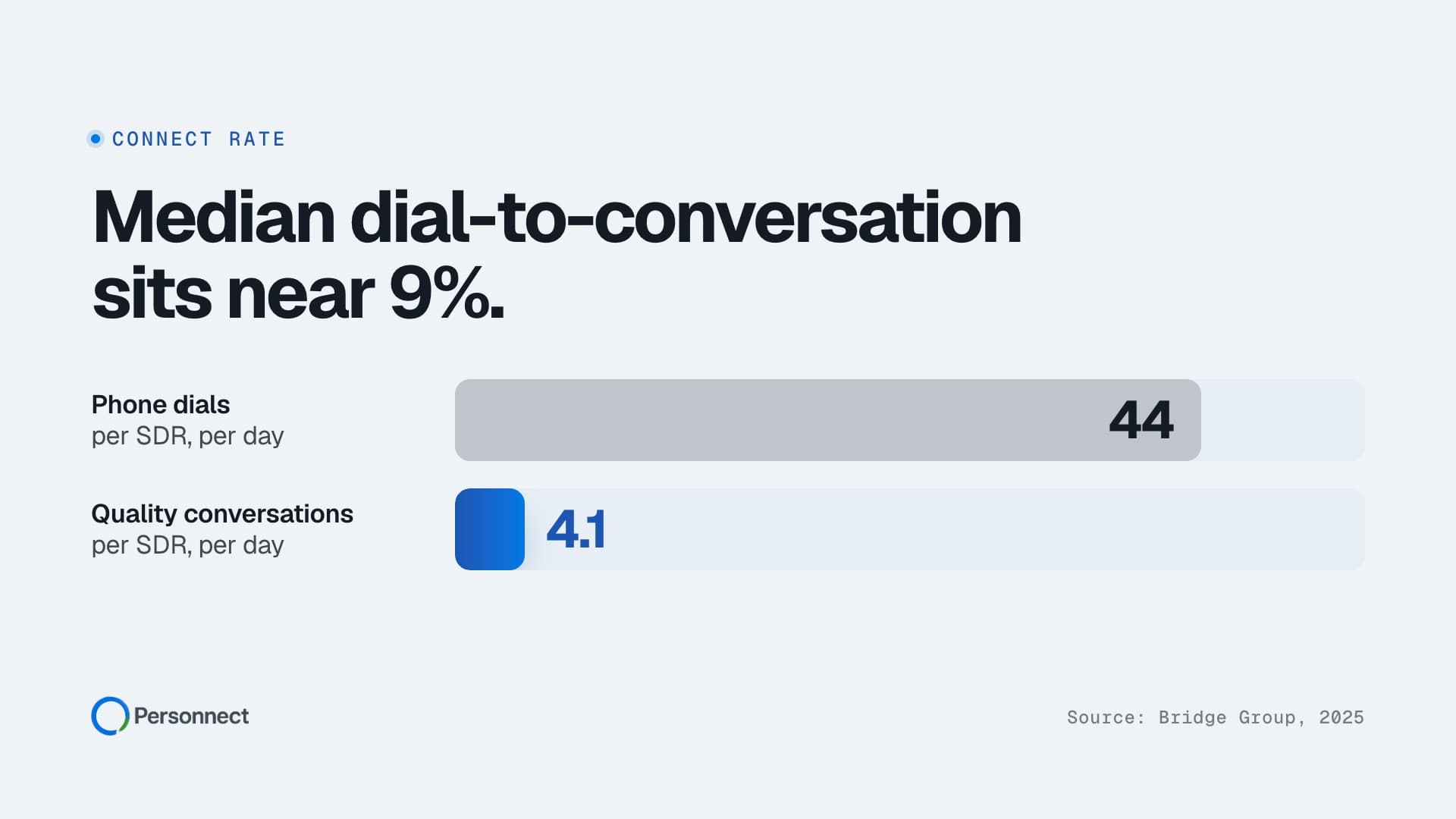
Start by measuring attempts per prospect instead of dials per rep. A team making 80 dials a day can still be giving most prospects only one or two tries, and you won't see it from the daily total.
Then write the cadence down. Three to five calls over two to three weeks, spaced across days and times, wrapped in emails and a social touch or two, with a final voicemail and a closing email. Set a hard stop at the end so reps move on cleanly, and a re-engagement date so good accounts don't disappear.
Finally, protect the hours. A cadence only works if the calls happen, and calls happen when reps have structured calling blocks with clean lists ready to go. The attempt count is a planning number. Your calendar decides whether you hit it.
Frequently Asked Questions
Is calling a prospect 10 times too many?
For a single phone number, yes in most cases. Cognism found more than 98% of conversations happen by the fifth attempt (Cognism, 2025). Ten calls to the same unanswered number over a few weeks rarely adds conversations and can annoy the person if they're screening you on purpose.
Should you leave a voicemail on every call attempt?
No. One or two voicemails across the sequence is plenty, usually on the second and final attempts. Keep them short, give one reason to call back, and repeat your number slowly. With a callback chance of roughly 26.85% (Cognism, 2025), a good voicemail earns its place without needing to appear on every call.
How do you keep attempt counts accurate across a team?
Log every call outcome against the contact, not just connected calls. Personnect syncs the summary, transcript and outcome of every call to HubSpot and Salesforce, so a manager can see how many attempts each prospect has had without asking reps to log anything by hand. Without a CRM, an uploaded list works as the record.
What if the prospect has more than one phone number?
Count attempts per person, but split them across numbers. Try the direct line or mobile first, then the office line if that fails. If neither works after a few tries, the problem is probably the data, not the timing, so check the contact before spending your remaining attempts on it.
Sources
- Cognism cognism.com/blog/cold-calling-statistics
- Cognism cognism.com/reports/cold-calling-report-2026
- Gong gong.io/blog/the-hidden-power-of-cold-calling-insights-from-300m-calls
- RAIN Group rainsalestraining.com/blog/how-many-touches-does-it-take-to-make-a-sale