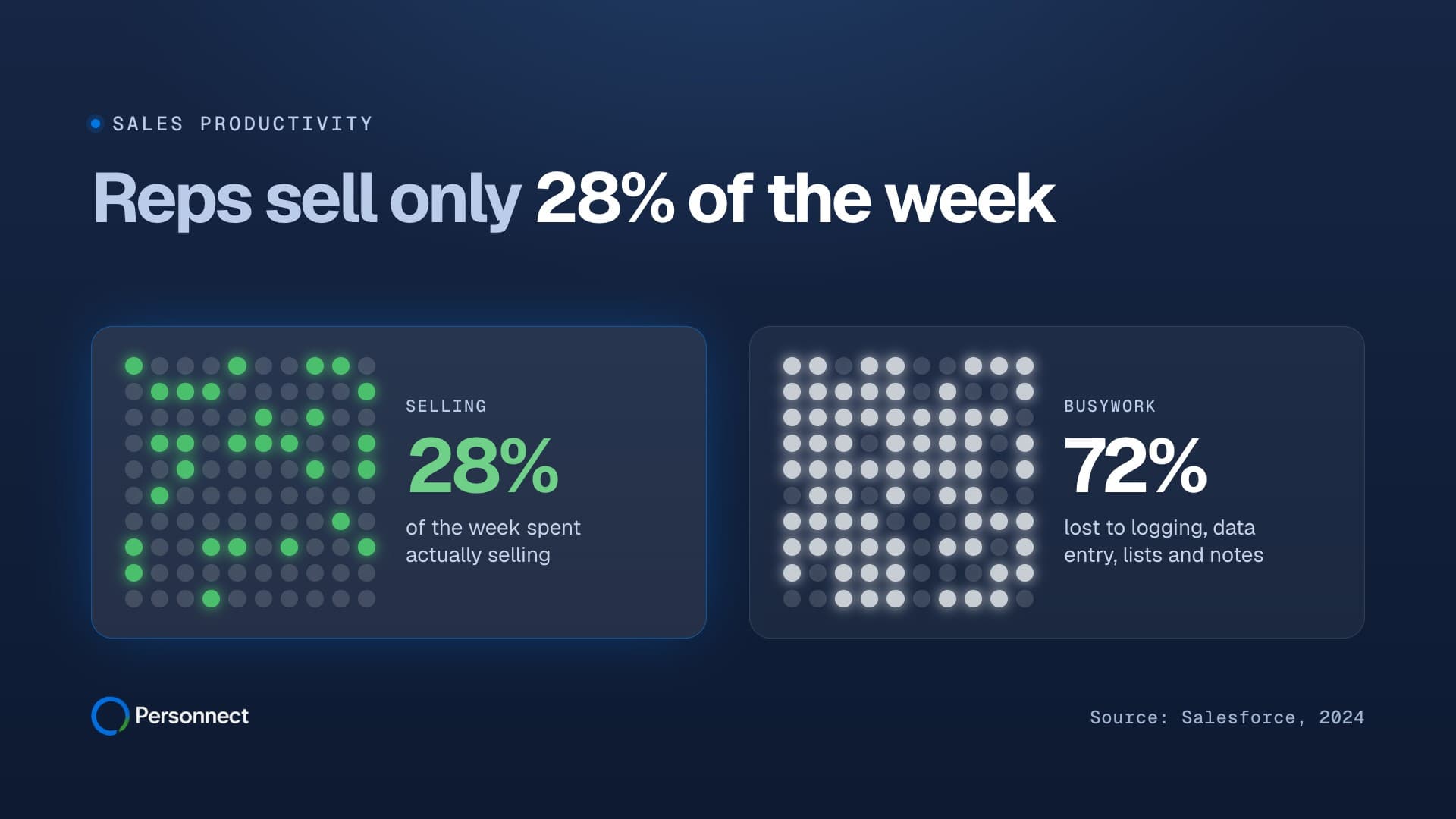
Sales reps spend roughly 28 percent of their week actually selling (Salesforce State of Sales, 2024). The other 72 percent disappears into logging calls, entering data, building lists, taking notes, and scheduling follow-ups, and that ratio has barely moved in five years despite a flood of new tooling. The question this article answers is what happens to a team's day when AI finally absorbs that busywork instead of just digitizing it, and what reps and managers gain when the keyboard work goes away.
Key Takeaways
- Reps spend only about 28 percent of their week selling; most of the rest is administrative drag (Salesforce State of Sales, 2024).
- Manual CRM entry is consistently the single largest non-selling time sink, and most reps do it badly or skip it.
- AI sales productivity gains concentrate in the busywork layer: logging, data entry, list hygiene, note-taking, and follow-up scheduling.
- Gartner puts the yearly price of poor data quality at about 12.9 million dollars per organization (Gartner, 2024); automation that verifies and writes back is a net producer of data quality.
- The win for managers is not faster typing. It is real conversation data to coach and forecast against.
What Counts as Sales Busywork, and How Much of It Is There?
Busywork is every task a rep does that does not involve a live conversation: logging the call, updating fields, researching the next account, building and cleaning lists, taking and formatting notes, and scheduling follow-ups. Reps spend roughly 72 percent of the week on this category of work (Salesforce State of Sales, 2024), and most of it adds no pipeline on its own.
The breakdown matters more than the headline
The 72 percent is not one blob. Salesforce's research splits non-selling time into administrative tasks like CRM entry and reporting, internal meetings and training, prospecting and account research, and planning, with manual data entry surfacing repeatedly as the largest individual drain. The distinction is practical: cutting internal meetings is a culture fix, while cutting CRM entry is an infrastructure fix. AI sales productivity tools target the second category, because it is the part a system can absorb almost entirely.
Why more software made it worse
Reps have access to more tools than ever, with the average B2B sales team using somewhere between 8 and 16 distinct tools in a daily workflow (Gartner, 2023). Each one was sold as a time-saver. In aggregate they consume more time, because every added surface is a new login, a new place data has to flow into and out of, and a new context switch. The promise of "less busywork" failed when the tools mostly relocated the work rather than removing it.
What Happens to a Rep's Day When AI Logs the Calls?
Manual call logging is one of the most time-consuming non-selling activities reps report, and it carries unusual psychological weight because it sits between the rep and the next conversation. A 2024 survey found that 54 percent of reps admit to skipping or deferring CRM updates (Sales Hacker, 2024), which means the data managers coach and forecast against is unreliable on its face.
Logging stops being a task and becomes an output
When transcript, disposition, sentiment, talk ratio, and next steps are captured automatically and pushed to the CRM, the rep is no longer responsible for the worst part of the day. This is the thinking behind platforms like Personnect, which capture conversation data on every call and sync it back to the CRM without rep involvement, so logging becomes a byproduct of the work instead of a separate chore. The rep hangs up and moves to the next dial; the record is already written.
The downstream effects compound
Bad logging does not just cost minutes. It corrupts pipeline reviews, hides objections that lose deals, and produces attribution that does not match reality. When the input is captured automatically and consistently, the entire downstream system improves at once: forecasting reflects real signal, and coaching works from what actually happened on the call rather than a rep's hurried, self-reported notes. The minutes saved are real, but the data quality recovered is the larger prize.
How Does Automated Data Entry and List Hygiene Change the Workflow?
Contact data decays at roughly 30 percent per year (Dun and Bradstreet, 2024), so a list that opens the year 90 percent accurate has slipped to around 63 percent by the end of it. Manual data entry and quarterly list cleanups cannot keep pace with that decay, which is why most reps spend a meaningful slice of every week working against records that quietly rot underneath them.
Verification as a continuous output, not a project
The old model treats data quality as an event: buy a list, clean it once, watch it decay until the next purchase. The newer model treats it as a continuous output of the work itself. This is one angle Personnect built into its dialing flow, where every call, including one that goes to voicemail, generates verified data about whether the number is active, whether it reaches the right person, and whether the role has changed. That reframes a missed call from a dead end into signal that improves the next dial.
The dollars hiding in bad records
The cost of poor data quality is not abstract. Gartner puts it at an average of 12.9 million dollars per organization per year (Gartner, 2024), and in sales the damage shows up as wasted dials, dead lines, and follow-up sequences sent to people who left months ago. Automated entry and hygiene attack this at the source: records update as a side effect of dialing, so the list improves with use. Forrester has framed the upside in terms of return, finding that investment in data quality pays back several times over in recovered productivity (Forrester, 2024).
What the rep actually feels
The experiential change is sharp. Instead of finishing a block of calls and facing a queue of records to fix, the rep finds the records already current. Instead of researching whether a number is still good before dialing, the rep trusts that bad numbers were flagged on the last attempt. List building shifts from a manual chore to a managed input, and the hour that used to go to cleanup goes back to conversations.
What Do Managers Gain When Note-Taking and Follow-Up Scheduling Are Automated?
Managers gain a reliable signal. Companies with strong sales enablement programs reach a 49 percent win rate compared to 42.5 percent without (CSO Insights / Gartner, 2024), and a large part of that gap comes from coaching on real conversation data rather than self-reported summaries. When notes and follow-up scheduling are automatic, the manager finally sees the team clearly.
Coaching moves from anecdote to evidence
For years a manager could only coach on what a rep chose to write down, which was incomplete and often flattering. With AI capturing sentiment, talk ratio, objections, and the exact moment a prospect lost interest, coaching shifts to the specific. A manager can point to the question that opened a discovery call, or the objection a rep talked past, and that kind of feedback closes the gap between average and top performers far faster than another generic role-play.
Follow-up that does not fall through
Missed follow-ups are a quiet revenue leak. When the system schedules the next touch based on what happened on the call, captures the action items, and queues them automatically, the rep is no longer the single point of failure for remembering. Personnect's call analysis extracts next steps as part of its automatic capture, which means the follow-up is set before the rep has even thought about it. The pipeline stops depending on memory.
Forecasting reflects reality
A forecast built on patchy, optional CRM entry is a forecast built on hope. When every interaction is logged consistently and automatically, pipeline reflects actual signal, and the manager can spot a stalling deal from the conversation data rather than discovering it at the end of the quarter. The McKinsey research on sales productivity found that organizations deploying AI across the outbound workflow report 10 to 20 percent gains (McKinsey, 2024), and the gains concentrate where AI is positioned as augmentation of the workflow rather than a replacement for the person.
Does Automating Busywork Actually Return Selling Time, or Just Move It?
It returns time when the tool absorbs a task rather than relocating it. The most useful test of any AI sales productivity tool is whether it gives the rep at least three hours back per week in honest practice; below that, you are paying for a dashboard. The highest-return AI deployments in outbound consistently target time-back-to-rep as the primary metric (McKinsey, 2024).
The "absorb versus add" question
The practical question to ask of any tool is not "what does this add?" but "what does this absorb?" A tool that requires a tab open all day and produces output a rep must manually move into another system has added a surface, not removed one. A tool that logs the call, enriches the contact, schedules the follow-up, and re-verifies the number for next time has absorbed four tasks and removed four context switches. Knowledge workers switch tasks roughly every few minutes and can take more than 20 minutes to return to focused attention after an interruption (University of California, Irvine, 2008), so each absorbed task is worth more than the minutes it directly saves.
Connect rate as the proof
Returned time should show up downstream as a better connect rate, not just a lighter calendar. On average only about 4.8 percent of outbound dials connect (Bridge Group, 2024), which means most dials never reach a person. Teams that verify contact data continuously, as a byproduct of every dial, post connect rates well above that baseline because the data layer compounds in their favor instead of decaying. The returned hour is real, and it lands on numbers that are more likely to ring.
Which Rep Skills Get More Valuable, and Which Get Less?
The skills that grow in value are the ones AI cannot do: voice presence, judgment in objections, and account strategy. The skills that lose value are the ones AI now does better: manual data entry, brute-force dialing, and memorizing a generic script. The shift is consolidation of the role around higher-judgment work, and 73 percent of sales professionals already report using AI tools in some part of the workflow (LinkedIn State of Sales, 2024).
What grows
As the surrounding workflow gets automated, the live conversation becomes the thing that differentiates one vendor from another, so a rep with genuine warmth and a sharp ear for objections is worth more, not less. Account strategy grows too: AI can score a list, but deciding which three people to reach inside a 200-person organization is still rep judgment, and modern B2B deals involve six to ten stakeholders on average (Gartner, 2023).
What shrinks
Manual data entry was always low-value and is now near zero. Brute-force dialing as a personal differentiator is gone, because the dialer does it better and faster. The reps whose edge was sheer activity volume feel the squeeze first, while the reps who were good at the conversation get more room to be good at it. The honest framing for a team is that the job gets harder in the parts that always mattered and easier in the parts that drained people.
Frequently Asked Questions
What is AI sales productivity, in practical terms?
It is the use of automation to absorb the non-selling work around a call: logging, data entry, list hygiene, note-taking, and follow-up scheduling. The goal is returned selling time and cleaner data, not a replaced rep. The clearest signal it is working is reps spending more of the week in live conversations (Salesforce State of Sales, 2024).
Will automating busywork make my reps obsolete?
No. It removes the lowest-judgment parts of the role, not the conversation itself, where trust and objection-handling decide B2B deals. Research shows productivity gains of 10 to 20 percent concentrate where AI augments the rep rather than replacing them (McKinsey, 2024). The rep gets harder, higher-value work, not a pink slip.
How does an unanswered call still produce useful data?
The call outcome itself is signal. A platform like Personnect analyzes what happens on every dial, including voicemails, to confirm whether the number is active and reaches the right person, then writes that back to the CRM, so the next attempt starts smarter.
What is the single highest-impact change a sales leader can make?
Eliminate manual call logging. It removes the most painful part of the rep's day, improves the quality of every downstream metric, and pays back in returned selling hours within the first week. If a dialer cannot push transcript, disposition, sentiment, and next steps to the CRM automatically, that is the gap to close first.
How do I know an AI tool is returning real time, not just adding a dashboard?
Run the math on a typical week. If the tool returns at least three hours per rep in honest practice and improves the connect rate over time, it is doing structural work. If only activity numbers move while selling hours stay flat, it is a surface to manage, not a task absorbed (McKinsey, 2024).
Conclusion
The 28 percent problem was never about lazy reps or weak managers. It was structural: selling buried under layers of logging, data entry, list cleanup, and note-taking that accumulated over years of well-meant tool purchases. What changes when AI absorbs that layer is not glamorous, but it is real. Reps get hours back and spend them on conversations. Managers get reliable data to coach and forecast against. The list improves with use instead of rotting. The conversation, the part where a buyer decides whether to trust a vendor, still belongs to the person on the call. AI sales productivity is best understood not as a replacement for that person, but as the quiet machinery that finally clears the 72 percent out of their way.
Sources
- Salesforce State of Sales salesforce.com/resources/research-reports/state-of-sales
- Gartner gartner.com
- Sales Hacker saleshacker.com
- Dun and Bradstreet dnb.com
- Forrester forrester.com
- McKinsey mckinsey.com
- University of California, Irvine ics.uci.edu/~gmark
- Bridge Group blog.bridgegroupinc.com/sdr-metrics
- LinkedIn State of Sales business.linkedin.com/sales-solutions/state-of-sales-report