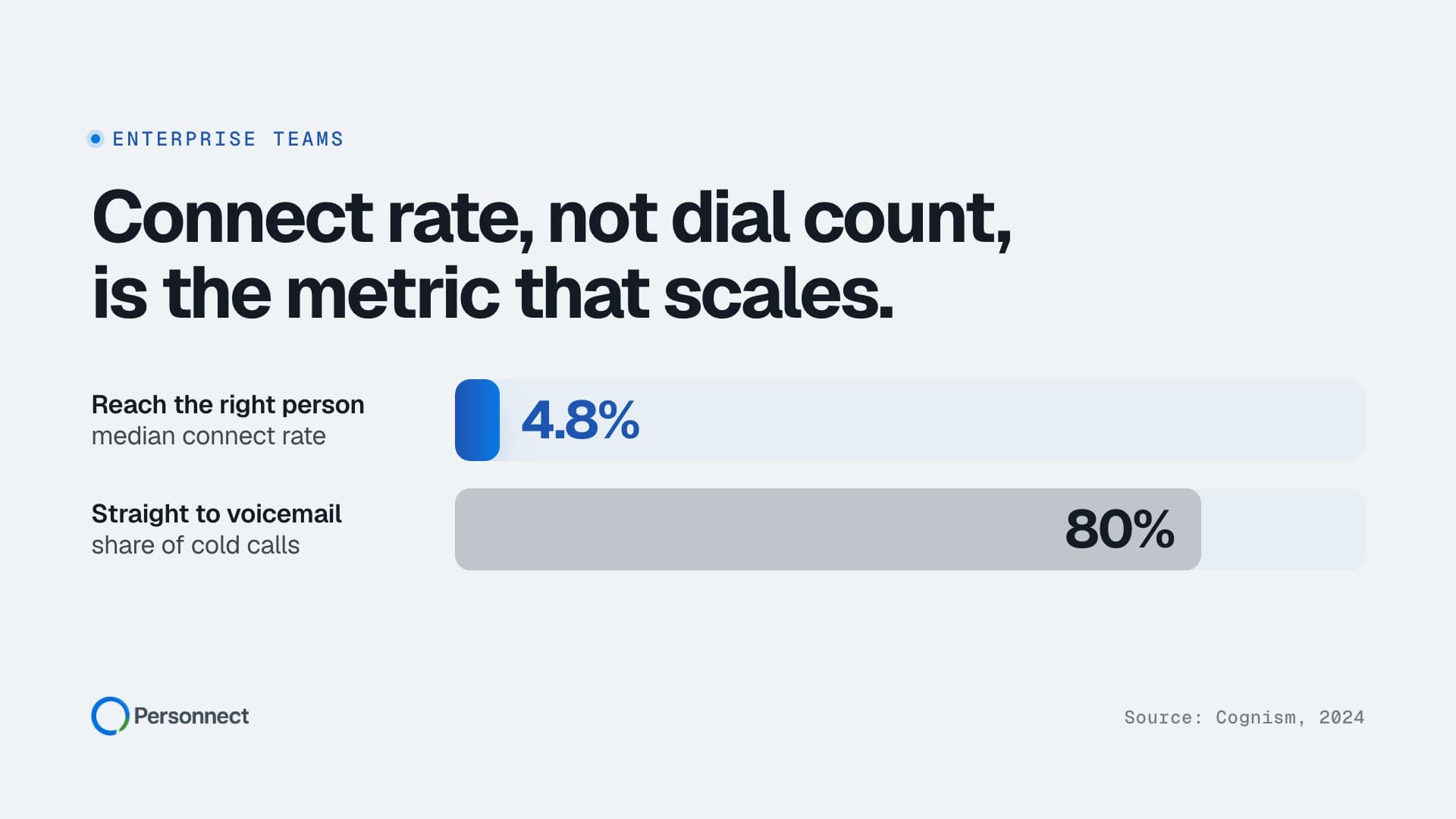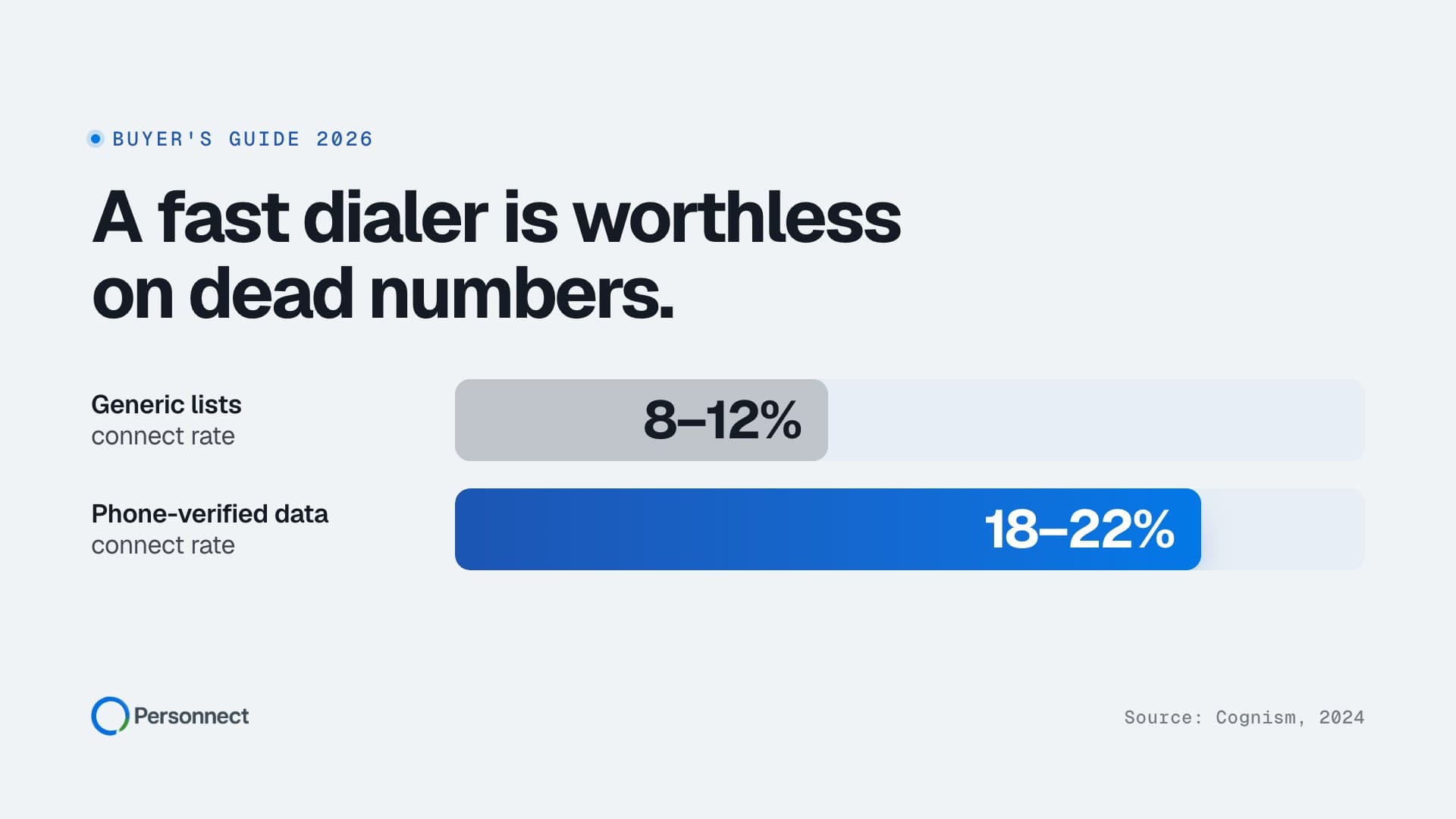
Phone-verified contact data reaches roughly 18% to 22% connect in Cognism's research, while generic, unverified lists stall around 8% to 12%, a gap Cognism puts at about three times (Cognism, 2024). That gap is the quiet story of outbound in 2026: a dialer that moves fast is worthless if it is sprinting through dead numbers. Only a sliver of B2B cold calls, about 4.8% at the median, ever turn into a live conversation (Cognism, 2024), so every wasted attempt is expensive. This guide evaluates dialers through one lens: verification built into the calling workflow, so bad data gets caught as you dial and even unanswered calls produce signal. Personnect, a parallel dialer for B2B outbound teams that rings up to five prospects at once, is the clearest example of that idea, but it is not the only tool worth knowing. Here is the honest roundup.
Key Takeaways
- "Built-in verification" means the dialer confirms the contact and the number as part of calling, instead of relying on a list you bought once and hope stays accurate.
- Cognism finds phone-verified numbers connect at roughly 18% to 22%, against 8% to 12% for generic lists, close to a threefold gap (Cognism, 2024).
- Contact records go bad at about 22.5% a year, so a list verified once does not stay verified (Cognism, 2024).
- On Personnect, verification runs on every call, and even unanswered calls still verify your contacts (Personnect, 2026).
- Most rivals verify adjacent to the call (bad-number filtering, number reputation) or lean on third-party enrichment. Know which one you are actually buying.
What does "built-in verification" actually mean in a dialer?
It means the dialer confirms who you are calling and whether the number is live as part of the call itself, rather than you buying a verified list once and hoping it stays accurate between refreshes. The verification happens inside the workflow, not in a separate tab.
In practice, "verification" gets used loosely, so it helps to separate three layers. The first is pre-dial data enrichment: a provider appends a phone number to a record and marks it verified at the moment it was collected. The second is in-call filtering: while you dial, the system detects voicemail, phone trees, and obviously dead numbers, then routes reps only to live pickups. The third, and the rarest, is verification on the outcome of the call itself, where the result of a dial updates the record, including when nobody answers.
Layer one is what data vendors sell. Layer two is table stakes for any serious parallel dialer in 2026. Layer three is where the meaningful differentiation sits, because it treats a phone number as a living asset that either rang, connected, or bounced, and it writes that truth back to your list every time you touch it. A record that "verified" a year ago is not the same as a record that rang correctly this morning.
Why does verified contact data change connect rates?
Because what looks like a dialing problem is usually a data problem in disguise. If four out of five attempts hit voicemail and the underlying numbers are stale, no amount of speed fixes the math (Cognism, 2024).
Start with the baseline. At the median, a B2B cold call connects around 4.8% of the time, and roughly 80% of cold calls go to voicemail (Cognism, 2024). Swap generic data for phone-verified data and connect rates move from about 8% to 12% up to roughly 18% to 22%, close to a threefold lift (Cognism, 2024). Then remember that lists rot: roughly 22.5% of B2B contact data goes bad every year, so a number that was accurate two quarters ago has a real chance of being wrong today (Cognism, 2024).
There is a second drag most teams underestimate: caller-ID reputation. A meaningful share of business numbers pick up a spam risk label in any given month, and once a "Spam Likely" tag appears, answer rates can fall sharply, in the worst cases by well over half (First Orion, 2024). So verified data and healthy numbers are two sides of the same coin. One makes sure the person exists at that number, the other makes sure your call is worth picking up.
The subtle point is what happens on the calls that do not connect. In a plain dialer, a no-answer is a zero. In a dialer that verifies on every attempt, a no-answer can still confirm the line is live and reaches the right person, so even that attempt leaves you something to act on later.
Which sales dialers offer built-in verification in 2026?
Several tools now touch verification, but they touch different layers of it. Below is an honest read on where each one actually sits, starting with the clearest example of call-time verification and moving through the strong number-reputation and enrichment-led options.
Personnect
Personnect is a parallel dialer for B2B outbound sales teams: it rings up to five prospects at once per rep and connects your rep to whoever picks up first (Personnect, 2026). Its signature is verification on every call: even a no-answer can confirm the number is live and belongs to the right person (Personnect, 2026). That is layer-three verification: the outcome of each dial, answered or not, feeds back into the record and flows into HubSpot or Salesforce.
Personnect pairs this with number ownership rather than remediation. Numbers are dedicated and company-registered, so callbacks reach the right team, with an ongoing number-health approach (new numbers eased in, calls spread evenly, flagged numbers rested) instead of cleanup bolted on after a flag (Personnect, 2026). On the throughput side, parallel dialing means more live conversations per rep-hour, with teams commonly placing in the neighborhood of 500 dials a day. As with every parallel dialer, a call can take a brief moment to reach your rep after the prospect answers, so try it on your own list first. Pricing is usage-based at about $0.085 per minute, with numbers from roughly $1 per month, unlimited users, and no seat or platform fee (Personnect, 2026). On the compliance front, it uses managed, company-registered numbers plus answering-machine detection, and as with any outbound program you should follow the calling rules in your jurisdiction.
Orum
Orum is a parallel and power dialer whose verification story lives mostly in layer two: as you dial, its detection sorts a live pickup from a voicemail, a phone tree, or a bad number, and it filters those out so reps spend time on real conversations (Orum, 2026). It also offers number intelligence to inform which lines to use. What Orum does not do is act as your contact database, so the accuracy of the records you feed it still depends on your own list or enrichment tool. It sits at the premium end, with reviews reporting roughly $250 per user per month (MarketBetter, 2026).
Nooks
Nooks is a parallel and power dialer that blends in-call detection with number-reputation management and some contact enrichment. Its "Nooks Numbers" prospecting intelligence verifies contact information and prioritizes verified mobiles, while its reputation layer runs multiple daily carrier checks and rotates or retires numbers that start showing spam risk (Nooks, 2026). That is a strong combination of number health plus enrichment, closer to continuous data hygiene than to per-call outcome verification, and it is worth a close look for teams that care most about keeping numbers clean.
Kixie
Kixie is a multi-line power dialer that can ring up to 10 lines at once, and its verification-adjacent strength is caller-ID reputation. Its ConnectionBoost add-on bundles local-presence dialing, reputation management, and spam-risk suppression, rotating a large pool of real numbers so calls are less likely to surface as "Spam Risk," alongside live-answer detection during dialing (Kixie, 2026). Read this as number-reputation protection rather than contact-record verification. Pricing is per seat with several capabilities, including local presence, sold as add-ons that stack on the base tier.
PhoneBurner
PhoneBurner is a single-line, delay-free power dialer, which means no connect lag when a prospect answers, a genuine plus for conversation quality. Its verification-adjacent features are Connect Scores, which prioritize the leads most likely to answer, and ARMOR spam protection for caller-ID reputation (PhoneBurner, 2026). Neither verifies the contact record at call time, but both help you spend more of the day on callable numbers with clean caller ID. Pricing is a flat per-seat fee with unlimited dialing minutes.
ConnectAndSell
ConnectAndSell sells "conversations as a service," pairing live agents and technology to navigate gatekeepers and hand your reps a connected prospect, and it reports 8 to 10 times more conversations per rep per day (ConnectAndSell, 2026). This is a throughput and navigation model, not a data-verification layer. If your bottleneck is getting past screeners at scale rather than confirming data accuracy, it is a distinct approach, and it sits at the premium end of pricing.
Salesloft and Outreach
Salesloft and Outreach are sales-engagement platforms that now ship power and parallel dialing inside a broader multichannel cadence. The honest caveat for a verification buyer: they orchestrate outreach but do not provide contacts, so verification is whatever your third-party data source supplies, typically an enrichment tool such as Apollo or a data provider bolted alongside (Landbase, 2026). That is layer-one, pre-dial verification, not call-time verification. These platforms are strong at sequencing and reporting, and many teams run one of them next to a dedicated dialer.
How do these dialers compare side by side?
Here is a general summary. Treat competitor pricing as directional, since seat costs, add-ons, and negotiated discounts vary widely.
| Tool | Verification approach | Dialing model | Pricing model |
|---|---|---|---|
| Personnect | Verification on every call, including no-answers; company-registered numbers | Parallel and power, up to 5 lines | Usage-based, about $0.085/min, numbers from ~$1/mo, unlimited users, no seat fee |
| Orum | In-call filtering of voicemail, phone trees, bad numbers; number intelligence | Parallel and power | Per seat, premium (reviews report ~$250/user/mo) |
| Nooks | Contact enrichment (Nooks Numbers) plus daily number-reputation checks | Parallel and power | Per seat, quote-based |
| Kixie | Caller-ID reputation and spam suppression; live-answer detection | Multi-line power, up to 10 lines | Per seat plus add-ons |
| PhoneBurner | Connect Scores and ARMOR number reputation | Single-line power (delay-free) | Flat per seat, unlimited minutes |
| ConnectAndSell | Agent-assisted navigation; no data-verification layer | Agent-assisted dialing | Per seat, premium |
| Salesloft / Outreach | Relies on third-party data enrichment (no call-time verification) | Power and parallel built in | Per seat plus dialer add-on |
How should you evaluate a dialer's verification capability?
Ask where in the workflow verification happens and what the tool does with a call that does not connect. Those two questions separate real built-in verification from a marketing label. Use this checklist against your shortlist:
- When does verification occur? Pre-dial enrichment, in-call filtering, or on the outcome of each dial. Layer three is the differentiator, so ask vendors to be specific.
- What happens on a no-answer? Does an unanswered call still confirm the line and write back to the record, or is it simply logged as a miss? Roughly 80% of cold calls hit voicemail, so this determines how much of your activity produces data (Cognism, 2024).
- Does verification write back to your CRM? Verified outcomes are only useful if they update the record other reps and sequences rely on.
- Who owns the numbers? Dedicated, company-registered numbers with an ongoing health approach beat shared pools that get flagged and remediated after the fact, especially given how quickly spam labels depress answer rates (First Orion, 2024).
- How does it handle data decay? With data rotting about 22.5% per year, a tool that re-verifies as a byproduct of normal dialing keeps your list fresher than a quarterly data refresh (Cognism, 2024).
- What is the true cost model? Usage-based versus per seat versus per seat plus add-ons changes the math a lot at scale. Price your expected minutes and seats, not the headline tier.
Frequently asked questions
What is a sales dialer with built-in verification?
It is a dialer that confirms the contact and the number as part of the calling workflow instead of relying only on a data list purchased earlier. The strongest versions verify on the call outcome itself, so accuracy is maintained as a byproduct of dialing rather than a separate step.
Does a no-answer really produce useful data?
It can. In a plain dialer a missed call is a zero, but a dialer that verifies on every attempt can confirm the line is live and reaches the right person even without a pickup. With Personnect, unanswered calls still verify your contacts (Personnect, 2026), which matters when about 80% of cold calls hit voicemail (Cognism, 2024).
Is a parallel dialer worth it if my data is bad?
Speed multiplies whatever your list already is. Parallel dialing raises live conversations per rep-hour, but with only a 4.8% median connect rate, dialing dead numbers faster just wastes time faster (Cognism, 2024). Pair throughput with verification so the dials you place are landing on real, reachable people.
How often does contact data go stale?
Quickly. B2B contact data decays about 22.5% per year, which is roughly 2% every month (Cognism, 2024). That is why one-time verification fades: a record marked accurate two quarters ago has a meaningful chance of being wrong now, which favors tools that re-verify continuously as you dial.
Do I still need a data provider like ZoomInfo or Cognism?
Often yes, but for a different job. Data providers are good at sourcing net-new records, while a verifying dialer keeps those records accurate over time. Many teams source from a provider, then let the dialer maintain the list, since roughly 22.5% of any list decays each year regardless of where it started (Cognism, 2024).
So which dialer with verification should you choose?
Go back to the three layers. Most tools in this list verify before the dial or filter during it, and each does that part well, from Orum's in-call filtering to the number-reputation tools at Nooks and Kixie. The layer that keeps a list accurate is the third one, verification on the outcome of every dial, and that is where Personnect is built: unanswered calls still verify your contacts, results write back to your CRM, numbers are registered in your company's name, and usage-based pricing means you pay for minutes rather than seats.
Whatever you shortlist, do not buy on benchmark numbers alone. Connect rates swing with industry, region, list quality, and time of day, so run a real pilot on your own list and measure your own connect rate, your data write-back, and how each tool treats the calls that do not connect. The right dialer is the one that turns the most of your activity into verified, workable signal.
Sources
- Cognism, 2024 cognism.com/blog/cold-calling-statistics
- First Orion, 2024 firstorion.com/blog/number-reputation-management-bad-labels
- Orum, 2026 orum.com/platform/dialer
- MarketBetter, 2026 marketbetter.ai/blog/orum-review-2026
- Nooks, 2026 nooks.ai/ai-dialer
- Kixie, 2026 kixie.com/features/local-presence
- PhoneBurner, 2026 phoneburner.com
- ConnectAndSell, 2026 connectandsell.com
- Landbase, 2026 landbase.com/blog/salesloft-pricing