If you're weighing Nooks vs Orum vs Personnect, you're looking at three tools that attack the same bottleneck from three different angles. Personnect keeps its focus on one number, connect rate, and gives each rep up to five lines ringing at once. Orum is one of the established names in parallel dialing, engineered around raw throughput and rep coaching, with a virtual salesfloor for distributed teams. Nooks is a broader outbound workspace that wraps a parallel dialer inside AI sequencing, signals, and coaching scorecards. All three will get reps into more live conversations than manual dialing ever did.
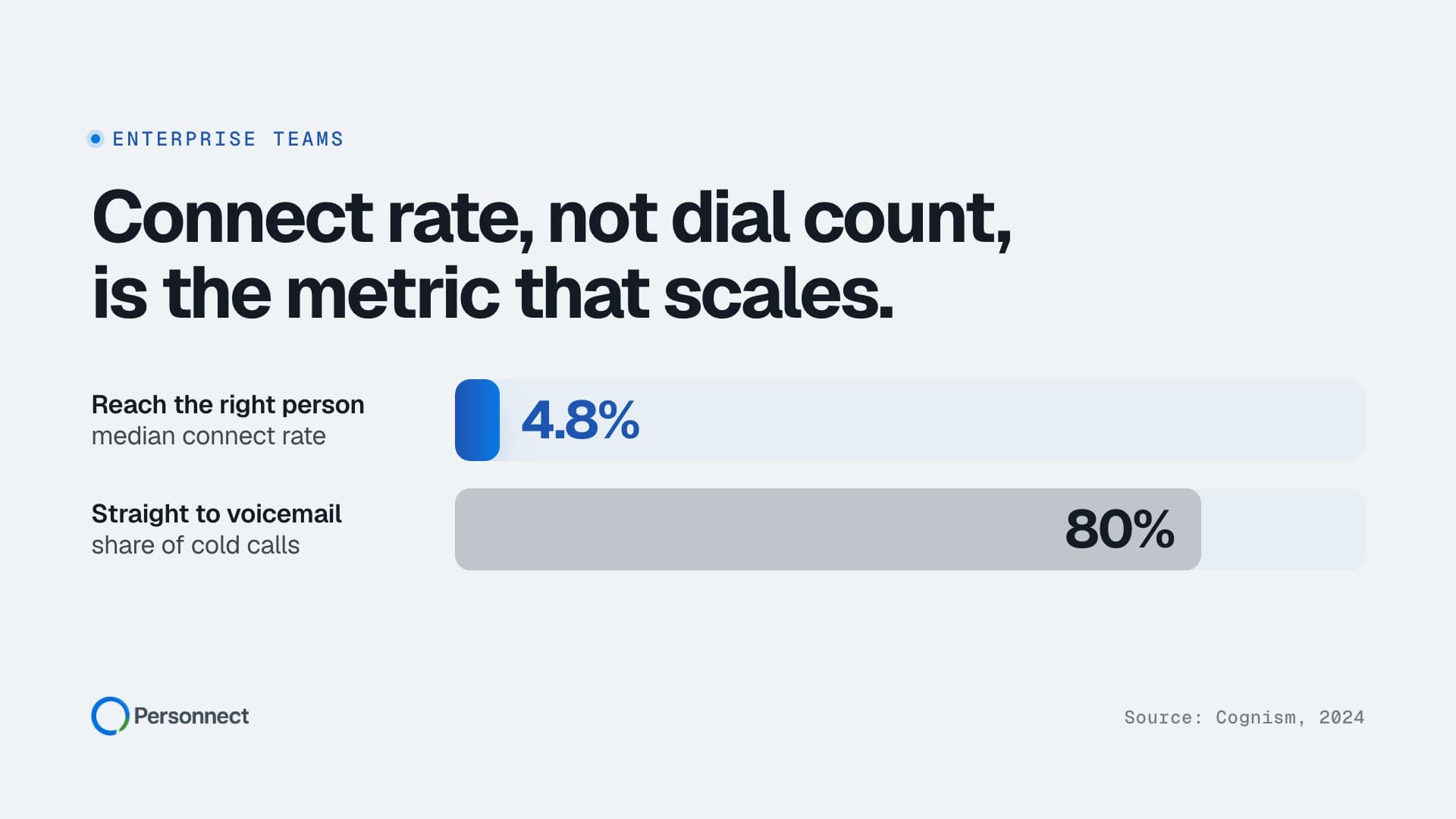
Where they split is everything that happens around the dial: how many lines run at once, what the tool learns from a call nobody answers, who owns the numbers you call from, and how the bill is calculated. Only about 4.8% of B2B cold calls connect at the median (Cognism, 2024), and about 80% go to voicemail. So the platform that wins is the one that either reaches more people per rep-hour, or calls better data. Ideally both.
Key Takeaways
- Personnect is a dedicated parallel dialer, up to five lines per rep, aimed squarely at connect rate rather than at a wider engagement suite.
- Orum's strength is throughput plus mature coaching infrastructure. Nooks' strength is breadth: dialer, sequencing, and signals in one workspace.
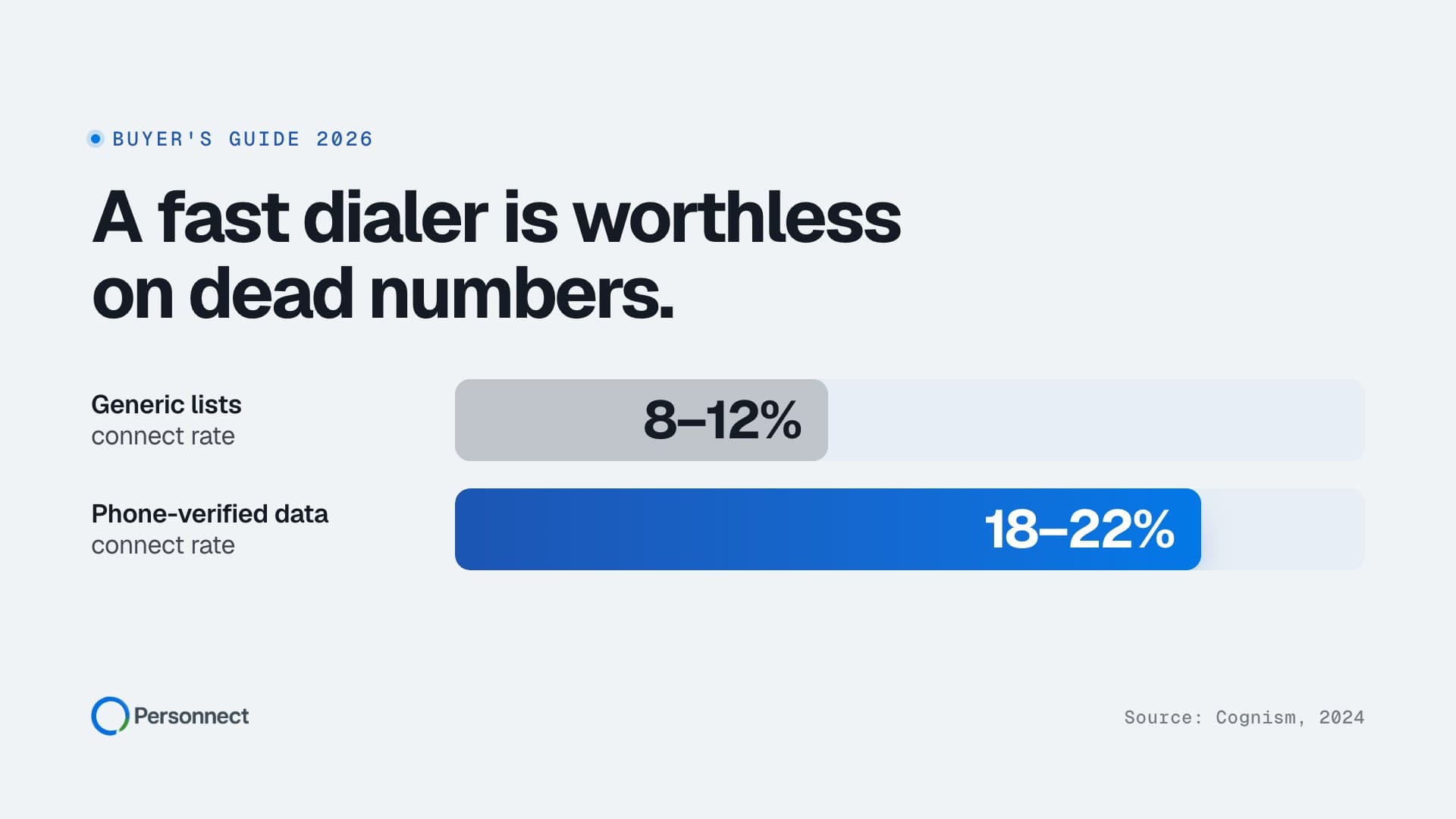
- Data decides the outcome: generic lists connect at roughly 8 to 12% and phone-verified data at 18 to 22%, about triple (Cognism, 2024).
- Only Personnect gets something back from the no-answers: its unanswered calls still verify your contacts.
- Pricing models differ structurally: Nooks and Orum are per-seat and quote-based, Personnect is usage-based at $0.085 per minute with unlimited users.
What does each platform actually do?
All three are phone-first tools, but only one of them is exclusively a dialer. Orum and Personnect are dialers with different centers of gravity. Nooks is a workspace. That distinction matters more than any feature grid, because phone-primary reps hold 6.8 conversations a day versus 3.3 for email-centric reps (The Bridge Group, 2025).
What is Nooks?
Nooks describes itself as "the agent workspace for intelligent outbound" and sells a bundle: AI Dialer, AI Sequencing, Signals and Intelligence, AI Coaching, and its Virtual Salesfloor. The dialer claim on its own site is "connect with 3x more prospects" (Nooks, 2026). Nooks carries a 4.8 rating on G2 across more than 1,500 reviews, and reviewers consistently single out the salesfloor as the reason they stay. If your reps run calls, email, and social in one motion, Nooks covers the widest surface area of the three.
What is Orum?
Orum positions itself around reliability: "Orum turns calling into a system and the phone back into your most reliable source of qualified pipeline." Its core modules are the Dialer, Salesfloor, AI Coaching, and Scout, its data agent product. Orum says its AI is trained on more than 1 billion real sales calls and supports calling across 160+ countries (Orum, 2026). It holds a 4.6 on G2 across 781 reviews, with praise clustering on ease of use and time saved. Orum is a well-established name on large, coached SDR floors.
What is Personnect?
Personnect is a focused parallel dialer. It calls up to 5 prospects simultaneously, detects when a real person answers, and bridges the rep onto that call while releasing the other lines. Around that dialer sit four things: VerificationLive, Coverage Analysis across 200+ US metro areas, AI Call Insights, and dedicated number management. It integrates natively with HubSpot and Salesforce (two-way) and includes unlimited users (Personnect, 2026). It does not sell sequencing or roleplay. It sells connect rate.
How do the dialing approaches differ?
This is where the real gap opens. All three run multiple lines, and that's the point: with a median connect rate of 4.8% (Cognism, 2024), a single-line dialer spends most of the hour listening to rings. Parallel dialing is the largest single lever on conversations per rep-hour, and all three platforms pull it.
How many lines does each one run?
Orum runs up to 5 parallel lines on its entry tier and up to 10 on higher tiers, so it can push the most aggressive line count of the three if you pay for it. Nooks pioneered the 5-line parallel model and pairs it with automatic phone-tree navigation. Personnect calls up to 5 prospects at once with instant connect, which puts a Personnect team comfortably around 500 dials a day, the same high-volume class as any dedicated parallel dialer.
Why is parallel dialing the whole ballgame?
Because the median SDR makes about 46 dials a day and books 14.6 meetings a month (The Bridge Group, 2025). Multiply the dial count by five and you don't just get five times the activity, you get five times the shots at the 4.8% that actually pick up. That's why Personnect leads with it rather than treating it as one feature among twelve: throughput is the input that everything else multiplies against.
What's the catch?
Every parallel dialer in the category carries the same physics: when several lines ring at once and someone answers, there can be a brief lag before the rep is bridged in. Vendors optimize this differently, and the gap between the best and worst implementations is real. Test the connect experience on your own list before you commit, because it's the one thing a demo script will never stress properly. On the rules side, all three use answering machine detection and Personnect adds managed, company-registered numbers, and you should follow the calling rules in your jurisdiction regardless of tool.
What happens to the calls nobody answers?
About 80% of cold calls go to voicemail (Cognism, 2024), which means four out of five dials produce nothing but a timestamp in most systems. Personnect is the only one of the three built to extract value from that 80%. Nooks and Orum log the outcome. Personnect verifies the contact.
How does VerificationLive work?
When a call goes unanswered, Personnect still captures data about the number and the contact. It confirms whether the line is active, whether you reached the right person's voicemail, or whether the number has been disconnected, and pushes that status back to the CRM automatically. The unanswered call still verifies the contact, and what would have been a bare timestamp ends up as a record update.
Why does that compound?
About 22.5% of B2B contact data goes stale every year (Cognism, 2024). Nearly a quarter of any list rots annually as people change roles and numbers get reassigned. A dialer that only learns something when someone picks up is blind to most of that decay. The bet is that a dial should clean the list while it works it, so volume compounds instead of burning through a stale file faster.
What do Nooks and Orum offer instead?
Both do genuinely useful things with answered calls. Nooks runs AI note-taking and post-call conversation analysis, and Orum's coaching suite produces call scorecards from real conversations. Orum has also moved into data with Scout. But neither markets an equivalent to per-call verification on the calls that never connect, so the 80% stays largely unmined. That's the clearest functional line in this comparison.
Who owns your number reputation?
Roughly one-third of outbound numbers get flagged as spam each month, and a "Spam Likely" label can cut answer rates by up to 80% (Cognism, 2024). At 500 dials a day, that isn't a nuisance, it's the difference between a working motion and a dead one. The three platforms treat this as either something you remediate or something you own.
What does structural ownership look like?
Personnect's answer is ownership rather than cleanup. Numbers are dedicated to you instead of drawn from a shared pool, and registered in your company's name with Verizon, AT&T and T-Mobile. New numbers are eased in, calls are spread evenly across them, and any number that gets flagged is rested. Callbacks route to your team, not a stranger's. Coverage Analysis maps where your contacts actually sit across 200+ US metros so the local number you display matches the person you're calling.
How do Nooks and Orum handle it?
Both offer spam protection, and Nooks explicitly markets it as a dialer feature. The model is remediation layered on top: monitor caller ID health, rotate when reputation degrades, and react to flags. That works, and for many teams it's sufficient. The structural difference is whose name the number sits under. If a number pool is shared, one noisy neighbor's behavior lands on your caller ID, and you're managing a problem you didn't create.
How does pricing compare?
The three models are structurally different, which matters more than the headline numbers. Personnect publishes $0.085 per minute plus numbers from about $1 a month, with unlimited users and no platform fee (Personnect, 2026). Neither Nooks nor Orum publishes pricing. Both are quote-based, per-seat, and annual.
What do Nooks and Orum actually cost?
Neither vendor lists a price publicly, so treat any figure as an estimate. Third-party analyses put Nooks in the $4,000 to $5,000 per user per year range (MarketBetter, 2026) and Orum at around $250 per user per month billed annually, with the 10-line tier and coaching add-ons pushing higher (CloudTalk, 2026). Both require a demo call for a real quote, and every added seat adds a full license fee.
What does usage-based pricing change?
The per-minute model tracks conversations instead of chairs. That favors variable headcount, seasonal pushes, teams that want managers and admins in the tool without paying for them, and anyone who wants to pilot on a real list before signing anything. A flat annual license, by contrast, charges the same for a seat whether its rep talks for ten minutes a month or ten hours a day.
What should revenue ops actually model?
Cost per conversation, not cost per seat. A fully loaded US SDR runs about $134,000 a year (The Bridge Group, 2025), so the software line is small next to the rep's time. The question is which tool produces the most live conversations per rep-hour on data that's actually reachable. Measure that on your own list.
How do Nooks, Orum, and Personnect compare side by side?
Here's the summary in one view. Every entry comes from each vendor's public materials or from published third-party reporting.
| Dimension | Personnect | Nooks | Orum |
|---|---|---|---|
| Category | Parallel/power dialer | Outbound workspace with dialer | Parallel dialer |
| Simultaneous lines | Up to 5 | Up to 5 | Up to 5, 10 on higher tiers |
| Core optimization | Connect rate | Breadth of workflow | Throughput and coaching |
| Verification on no-answer | Yes, VerificationLive | Not marketed | Not marketed |
| Number ownership | Dedicated, registered in your name | Spam protection, shared model | Spam protection |
| Local presence | Coverage Analysis, 200+ US metros | Yes | Yes, 160+ countries |
| Coaching / roleplay | Call insights only | Scorecards, battlecards, roleplay | Full AI Coaching Suite |
| Salesfloor | Not offered | Signature strength | Yes |
| Sequencing | Phone-focused | AI Sequencing included | Dialer-focused |
| CRM integrations | HubSpot & Salesforce (native, two-way); any other CRM via CSV import and export or a direct integration on request | Yes | Yes |
| Pricing model | Usage-based, $0.085/min | Per seat, quote-based | Per seat, quote-based |
| Published pricing | Yes | No | No |
| G2 standing | Newer entrant | 4.8, 1,500+ reviews | 4.6, 781 reviews |
Frequently asked questions
Is Personnect a real parallel dialer or a lighter tool than Nooks and Orum?
It's a real parallel dialer in the same volume class. Personnect calls up to 5 prospects at once with instant connect when someone picks up, which supports roughly 500 dials a day per rep. That's the same bar Nooks and Orum clear. The difference isn't capacity, it's that Personnect points the entire product at connect rate rather than bundling a dialer into a wider suite.
Which platform dials the most lines at once?
Orum, if you pay for the higher tier: it runs up to 5 lines on entry and up to 10 above that. Nooks and Personnect both run up to 5. More lines isn't automatically better, though. Past a point you're multiplying dials against the same 4.8% connect rate on the same list (Cognism, 2024), so list quality starts binding before line count does.
What happens to unanswered calls in each tool?
In most dialers, including Nooks and Orum as publicly documented, an unanswered call is logged as a no-answer and that's it. Personnect captures data on the attempt itself: whether the line is active, whether it's the right person's voicemail, whether the number is disconnected. That status syncs to the CRM, so unanswered calls still verify your contacts.
How much do Nooks, Orum, and Personnect cost?
Personnect publishes $0.085 per minute, numbers from about $1 a month, unlimited users, no platform fee. Nooks and Orum don't publish pricing at all. Third-party estimates put Nooks around $4,000 to $5,000 per user per year (MarketBetter, 2026) and Orum near $250 per user per month on annual billing (CloudTalk, 2026). Get quotes rather than trusting estimates.
Does a spam label really hurt connect rate that much?
Yes. About one-third of outbound numbers get flagged each month, and a "Spam Likely" label can cut answer rates by up to 80% (Cognism, 2024). All three platforms address it. The structural question is whether the numbers you dial from are dedicated and registered to your company, as Personnect does it, or drawn from a shared pool where other callers' behavior affects your reputation.
Which one is best for a small or variable-size team?
Usually Personnect, on pricing structure alone. Unlimited users and per-minute billing mean a five-rep team with two managers pays for minutes rather than seven licenses. Nooks and Orum are built around annual per-seat commitments, where every added rep or manager adds a full license.
So which one should you choose?
All three are capable: Orum's coaching suite and salesfloor are well reviewed, and Nooks covers the widest surface area of the three, with dialing, sequencing, and signals in one workspace. The question that decides pipeline, though, is connect rate, and that is where Personnect puts everything. It's a parallel dialer calling up to 5 at once, so throughput is there, but even its unanswered calls verify your contacts, it owns your number reputation structurally rather than patching it, and it charges per minute instead of per chair.
Now do the part no comparison post can do for you. Take a real slice of your list, run it through whichever two you're deciding between, and measure three numbers: live conversations per rep-hour, connect rate against your own data, and how many records came back cleaner than they went in. At a 4.8% median connect rate, most dials never reach anyone, so the teams that win are the ones who either reach more people per hour or call better data. Your list will tell you which constraint is actually yours faster than any vendor will.
Sources
- Cognism cognism.com/blog/cold-calling-statistics
- The Bridge Group bridgegroupinc.com/research/2025-sdr-models-metrics-report-the-bridge-group
- Nooks nooks.ai
- Orum orum.com
- MarketBetter marketbetter.ai/blog/nooks-pricing-breakdown-2026
- CloudTalk cloudtalk.io/blog/orum-dialer-pricing