The best time to cold call B2B prospects is late morning, roughly 10 to 11 a.m. in the prospect's own time zone, with a second window from about 2 to 3 p.m. Tuesday through Thursday tend to beat Monday and Friday, but the studies disagree at the edges of the day, so treat these as windows to test on your own list rather than a magic hour.
Key Takeaways
- Late morning (10 to 11 a.m. local) is the strongest window in current cold calling data, and 2 to 3 p.m. is a solid second.
- Thursday and Tuesday lead the week in recent data; Friday trails, Monday sits in the middle.
- Older research favoured 8 a.m. and 4 to 6 p.m., but it measured inbound leads, not cold prospects, which explains most of the disagreement.
- Every window is in the prospect's local time, so a list across four US time zones gives a rep several late mornings in one day.
- Your own connect rate by local hour, tracked over a few weeks, beats any published benchmark.
What does recent data say is the best time to cold call?
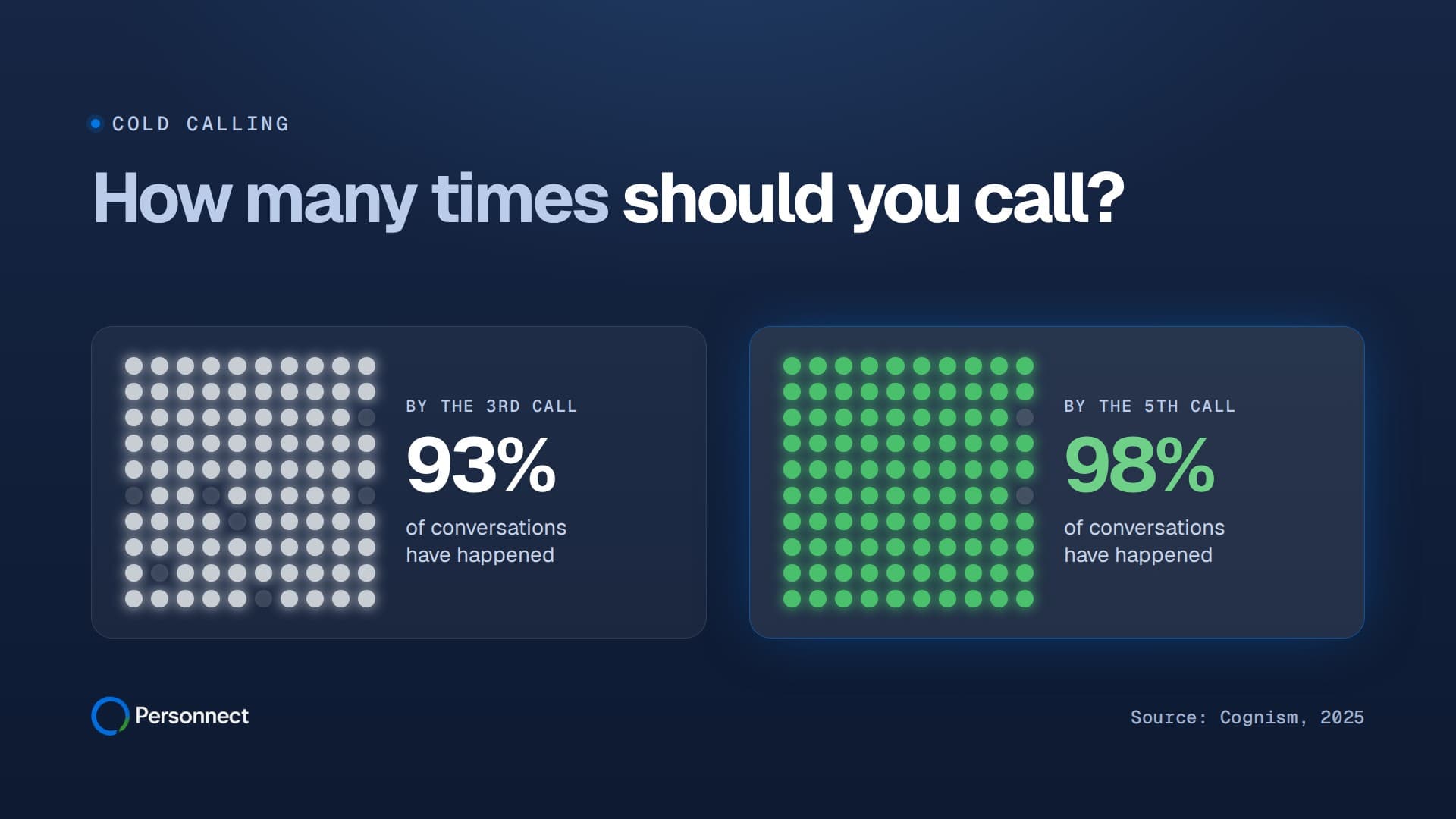
Recent data points to 10 to 11 a.m. as the single best hour. Cognism's 2026 report found reps had their longest and most meaningful conversations in that slot, with 2 to 3 p.m. as a reliable second window and a clear drop before 9 a.m. and after 4 p.m. (Cognism, 2026).
Lunch is the other weak spot. The same report puts 12 to 1 p.m. among the low-engagement hours, because prospects are away from their desks or distracted (Cognism, 2026). None of this is surprising once you picture a buyer's day: they arrive, clear the morning fires, and only around mid-morning do they have attention left for a stranger on the phone.
Here's how the windows line up when you put the studies next to each other:
| Window | Signal | Source |
|---|---|---|
| Before 9 a.m. | Mixed | Cognism vs InsideSales |
| 10 to 11 a.m. | Strong | Cognism |
| 12 to 1 p.m. | Weak | Cognism, BLS |
| 2 to 3 p.m. | Good | Cognism |
| 4 to 5 p.m. | Mixed | Cognism vs InsideSales |
The strong and weak rows are where the sources agree. The two "mixed" rows are where they don't, and that disagreement is worth understanding before you plan a team's week around it.
Why late morning works
By 10 a.m. most people have finished their commute, their first stand-up and the inbox triage that eats the first hour. They're working, but they haven't yet been pulled into the afternoon's commitments. A call in that gap competes with fewer things, which is why conversations in the slot tend to run longer.
Why do studies disagree about early morning and late afternoon?
They measured different people. The research behind the classic "call at 8 a.m. or after 4 p.m." advice came from Dr. James Oldroyd's work on web leads, which found 8 to 10 a.m. and 4 to 6 p.m. much more productive than 10 a.m. to 4 p.m. (InsideSales, 2009).
That study looked at people who had filled in a form and asked to hear from a company. A lead who requested contact will pick up at 8 a.m. because they're expecting the call. A cold prospect has no such reason, and at 8 a.m. they're still getting settled. Cognism's cold calling data, by contrast, shows performance falling off before 9 a.m. (Cognism, 2026).
The InsideSales summary also reports that a call at 8 a.m. had a 164% better chance of making contact than one placed between 1 and 2 p.m. (InsideSales, 2009). That's a big gap, and it's real for inbound leads. Applied to a cold list in 2026, it's a different population, a different decade and, for many buyers, a different phone sitting on a different desk.
The late afternoon case
Late afternoon is the trickier one. Some prospects do clear their calendars after 4 p.m. and will take a call while they wrap up. Gong's analysis of scheduled sales meetings found that a call booked for 4 p.m. was 30% more likely to have the prospect show up than one booked for 8 a.m. (Gong, 2017). That's about meetings people already agreed to, though, not cold dials.
So what should a team do with conflicting evidence? Keep late morning as the anchor, because the cold calling data supports it most directly. Then test 4 to 5 p.m. against 2 to 3 p.m. on your own list for a few weeks. The answer for a list of CFOs at manufacturing firms may differ from the answer for IT managers at software companies.
Which day of the week is best for cold calling?
Thursday is the best-supported day. Cognism's 2026 data has Thursday as the standout day for getting through, with Tuesday moving up into second place ahead of Wednesday, Friday trailing the rest of the week, and Monday sitting in the middle (Cognism, 2026).
The older InsideSales research also picked Thursday, with Wednesday nearly as good, though it ranked Tuesday as the worst day and Monday and Friday almost as weak (InsideSales, 2009). The two datasets split on Tuesday, but both put Thursday first, more than a decade apart, which is about as close to a rule as call timing gets.
Friday is the interesting exception. Microsoft's workplace data shows Tuesday carries the heaviest meeting load at 23% of the week's meetings, while Friday drops to 16% (Microsoft, 2025). Fewer meetings should mean more free prospects, yet Friday still underperforms. The likely reason is that people with open calendars on Friday are often out early, travelling, or protecting the time for focused work.
Cognism adds that fewer reps call on Fridays, so a prospect who is at their desk faces less competition for attention (Cognism, 2026). That makes a short Friday morning block worth keeping, even if it shouldn't carry the week.
What are prospects actually doing at each hour of the workday?
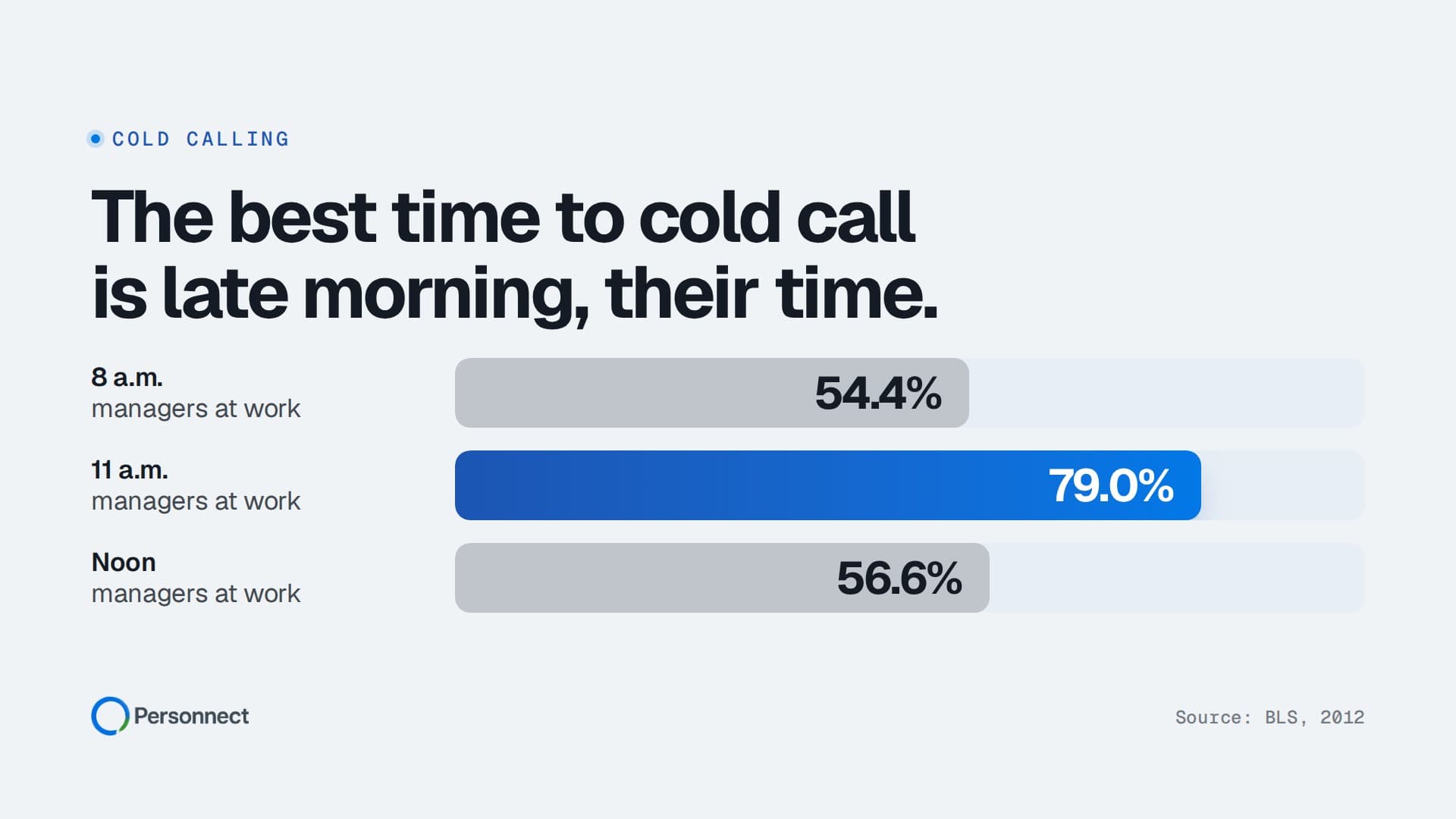
Most of them are at work from 9 a.m. to 4 p.m., with a sharp dip at noon. US time use data for management, business and financial occupations shows 79.0% working at 11 a.m., falling to 56.6% at noon, recovering to 74.9% at 2 p.m. and dropping to 40.6% at 5 p.m. (BLS, 2012).
| Hour | Working | Takeaway |
|---|---|---|
| 8 a.m. | 54.4% | Thin |
| 10 a.m. | 78.2% | Prime |
| 11 a.m. | 79.0% | Prime |
| 12 p.m. | 56.6% | Lunch dip |
| 2 p.m. | 74.9% | Good |
| 4 p.m. | 67.1% | Fading |
| 5 p.m. | 40.6% | Gone |
Being at work isn't the same as being free, though. Microsoft found that half of all meetings take place between 9 and 11 a.m. and between 1 and 3 p.m. (Microsoft, 2025). That puts many buyers in back-to-back calls during exactly the hours when they're most likely to be working.
Put the two datasets together and a pattern shows up. The hours when most managers are at work and the hours packed with meetings overlap heavily, and the gaps fall around 11 a.m. and from 3 p.m. onward. That fits Cognism's findings well: late morning wins because prospects are present and starting to come out of their morning meetings.
What the averages hide
These figures are averages across millions of working days. A sales leader at a field services company might live in the truck until 10 a.m., while a finance director may be unreachable during month-end close. Use the averages to pick where to start, then let your list's job titles adjust it.
How do time zones change the best time to cold call?
Every window above is in the prospect's local time, not the rep's. Microsoft reports that 30% of meetings now span multiple time zones, up 8 percentage points since 2021 (Microsoft, 2025), which means your buyers' days are increasingly shaped by colleagues somewhere else too.
For a US list, time zones are an advantage if you plan for them. A rep in New York can call Eastern prospects from 10 to 11 a.m., move to Central and Mountain contacts as the morning goes on, and reach Pacific prospects' late morning at 1 to 2 p.m. Eastern. One rep, one day, three or four prime windows.
Doing that by hand is where lists go wrong. Sorting by state misses area codes that span two zones and places like most of Arizona that skip daylight saving time. Personnect's free prospect local time tool reads area codes or full phone numbers and shows each prospect's local time.
What prospects see when you call
Timing gets you to a prospect while they're free, but they still decide whether to answer. Pew found that 80% of Americans generally don't answer their cellphone when an unknown number calls, and 67% let it ring but check any voicemail left (Pew Research Center, 2020). A familiar area code gives your call a better chance in that split second, which is why Personnect calls each contact from a local number in their area code.
How many prospects can you reach inside one window?
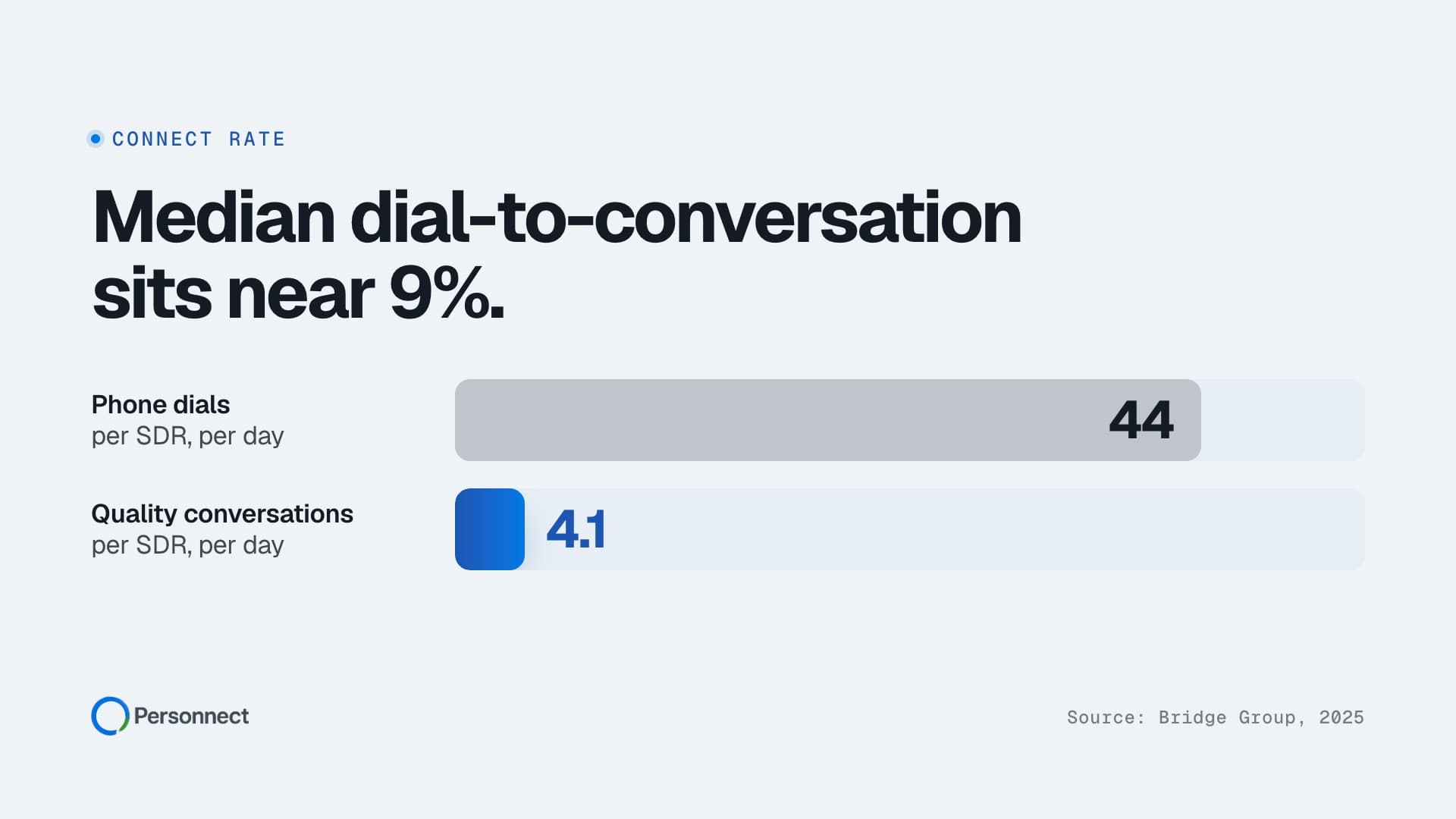
Fewer than most managers expect. A one-hour late-morning window, at a typical one-line pace, covers a few dozen dials, and most of those ring out or reach voicemail. The window is short and the minutes inside it are the most valuable ones in the rep's day.
That's the real constraint behind timing advice. Knowing that 10 to 11 a.m. works only helps if the rep reaches enough people inside it. Two options exist: run longer windows, which drags calls into weaker hours, or put more dials into the same window.
A parallel dialer takes the second route. Personnect dials up to five lines at once per rep, connects the rep the moment a person answers, and detects and skips voicemail greetings. A high-probability window then covers more contacts instead of being spent listening to rings. A brief pause can happen when the call connects, and reps should be ready to speak first.
Structure matters as much as tooling. Our guide to how top SDR teams structure their calling blocks covers block length, what stays outside the block, and how to schedule a week around these windows.
How can you find the best time for your own list?
Track your connect rate and conversations by the prospect's local hour and day for at least four weeks. Published data tells you where to start, but your list has its own job titles, industries and habits, and they matter more than any average.
A simple method works for most teams:
- Tag every call with the prospect's local hour and weekday, not the rep's.
- Compare connect rate and conversations per hour, not dial counts.
- Wait for a few hundred dials per window before drawing conclusions.
- Shift one block at a time, so you know which change moved the numbers.
Small samples lie. Two good Wednesdays at 4 p.m. don't make a trend, and a quiet holiday week can sink any window. Compare your results against typical connect rates for cold calling to see whether a weak hour is a timing problem or a list problem.
Clean data makes the test fair. If a third of the numbers in your afternoon list are wrong, the afternoon will look bad for reasons that have nothing to do with the clock. With Personnect, unanswered calls still verify your contacts as part of calling, and the summary, transcript and outcome of every call are logged and synced to the CRM, so the hour-by-hour picture builds itself as reps dial.
Where should your next calling block go?
Start with late morning in the prospect's time zone, Tuesday through Thursday. That's where current cold calling data, government time use figures and workplace calendar data all point, and it's the safest place to put your most important block.
Add a second block in the early afternoon, around 2 to 3 p.m., and treat 4 to 5 p.m. as a test rather than a habit. Skip lunch. Keep Friday to a short morning session. If your list spans the country, work east to west so each region gets its own late morning.
Then measure. The studies above disagree on early mornings and late afternoons because their prospects differed, and yours differ too. A month of tagged calls will tell you more about your market than any benchmark, including the ones in this post.
Frequently Asked Questions
Is it better to cold call in the morning or the afternoon?
Late morning usually wins. Cognism's 2026 data puts 10 to 11 a.m. at the top and 2 to 3 p.m. second, with weaker results before 9 a.m. and after 4 p.m. (Cognism, 2026). If you can only protect one block, put it in the prospect's late morning.
Should you cold call on Mondays or Fridays?
Yes, but give them less weight. Monday sits mid-table in Cognism's 2026 data and Friday trails the week, though fewer reps call on Fridays (Cognism, 2026). A short block on each day keeps the pipeline moving while Tuesday to Thursday carries most of the volume.
Is calling over lunch a waste of time?
Mostly. US time use data shows the share of managers and business staff at work falls from 79.0% at 11 a.m. to 56.6% at noon (BLS, 2012). Use the lunch hour for list prep, follow-up emails or callbacks, and save live dials for the hours either side.
How do you call prospects across several time zones in one day?
Sort the list by local time and work east to west, so each region gets its own late-morning window. Personnect helps here in two ways: it calls each contact from a local number in their own area code, and it dials up to five lines at once per rep, so each short regional window reaches more people.
Sources
- Cognism cognism.com/reports/cold-calling-report-2026
- InsideSales resources.insidesales.com?p=3110
- Gong gong.io/blog/worst-time-to-schedule-sales-calls
- Microsoft microsoft.com/en-us/worklab/work-trend-index/breaking-down-infinite-workday
- BLS bls.gov/tus/tables/a4_1112.htm
- Pew Research Center pewresearch.org/short-reads/2020/12/14/most-americans-dont-answer-cellphone-calls-from-unknown-numbers