
The Compounding Cost of Bad Phone Data
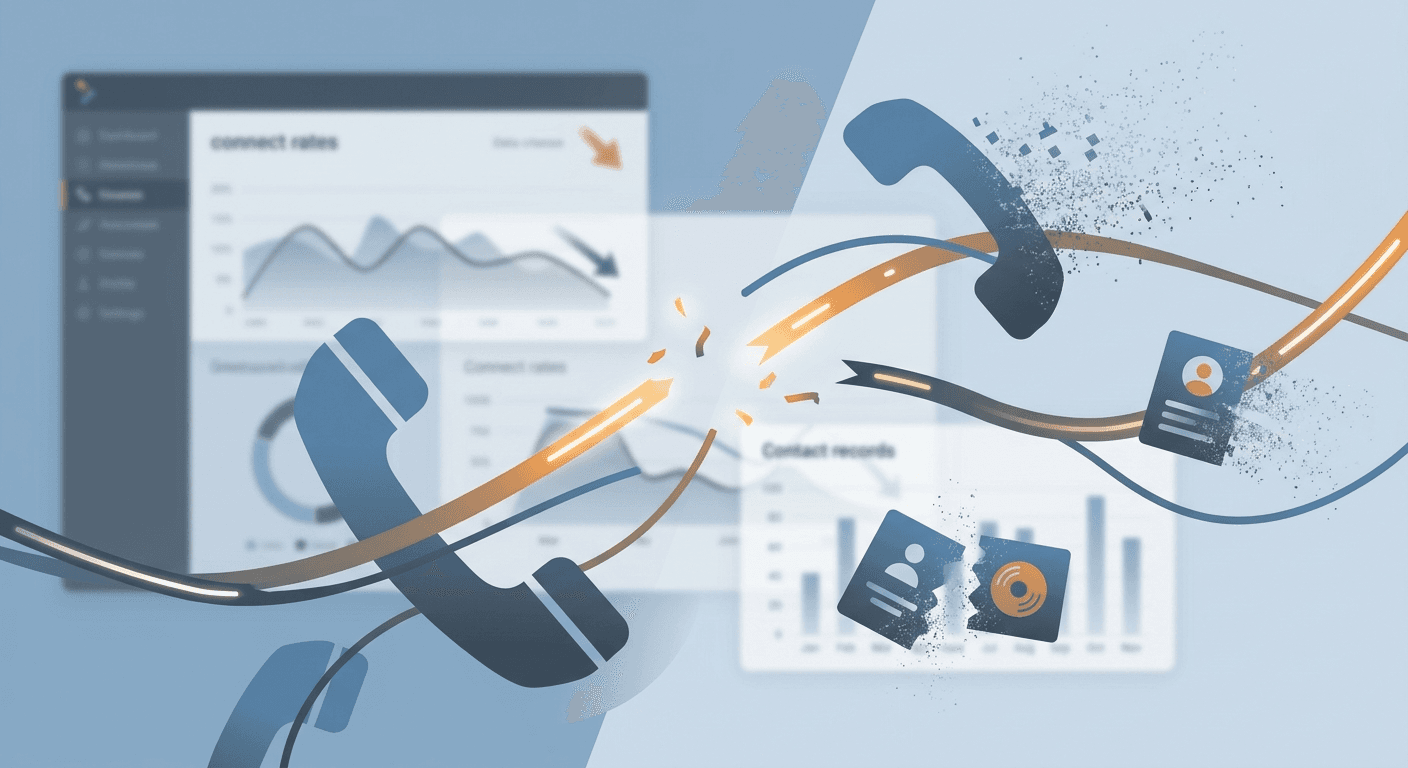
Gartner pegs the average enterprise cost of poor data quality at $12.9 million per year. That figure gets quoted in every data-quality deck on the planet, and it still understates what bad phone data does to a sales org. The $12.9 million captures storage, rework, and missed opportunity in aggregate. It does not capture the second-order damage: reps dialing dead numbers, dialers getting flagged as spam, managers coaching to broken metrics, and SDRs quitting because the job feels rigged. Bad phone data does not cost you once. It compounds, the way a high-interest loan compounds, and most sales orgs never see the full bill because the costs hide in line items nobody owns.
What Counts as "Bad" Phone Data?
When sales leaders hear "bad data," most picture an obvious failure: disconnected number, dead lead, contact who left three years ago. Those are the easy cases. The harder ones look fine on the spreadsheet:
- A number that rings but routes to a generic IVR.
- A direct dial that quietly forwarded to a colleague six months ago.
- A mobile that the contact still owns but never answers from unknown numbers.
- A number that connects to the right person in the right role, but at a company they left in February.
- A correctly attributed number that your dialer's caller ID got flagged as spam, so it never rings on the other end.
Each passes a basic validation check. None produces a connected, qualified conversation. Experian research found that 94 percent of businesses suspect their customer data is inaccurate, and the discrepancy between "looks valid" and "is useful" is a big part of why.
The category stretches into metadata too. A number might be correct but tagged with the wrong time zone, title, account owner, or opt-in status. Each piece of broken metadata creates a different downstream failure: calls placed at 6 a.m. local time, voicemails left for the wrong persona, follow-ups assigned to a rep who already lost the relationship. "Bad phone data" here means anything in your phone-record stack that produces a non-productive outcome at the moment of dialing.
Why Does Phone Data Decay So Fast?
B2B contact data has a half-life. Estimates of the decay rate vary, but the consensus range is brutal. Marketing Sherpa's benchmark puts annual decay around 22.5 percent, roughly 2.1 percent per month. Salesforce research has cited CRM decay of up to 70 percent per year once you include role changes and re-orgs alongside hard disconnections. Dun & Bradstreet has reported that 91 percent of CRM data is incomplete to begin with.
Four forces drive that decay:
Job mobility. The U.S. Bureau of Labor Statistics reports median employee tenure around four years, and far less in tech and sales-adjacent roles. Every job change desyncs a direct line, mobile policy, and CRM record.
Role mobility within companies. A promotion or lateral move quietly invalidates the title and persona tag even when the email address stays valid. Your "VP of Marketing at Acme" might still be at Acme but might now run product.
Carrier and number-pool churn. Mobile carriers recycle numbers. Direct lines get reassigned. None of this generates an alert in your CRM.
Caller-ID and spam labeling. Even if your data is correct, the network on the other side may have learned to suppress your calls. Carrier analytics engines flag numbers based on call patterns, complaint rates, and short-duration ratios. A number you dialed cleanly from six months ago can become a "Scam Likely" label without any change on your end.
The compounding starts here, because every form of decay creates more of the next form. A spam-flagged number gets fewer pickups, which generates more short calls, which deepens the spam reputation. A mis-titled contact gets pitched on the wrong product, gets logged as a disqualification, and teaches your scoring model the wrong lesson about an entire segment.
How Does Bad Data Compound Across the Funnel?
Most teams measure data quality at the top of the funnel: percent of records with a phone number, percent that pass a syntax check. That is the wrong place to measure it, because the cost shows up everywhere downstream.
A rep pulls a list of 200 prospects. Cognism's cold calling research puts industry connect rates around 4 to 5 percent on unmanaged lists. Optimistically, 10 of the 200 turn into conversations. The remaining 190 are some mix of dead numbers, voicemails, gatekeepers, and misattributed contacts. The rep does not know which is which, so they spend equal effort on each. Forrester has estimated that reps lose on the order of 546 hours per year to bad data, equivalent to roughly $20,000 per rep annually, and that assumes the rep eventually realizes the data was bad. Often they do not.
The 190 unproductive dials do not just consume rep time. They also:
- Generate spam-pattern signals that degrade your number reputation.
- Pollute your activity dashboards with misleading volume.
- Train your sequencing logic on a population that does not represent your real ICP.
- Get scored, ranked, and re-prioritized by automation that does not know any of the records were broken.
Now multiply that by every rep, every list, every quarter. Activity becomes downstream of data quality, not upstream. A team with mediocre data running at 200 percent activity is generating noise at scale, and the most efficient activity in the world cannot fix a broken input.
The compounding shows up in pipeline math. If 30 percent of your contact data is wrong this quarter and you do nothing, next quarter the share will be higher than 30 percent: contacts who moved did not become unbroken in the meantime, new contacts arrived in a similar state, and the records flagged "called, no answer" are sitting in re-engagement campaigns that will repeat the same failure.
What Is the True Per-Dial Cost of Bad Data?
Most sales orgs underestimate per-dial cost by an order of magnitude. The naive calculation (dialer cost per minute times average call length) gets you a few cents per attempt. That is the cost of the carrier path, not the cost of the dial.
The honest calculation includes fully loaded rep cost per hour divided by attempts per hour, manager and ops time reviewing the resulting data, CRM and platform costs allocated per attempt, number-reputation amortization, and the opportunity cost of the dial that did not happen because this one did.
A fully loaded SDR cost of around $90,000 per year, divided by 1,800 working hours, lands at $50 per hour. A power-dialer cadence runs maybe 30 to 50 attempts per hour. That puts the labor cost alone at $1.00 to $1.67 per attempt, before platform fees. If 70 percent of those attempts hit bad data, the team is burning $35 to $58 per productive hour on dials that were never going to convert.
Pricing models matter here. A per-seat dialer charges you the same whether the rep dials productive numbers or burned ones. A usage-based model at least aligns platform cost with productive call volume rather than seat occupancy. It does not fix bad data, but it stops you from prepaying for the privilege of dialing it.
Bridge Group's SDR research found reps waste roughly 14 percent of their calling hours on disconnected contacts alone. That is the floor. Add spam-flagged dials, IVR loops, voicemail-only contacts, and contacts who left the role, and the productive share of the average outbound hour is well under half.
How Does Bad Data Damage Number Reputation?
This is the part nobody warns you about until it has already happened.
Carrier-side analytics platforms (the engines that decide whether a call shows up as a clean caller ID, a generic location, or "Scam Likely") score outbound numbers using signals like short-duration call ratios, complaint rates, call frequency, and the ratio of unanswered to answered calls. Bad phone data produces all of those signals at scale: wrong contacts do not pick up, misattributed calls hang up fast, and some "wrong contacts" are actually right contacts who do not remember opting in.
Within weeks, that number gets a worse label. Pickup rates drop. The rep, not understanding what changed, dials harder. The signals worsen. The label worsens. The rep eventually rotates to a new number, the cycle resets, and a perfectly good DID is now permanently degraded.
The fix is not better dialing software. It is better data going into the dialer. A verification-first sequencing model, where contacts are validated before they consume a number's reputation budget, breaks the loop. Personnect's positioning around verification on every call, including unanswered ones, is one expression of this pattern: even the calls that do not connect become data that improves the next attempt, instead of degradation that sabotages it. There is no formal accounting line for "burned number reputation," which is why this cost stays invisible until pickup rates collapse. Then it shows up everywhere at once.
What Does It Cost in Rep Morale and Turnover?
Bridge Group has reported median SDR tenure of roughly 1.9 years, with annual turnover hovering around 40 percent in many orgs. The total cost of an SDR departure (recruitment, ramp time, lost pipeline momentum, manager attention) is commonly estimated above $150,000 per seat. The interesting question is how much of that turnover traces back to data quality.
The morale loop runs like this. A rep takes the job believing they will be having sales conversations. They show up to find that 70 percent of their dials produce no person on the other end. They start to question whether the problem is their script, their list, or themselves. Managers push for higher dial counts, which makes the experience worse, not better. The rep concludes the role is mostly busywork and starts updating their resume. SDR burnout is more often a data problem than a people problem: no script, cadence, or rep can survive a list where most of the contacts are wrong.
Salesforce's State of Sales research found that reps spend only 28 percent of their time actively selling. That 28 percent is the ceiling. Everything below it is administrative, validation, and recovery work, much of it caused by data quality problems the rep cannot fix and the org has not prioritized fixing. Add Forrester's $20,000 per rep annually in lost time to $150,000 per departure at typical churn, and the per-rep, per-year cost of bad phone data quietly clears six figures for a typical SDR org. A high-turnover SDR floor also produces less institutional knowledge, weaker call coaching, and noisier handoffs to AEs, which lowers conversion further down the funnel.
How Do You Stop the Compounding?
The good news in compounding cost is that the math runs both directions. Once you fix the upstream input, every layer of downstream cost improves, and the improvements stack. A few patterns separate teams that escape the loop from teams that do not:
Treat verification as infrastructure, not a feature. Verification-first sequencing assumes no contact is dialed without a recent confidence signal that the person, the number, and the reachability hold up. This is the principle behind Personnect's "Every Call Counts" framing: even calls that do not connect should produce a verified data point that updates the record for the next attempt, rather than being logged as a flat "no answer."
Measure connect rate and verified-contact rate, not dial volume. A team that dialed 10,000 records and had 400 conversations is not necessarily better than a team that dialed 4,000 and had 600. The right top-line metrics reward connection density, not phone wear.
Sync verification results back to the CRM continuously. A contact verified today is a different record from a contact verified eight months ago. CRM emptiness is usually a sync-and-verification problem disguised as a data-entry problem.
Score number health, and rotate before you have to. Tracking your outbound numbers as an asset class (with reputation, pickup rate, and complaint signals) lets you retire numbers before they hit the carrier-flagging tipping point, instead of after.
Stop paying flat fees for a workload you cannot fully use. Per-seat dialer economics pre-commit you to capacity that bad data will eat. Usage-based models put the economics on productive output instead of provisioned chairs.
None of these moves is exotic. The reason most teams do not run them is that the cost of bad data is distributed across so many line items that no single owner ever sees the full bill. The CFO sees the dialer line. The VP Sales sees the activity dashboard. The SDR manager sees the turnover. Nobody sees the $12.9 million plus the spam reputation plus the burned tenure in one place. When you do, the priority changes.
Frequently Asked Questions
What is the single biggest hidden cost of bad phone data?
Number reputation degradation. Most teams track rep time and CRM hygiene because those costs are visible. Carrier-side spam labeling is invisible until pickup rates collapse, and by then the damage is already permanent for the affected numbers. A burned DID can take months to recover, if it recovers at all, and the rep dialing it usually has no idea anything has changed.
How fast does B2B phone data really decay?
Estimates vary, but a useful planning range is 22 to 30 percent of contact records becoming wrong each year on the strict definition (disconnected, role change, company change). The looser definition, which includes contacts whose number still rings but no longer reaches the right person at the right company, runs much higher, with some research citing up to 70 percent annually once you include role changes.
Is verifying contacts before calling worth the extra step?
The evidence says yes, by a lot. Verified mobile lists are commonly cited at 12 to 18 percent connect rates against 3 to 5 percent on unmanaged lists, roughly a 3x improvement in productive conversations per hour. Dialers like Personnect that build verification into the call flow itself, including for unanswered calls, remove the operational tax that historically made verification a separate step.
Why do unanswered calls still produce data?
Because the network response, the carrier signaling, and the answering-machine versus person classification all carry information about whether the contact and number still match up. A modern dialer can resolve a "no answer" into "verified person on this line, try Tuesday morning" or "number reassigned, retire this record." Treating unanswered calls as data instead of noise is one of the highest-impact changes a sales org can make.
How much of SDR turnover is actually a data problem?
More than most managers credit. Reps quit when the job feels unwinnable, and dialing a list where most contacts are wrong is the textbook unwinnable job. Better data lowers turnover by margins no comp plan can match.
What is the right metric to replace "dials per day"?
Connect rate, verified-contact rate, and cost per connected conversation. Dial counts measure phone wear. Connect counts measure the thing you actually want.