Cold calling statistics from 2024 to 2026 tell a consistent story: buyers still pick up and still value a call from a seller, and the conversations that do happen turn into meetings at a steady rate. The hard part is volume, because a rep needs many dials to reach one person, and most people now screen numbers they don't recognize.
That split matters when you plan or defend a phone program. If you judge cold calling by dials, it looks wasteful. If you judge it by what happens after someone says hello, it holds up well. The numbers below are grouped by question, each with who measured it, when, and what it means for a sales team.
Key Takeaways
- In Bridge Group's 2025 SDR study, phone-first reps averaged 56 dials and 4.6 quality conversations a day.
- Cognism's own 2024 calling data turned 4.82% of conversations into booked meetings; its 2025 report puts the industry norm near 2%.
- In a 2025 Gartner survey, 67% of B2B buyers preferred a rep-free experience, yet RAIN Group's buyers still rank the phone as a preferred way to hear from sellers.
- Cognism's 2025 data shows 93% of conversations happen by the third call, so attempts beyond five add very little.
- Measure conversations per rep per day, meetings per conversation and cost per conversation, not raw dials.
Which cold calling statistics should you know first?
Start with five numbers: dials per conversation, the answer habits of the public, buyer attitudes, meetings per conversation and rep time. The table below collects the headline figures from this round-up, each with its source and year, so you can cite them in a planning doc without hunting.
| Statistic | Source | Year |
|---|---|---|
| 56 dials, 4.6 talks a day | Bridge Group | 2025 |
| 4.82% of talks booked | Cognism | 2024 |
| About 2% industry norm | Cognism | 2025 |
| 19% answer unknown calls | Pew | 2020 |
| 67% prefer rep-free buying | Gartner | 2025 |
| 93% of talks by call 3 | Cognism | 2025 |
| Sellers sell 40% of time | Salesforce | 2025 |
Each section below adds the context behind these figures and a reading for your own team.
How many dials does it take to reach a prospect?
Expect roughly a dozen dials for every real conversation. Bridge Group's 2025 SDR research found that phone-centric teams average 56 dials and 4.6 quality conversations a day, against 28 dials and 3.4 conversations for email-centric teams (351 B2B companies, published February 2025).
The same Bridge Group report puts the median SDR at 4.1 quality conversations a day, the first rise the study has recorded. Median total activity is 112 touches a day, of which 44 are phone calls. For your team, that means a phone-led rep who holds five conversations a day is already ahead of the median.
Cognism's figures show where the dials go. In its 2024 State of Cold Calling report, 55,701 dials produced 9,247 connected calls, and those connects produced 5,265 conversations. By our arithmetic, that is one connect for about every six dials, and a little over half of connects becoming a real talk.
The 2025 edition counted 41,936 connected calls worldwide and 27,513 conversations from them. Read together, the two years say that the gap between "someone picked up" and "we actually talked" is wide, and that a team should track both stages separately. Our post on what a good connect rate looks like goes deeper on those definitions.
Most of a rep's dialing hour goes to rings, voicemail greetings and numbers that don't work. A parallel dialer such as Personnect works on that dead time: it calls up to five lines at once for each rep, detects and skips voicemail, and connects the rep the moment a person answers, with the contact's details already on screen.
Do people still answer calls from unknown numbers?
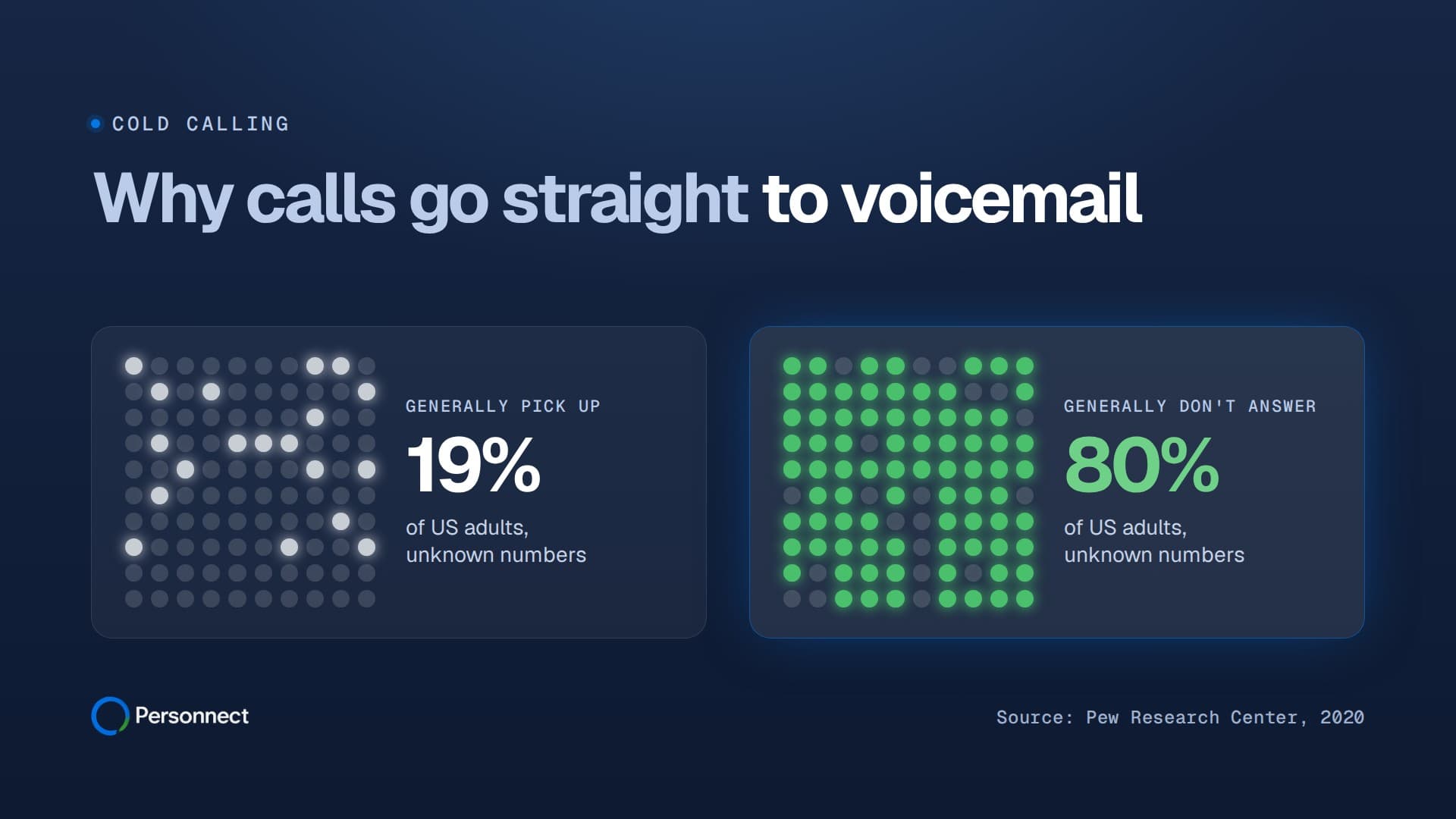
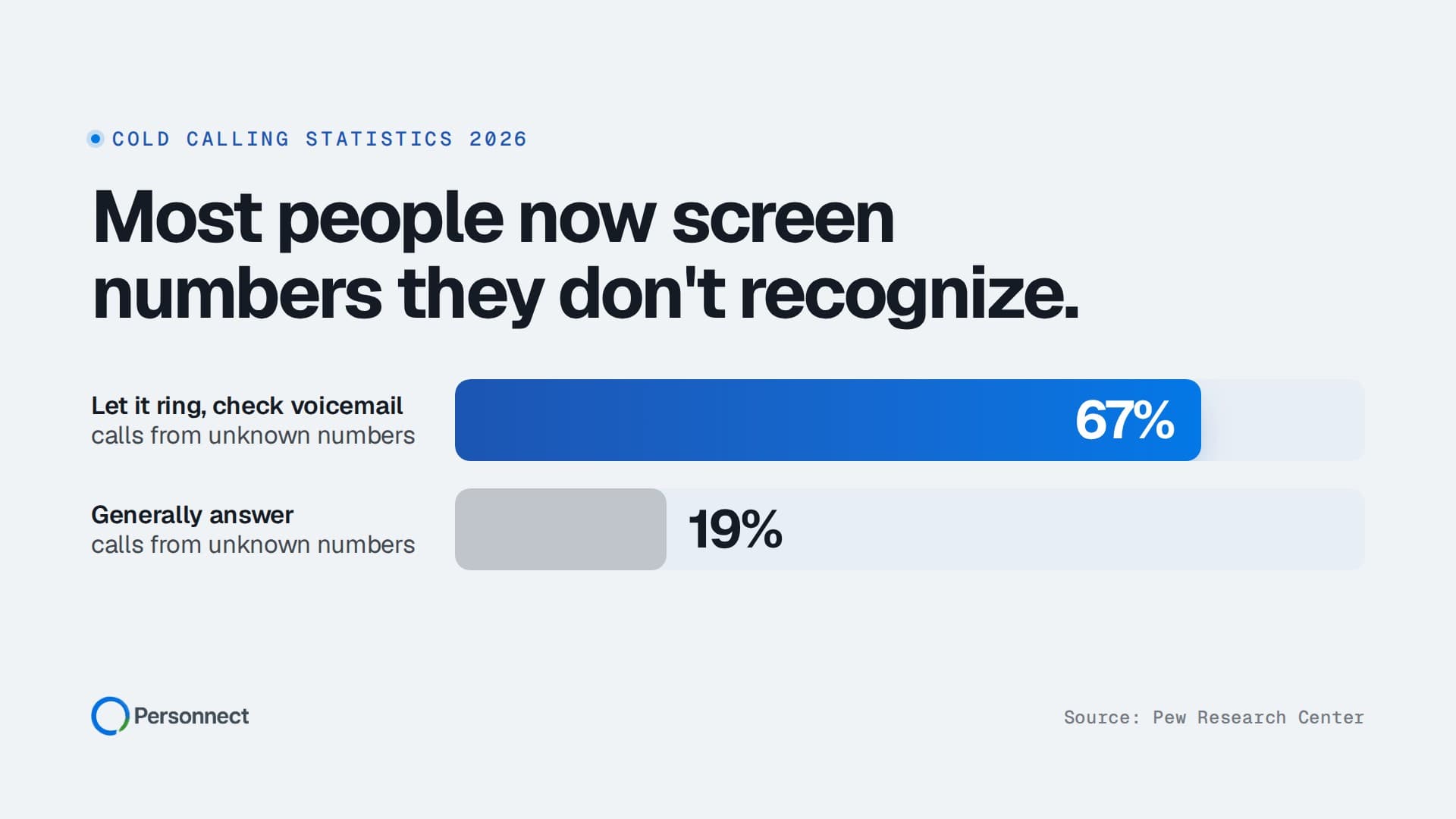
Mostly no, at least on the first ring. In a Pew Research Center survey of 10,211 adults, 67% said their usual practice is to let a call from an unknown number go and check any voicemail later, and only 19% said they generally answer such calls (July 2020).
The pressure on unknown numbers has grown since then. Pew's 2025 report on scams found that 31% of U.S. adults get scam phone calls at least daily, including 21% who get them several times a day (survey of 9,397 adults, April 2025). People who get that many scam calls learn to ignore the screen.
Regulators see the same flood. The FTC's biennial Do Not Call report says consumers had placed more than 258 million numbers on the Registry by the end of fiscal year 2025. The agency also logged more than 2.6 million Do Not Call complaints that year, an increase on the year before, mostly about robocalls rather than live callers.
None of that is about B2B sellers specifically, but your prospect carries the same phone. A rep's call lands in a stream of junk, so a caller ID the prospect can place, and a reason to call they'd care about, matter more than they did five years ago.
How do B2B buyers feel about calls from sellers?
Buyers are split: they want to research alone, yet many still welcome a well-timed call. RAIN Group's prospecting research found the phone is the second most preferred way buyers like to connect with sellers, at 49%, and that 57% of C-level and VP-level buyers prefer it (survey of 488 buyers and 489 sellers, page updated 2026).
Sellers in that RAIN Group survey are less sure of their own calls: only 27% rated phone calls to new contacts very or extremely effective. Calls to existing clients scored 51% and calls to past clients 37%. The gap suggests reps doubt the cold call more than buyers do.
Gartner's data pulls the other way. Its June 2025 press release reported that 61% of B2B buyers prefer an overall rep-free buying experience and that 73% actively avoid suppliers who send irrelevant outreach (632 buyers, surveyed August to September 2024). A March 2026 release raised the rep-free share to 67% (646 buyers, surveyed August to September 2025).
What does that mean for a calling program? Buyers will take a call that helps them and punish one that doesn't. Relevance does more for your numbers than volume, and the cold calling vs cold email comparison shows where each channel fits.
What happens once a cold call becomes a conversation?
Conversations convert at a few percent, and the good ones run longer. Cognism's 2024 report found 254 meetings booked from 5,265 conversations, a success rate of 4.82%, up from 2% in its 2023 data. Its 2025 report says the industry standard sits around 2%, while Cognism's own success rate was 6.7%.
So a team should plan on somewhere between two and seven meetings per hundred conversations, depending on list, offer and market. In that 2025 report, the success rate on dials by Cognism's WHAM team came in at almost half the prior year's, which the company tied partly to more calls from the UK into mainland Europe and a busier channel.
How long do successful calls last?
Longer than you might think. Gong Labs data on its cold calling page puts successful cold calls at an average of 5:50 minutes, against 3:14 for unsuccessful ones (page checked November 2026). The average call overall is short, though: Cognism measured 83 seconds in 2024 and about 93 seconds in 2025.
Cognism also found that only 31% of calls get past the pitch (2024). For a manager, that points to the opening 30 to 60 seconds as the place where coaching pays off fastest.
What do reps say on the calls that work?
Successful calls are more of a dialogue, and the opener matters. Gong found reps talk 55% of the time in successful cold calls (published 2021, updated 2026), and its cold calling tips research found 77% more speaker switches per minute in successful calls than in unsuccessful ones (published 2018, updated 2026).
Openers shift results too. In Gong's analysis of 90,380 cold calls, calls that began with "Did I catch you at a bad time?" booked meetings 0.9% of the time, against a 1.5% baseline (published 2018, updated 2026). Cognism's 2024 data adds the objections that end calls: "I'm not interested" ended 30% of them and "I'm the wrong person" ended 27%.
How much of a rep's week goes to selling?
Less than half. Salesforce's State of Sales announcement for 2026 says the average seller spends 40% of their time selling, and Gen Z reps only 35% (survey of more than 4,000 sales professionals, August to September 2025).
The same release says sellers give nearly a full workday each week to prospecting, yet 48% still lack the bandwidth for adequate cold outreach. For a sales leader, the useful question is where that prospecting day goes. If most of it is spent waiting on rings and greetings, you are paying for time that never reaches a buyer.
Quota attainment shows the strain. Bridge Group's 2025 report found that 60% of SDRs hit quota, the lowest share in the study's history, while pipeline sourced per SDR rose to $3.78M. Our guide to how many cold calls per day turns those activity figures into daily targets by role.
How do spam labels and bad phone data hurt results?
They cut answers before a rep ever speaks. With 31% of adults getting scam calls daily, according to Pew's 2025 survey, people have every reason to screen, and a spam label on the screen makes a stranger's call even easier to ignore. Our Spam Likely guide explains what triggers those labels and how to clear them.
Personnect calls each contact from a local number in their area code, registered in your company's name with Verizon, AT&T and T-Mobile, and rests flagged numbers until they are clean. No one can guarantee a number is never labeled, but a recognizable local caller ID still gives a rep a strong advantage.
Data quality is the other leak. Gartner estimates poor data quality costs organizations at least $12.9 million a year on average (Gartner research from 2020). Salesforce's 2026 release adds that 74% of sales professionals are focusing on data cleansing, and that 79% of high performers prioritize data hygiene against 54% of underperformers.
Every dial to a dead number or a person who has left the company is wasted time. With Personnect, unanswered calls still verify your contacts, so even dials that reach nobody leave the list in better shape.
How many attempts does it take before more calls stop paying?
Three calls capture most of the reachable conversations, and five capture nearly all of them. Cognism's 2025 report found conversations dropped 73% from the first call to the second and another 60% from the second to the third, with 93% of all conversations happening by call three.
Calling up to five times brought that share to 98.6%. In other words, attempts six through ten add very little, and the time is better spent on fresh contacts or a different channel. For spacing and cadence, see how many times to call a prospect.
How should you benchmark your own team against these numbers?
Use the published figures as a starting range, then measure your own. Track conversations per rep per day against Bridge Group's 4.1 median and 4.6 phone-first average. Track meetings per conversation against the 2% to 7% band from Cognism. Then add cost per conversation: rep hours plus dialing costs, divided by real conversations.
Watch those three for a month before changing targets. If conversations are low but meetings per conversation are healthy, fix reach: lists, caller ID and dial capacity. If conversations are fine but meetings lag, fix the opener and the offer. Personnect charges 8.5 cents per minute on answered calls, and calls that ring out, are busy or fail cost nothing, which ties the calling cost to conversations rather than to seats.
Frequently Asked Questions
What is the average cold call success rate in 2026?
Most published data puts it between about 2% and 7% of conversations booking a meeting. Cognism's 2025 report cites an industry standard of around 2% and a rate of 6.7% for Cognism itself, while its 2024 calling data reached 4.82%. Your rate depends on list quality, offer and market, so measure it per rep.
How many dials does one booked meeting take?
At Bridge Group's phone-first average of about 12 dials per quality conversation, and a 2% to 7% meeting rate, a booked meeting needs roughly 170 to 600 dials. Treat that as a planning range, then replace it with your team's own numbers after a month.
Do executives pick up cold calls?
Some do, and they say they like the phone. RAIN Group found 57% of C-level and VP-level buyers prefer to connect with sellers by phone. Cognism's 2024 data found CEOs and executives made up 11.91% of its conversations, the largest single group.
How can a team get more conversations without more reps?
Cut the time each rep spends on rings, voicemail and dead numbers. Personnect dials up to five lines at once per rep, skips voicemail and connects the rep when a person answers, so the same hour holds more conversations without adding headcount.
Sources
- Bridge Group's 2025 SDR research bridgegroupinc.com/research/2025-sdr-models-metrics-report-the-bridge-group
- 2024 State of Cold Calling report cognism.com/state-of-cold-calling
- 2025 edition cognism.com/cold-calling-report-2025
- Pew Research Center survey pewresearch.org/short-reads/2020/12/14/most-americans-dont-answer-cellphone-calls-from-unknown-numbers
- 2025 report on scams pewresearch.org/internet/2025/07/31/online-scams-and-attacks-in-america-today
- FTC's biennial Do Not Call report ftc.gov/news-events/news/press-releases/2026/01/ftc-issues-biennial-report-congress-national-do-not-call-registry
- RAIN Group's prospecting research rainsalestraining.com/blog/sales-prospecting
- June 2025 press release gartner.com/en/newsroom/press-releases/2025-06-25-gartner-sales-survey-finds-61-percent-of-b2b-buyers-prefer-a-rep-free-buying-experience
- March 2026 release gartner.com/en/newsroom/press-releases/2026-03-09-gartner-sales-survey-finds-67-percent-of-b2b-buyers-prefer-a-rep-free-experience
- cold calling page gong.io/cold-calling
- talk 55% of the time gong.io/blog/cold-call-stats
- cold calling tips research gong.io/blog/cold-calling-tips
- booked meetings 0.9% of the time gong.io/blog/cold-call-opening-lines
- State of Sales announcement for 2026 salesforce.com/news/stories/state-of-sales-report-announcement-2026
- estimates poor data quality costs organizations at least $12.9 million a year gartner.com/en/data-analytics/topics/data-quality