No, cold calling is not dead in 2026. Buyers still pick up and still book meetings from a good call; what has changed is the cost of getting a person on the line, because fewer people answer unknown numbers, it takes more dials to land each conversation, business numbers get labeled as spam and contact lists go stale faster than most CRMs get cleaned. A conversation that does happen still converts: in one study of more than 5,000 cold call conversations, close to one in twenty ended with a booked meeting. For most B2B teams the question is less "does the phone work" and more "what does each conversation cost us, and can we bring that cost down?"
Key Takeaways
- Cold calling still works: in RAIN Group's buyer research, 49% of buyers say the phone is a preferred way to hear from sellers, and 57% of C-level and VP-level buyers say so.
- Conversations still convert: Cognism's 2024 study found 4.82% of cold call conversations ended with a booked meeting.
- What got harder is reaching people, from unanswered unknown numbers to stale lists and spam labels, so the dialing time per conversation went up.
- Judge the channel on conversations per rep per day, meetings per conversation and cost per conversation, not on dials.
Does cold calling still work in 2026?
Yes. Buyers still say they want sellers to call, and conversations still produce meetings. RAIN Group's prospecting research reports that 49% of buyers prefer to connect with sellers over the phone, rising to 57% among C-level and VP-level buyers, which is hard to square with the idea that nobody takes calls anymore.
Before anyone cuts the phone budget, look at a second figure on the same RAIN Group page: 82% of buyers say they accept meetings, at least some of the time, from sellers who contact them proactively. That is a buyer-side answer to "does cold calling still work": the willingness is there, even if the first ring often goes nowhere.
Seller-side data points the same way. Cognism's State of Cold Calling analysed 5,265 cold call conversations and found that 254 of them ended in a booked meeting, a success rate of 4.82%. Put simply, roughly one conversation in twenty became a meeting.
Why the "it's dead" headline keeps coming back
Falling numbers get quoted without their context. Cognism's 2025 follow-up report says the industry norm for cold call success is around 2%, and that the rate in this year's larger dataset was almost half of the year before. The same report lists its reasons: more calls into mainland Europe, a bigger sample, and a resurgence of phone outreach that made the channel busier. That describes a crowded channel, which is a different problem from a dead one.
What actually changed about reaching buyers by phone?
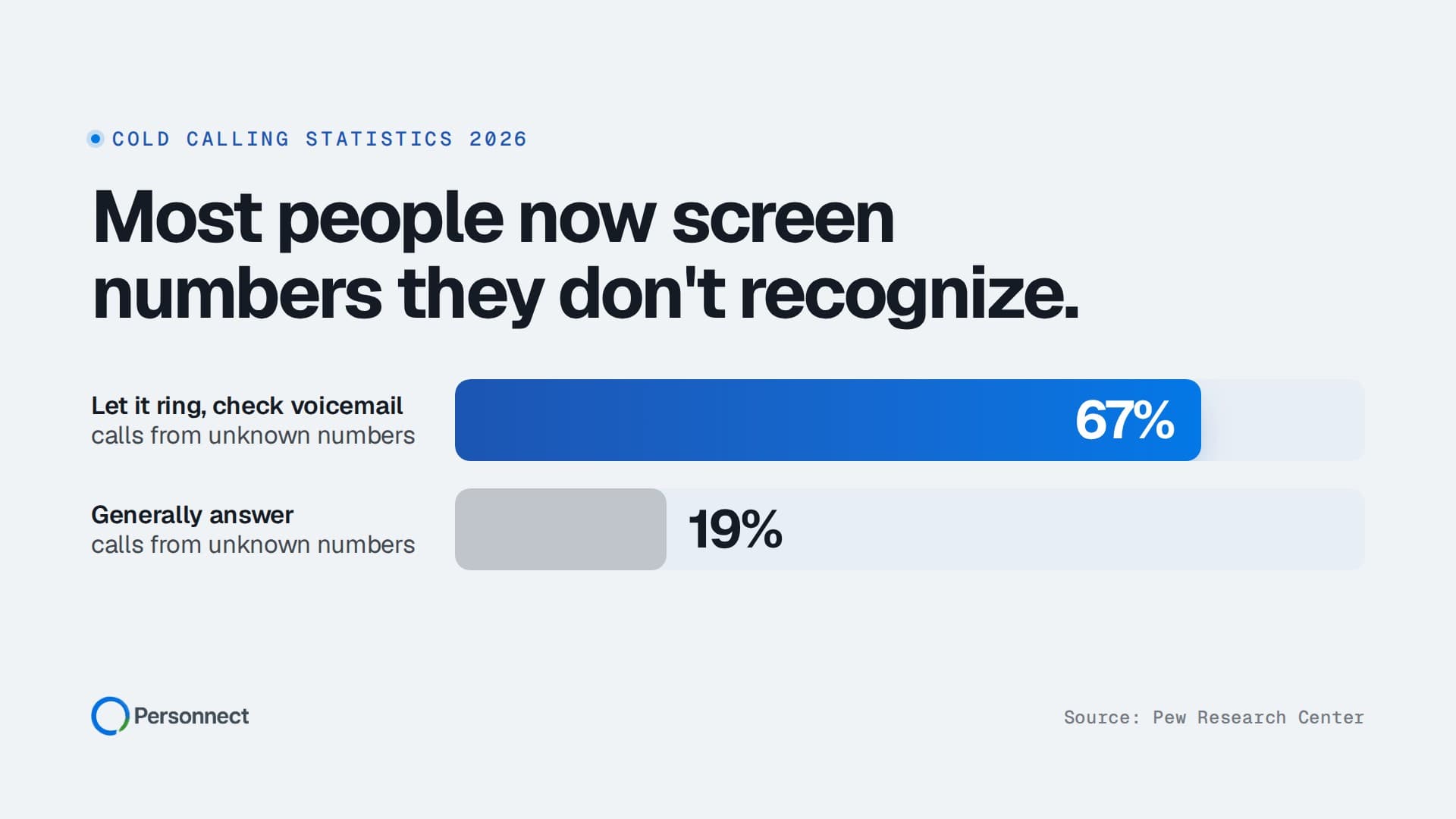
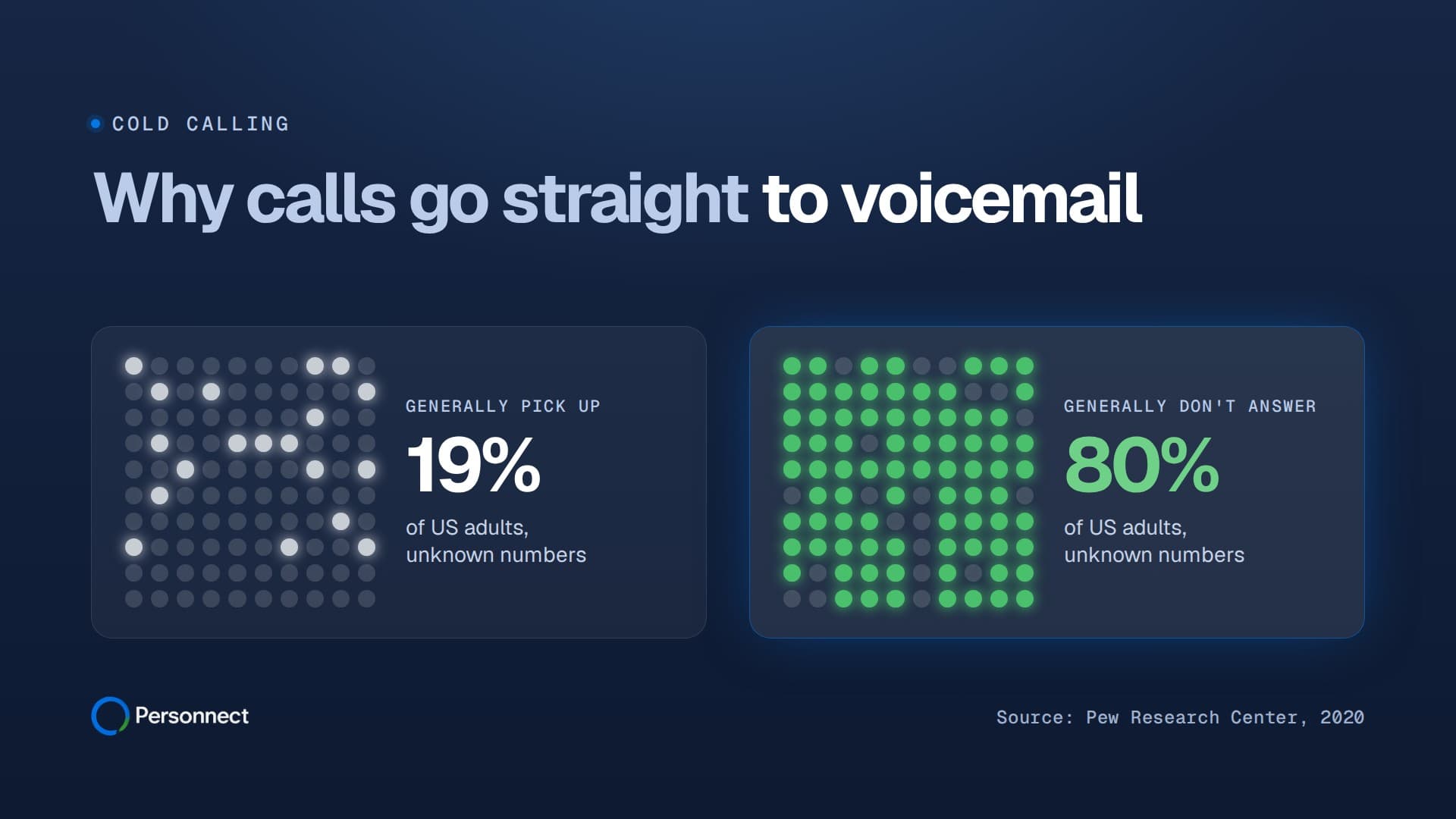
Reaching a person got more expensive, while the conversation itself did not get worse. The clearest sign is answering behavior: Pew Research Center found that 67% of Americans say their usual habit is to let an unknown number go unanswered and check the voicemail instead, if one is left.
That habit sits on top of three other shifts. Business numbers get labeled as spam on the recipient's screen, which pushes the answer rate down further. Contact data decays, so a share of every list points at people who changed jobs. Reps also have less time to call: Salesforce's 2026 State of Sales announcement says sellers give nearly a full day a week to prospecting, yet 48% say they lack the bandwidth for adequate cold outreach.
When people answer matters too. Cognism's 2025 report found that conversations drop by 73% from the first call to the second and by another 60% from the second to the third, and that 93% of all conversations had happened by call three. Most of the reachable people are reached early, which makes list size and dial speed matter more than persistence on a single number.
| Area | What changed | What held |
|---|---|---|
| Answering | Fewer pick up unknown numbers | People still answer some calls |
| Data | Lists go stale faster | Good data still reaches people |
| Caller ID | Spam labels cut answers | Local numbers still help |
| Buyers | Busier, more research first | Most still accept meetings |
| Outcome | More dials per talk | Talks still book meetings |
Why does cold calling feel dead to so many sales teams?
It feels dead because reps spend most of a calling block not talking to anyone. When a rep dials one number at a time, every ring, wrong number and voicemail greeting comes out of the same hour, and the number of real conversations per day shrinks even if the pitch is fine.
The manual dialing math
A single-line rep waits through each call before the next one starts. If only a small share of dials reach a person, the rep may spend most of an hour listening to rings and greetings for a handful of conversations. Managers see a low meeting count, read it as "the phone doesn't work", and move budget to email, when the bottleneck was minutes per conversation.
Lists that point at the wrong people
Stale data wastes dials before the rep says a word. Salesforce's 2026 research says 74% of sales professionals are focusing on data cleansing, and that 79% of high performers prioritize data hygiene compared with 54% of underperformers. A list full of people who left their company makes any channel look broken.
Numbers labeled as spam
A number shown as "Spam Likely" gets ignored by people who would otherwise answer. Heavy use of one or two outbound numbers is a common way to end up there, and the effect builds slowly enough that teams often blame the market first. This guide on why calls get marked as spam covers the usual causes.
Reps burning out on dead air
Hours of unanswered calls wear people down. The Bridge Group's 2025 SDR Metrics report, based on 351 B2B companies, puts the share of SDRs at quota at 60%, the lowest in the study's history, with median annual attrition of 40%. Burned-out reps make fewer calls, and the channel looks worse again.
What separates teams for whom cold calling still works?
Teams that still get results from the phone tend to share a few habits: current data, more conversations per rep per hour, a clear reason for every call, and a follow-up plan that respects how quickly reach drops off. None of these is a secret, but each one moves cost per conversation directly.
They call people who are still there
Good programs clean the list before anyone dials and keep cleaning it as they call. That is the same split Salesforce saw between high performers and underperformers on data hygiene. In Personnect, unanswered calls still verify your contacts as part of calling, so the list gets checked while reps work it.
They get more conversations out of each hour
The fastest lever is removing the waiting. A parallel dialer calls several numbers at once for one rep and connects the rep to whoever answers. Personnect's parallel dialer runs up to five lines at once per rep, connects the rep the moment a person answers with the contact's details on screen, and skips voicemail, so the hour goes to talking instead of listening to rings.
They give a reason for the call
Once someone answers, the opening still decides a lot. Gong's analysis of cold calls found a 2.1x higher success rate for salespeople who state their reason for calling. A short, specific reason respects the buyer's time and gets past "who is this?" before it is asked.
They plan around timing and follow-up
Because most reachable people answer within the first few attempts, strong teams spread a short sequence across days and times instead of hammering one number. Cognism's 2025 data shows calling up to five times captures 98.6% of total conversations. Each conversation is short, too: the same report puts the average cold call at around 93 seconds, so the follow-up email has to carry the detail.
Is cold calling worth it for your B2B team?
It is worth it when your cost per conversation is low enough that meetings from the phone cost less than meetings from other channels. You can measure that directly from your own call logs, and the answer usually says more about your process than about the channel.
Start with three numbers per rep: conversations per day, meetings per conversation and cost per conversation (rep time plus tooling, divided by conversations). Watch them over a few weeks, not a few days. If meetings per conversation is healthy but conversations per day is low, the problem is reach, which better data, local numbers and faster dialing can fix.
| Signal | Channel problem | Process problem |
|---|---|---|
| Meetings per talk | Falling with good reps | Steady |
| Talks per day | Low on clean lists | Low on stale lists |
| Answer rate | Low on every number | Low on a few numbers |
| Rep morale | Pitch keeps failing | Too much waiting |
The method matters as much as the channel. Cognism's 2025 report gives its own team a 6.7% success rate against the roughly 2% norm it cites. If you are weighing the phone against email, this cold calling vs cold email comparison lays out how the two channels differ.
Cost is the other half. Personnect charges 8.5 cents per minute on answered calls, billed per started minute, with no seat fees; calls that ring out, are busy or fail cost nothing. Pricing like that ties spend to conversations, which makes cost per conversation easy to read off the bill.
Where should the phone budget go from here?
Cold calling in 2026 rewards teams that treat reach as the problem to solve. Buyers still take calls, still say yes to meetings, and conversations still turn into booked time. The cost sits in the minutes before a conversation: unanswered unknown numbers, spam labels, stale records and reps waiting through rings. Before cutting the channel, look at conversations per rep per day and meetings per conversation side by side. If the second number is steady and the first is low, fix the reach: refresh the list, call from local numbers in good standing, and stop making reps dial one line at a time. If both are falling with clean data and experienced reps, then the market has shifted for your offer, and the phone deserves less of the budget.
Frequently Asked Questions
Do executives still answer cold calls?
Many do. RAIN Group's research found that 57% of C-level and VP-level buyers prefer to connect with sellers over the phone, a higher share than buyers overall. Senior people are harder to reach on the first try, so accurate direct numbers and a few attempts across different days matter more than volume.
How many conversations does it take to book one meeting?
Cognism's 2024 data put the rate at 4.82% of conversations, about one meeting for every 21 conversations. Its 2025 report cites roughly 2% as the industry norm. Your own ratio depends on list quality, offer and rep skill, so track it per rep rather than borrowing a benchmark.
Can a parallel dialer fix a cold calling program that isn't working?
It fixes the reach side, not the pitch. Personnect dials up to five lines at once per rep, connects the rep when a person answers and skips voicemail, so reps spend the hour talking instead of waiting. If meetings per conversation are low, the script, the list or the offer needs work too.
Should a team stop cold calling if the answer rate keeps dropping?
Not on that number alone. A falling answer rate often points to stale data or numbers labeled as spam, and both are fixable. Check meetings per conversation first: if it holds steady, the channel still works and the reach problem is where the effort should go.
Sources
- one study of more than 5,000 cold call conversations cognism.com/state-of-cold-calling
- RAIN Group's prospecting research rainsalestraining.com/blog/sales-prospecting
- 2025 follow-up report cognism.com/cold-calling-report-2025
- Pew Research Center pewresearch.org/short-reads/2020/12/14/most-americans-dont-answer-cellphone-calls-from-unknown-numbers
- 2026 State of Sales announcement salesforce.com/news/stories/state-of-sales-report-announcement-2026
- Bridge Group's 2025 SDR Metrics report bridgegroupinc.com/research/2025-sdr-models-metrics-report-the-bridge-group
- Gong's analysis of cold calls gong.io/blog/cold-call-stats