A B2B calling list connects when every row points at a person who fits your ideal customer profile, still holds the job on the record and can be reached on a working number that rings near them. You get there by defining the target before you source anything, preferring mobiles and direct dials over main lines, cleaning and verifying the file before the first session, and refreshing it on a schedule because the data starts going stale the day you buy it.
Key Takeaways
- Write the ideal customer profile and the title rules down before you pull a single contact, or the list will drift toward whatever is easy to find.
- Mobiles and direct dials reach the buyer; a main line usually reaches a receptionist or a phone menu.
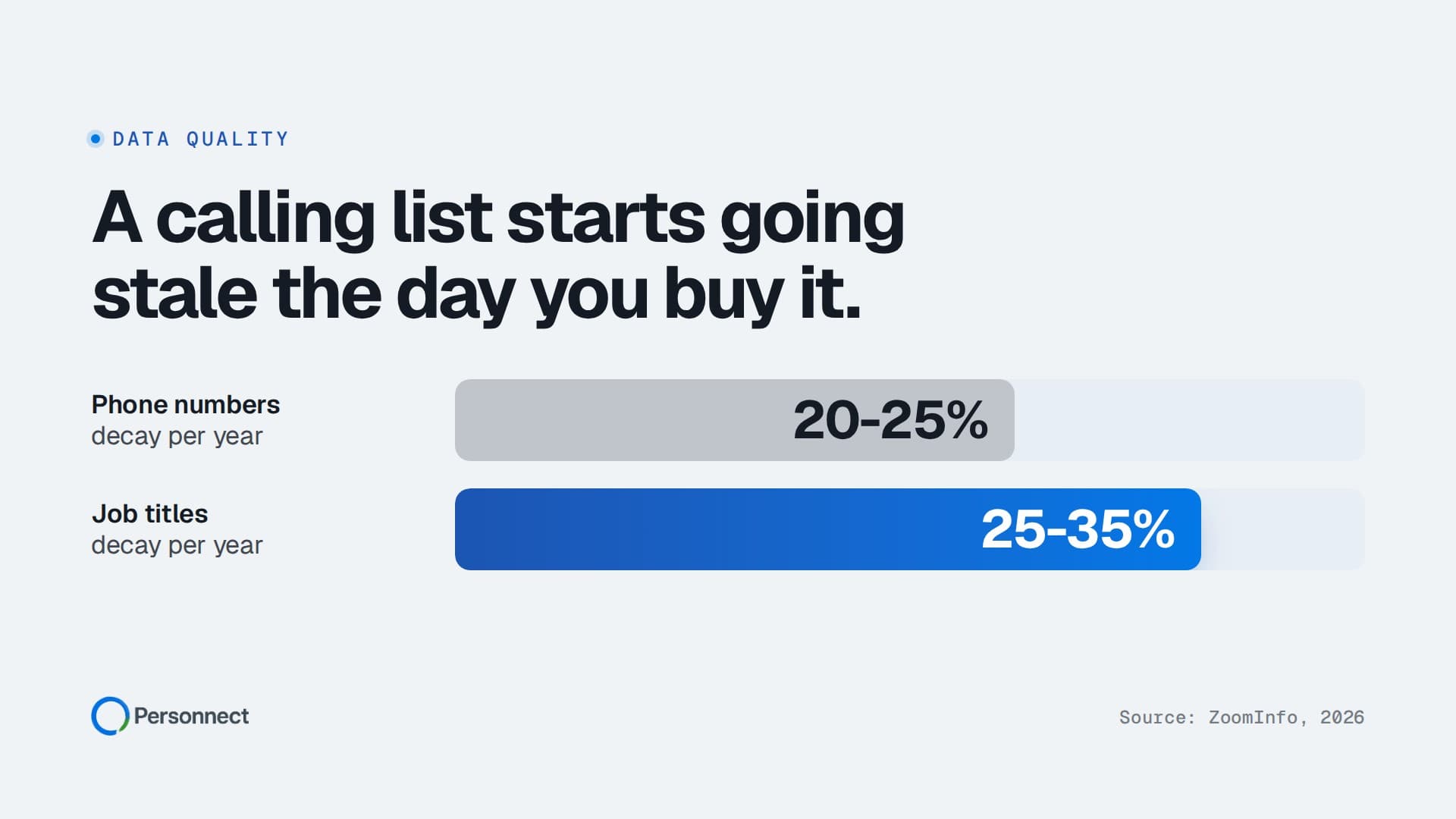
- Job titles and phone numbers each go stale at roughly 20% to 35% a year, so check every lead before anyone dials it.
- Segment by time zone, tier and persona so each calling block works one coherent slice of the list.
- Log an outcome for every dial, including the ones nobody picks up, and the list cleans itself as you work it.
What Separates a Calling List That Connects From One That Just Rings?
A list connects when each row names the right person, in the job they hold today, on a number that reaches them. Miss any one and the dial is wasted, however good the opener is.
Most lists fail on the third question without anyone noticing. A record can carry a perfect title at a perfect account and still list the company switchboard, a desk phone the person stopped using two years ago, or a number that now belongs to someone else. Sellers feel this. In research cited by Cognism's cold calling statistics roundup (2025), 71% of reps named reaching and engaging decision-makers as the hardest part of cold calling, and 43% of salespeople said better data was their biggest prospecting challenge.
The fix sits upstream of the dialer. Teams that treat list building as a one-time export from a data vendor end up coaching reps on talk tracks when the real problem is that half the calls never had a chance. Treat the list as a product with an owner, a spec and a refresh date, and the connect problem shrinks before anyone picks up a headset.
Who Should Be on Your B2B Calling List?
Only people at accounts that match your ideal customer profile, in roles that own or heavily influence the problem you solve. Everyone else costs dial time and drags down every metric you report.
Define the account first
Start with firmographics: industry, headcount band, revenue range, geography and any technology or trigger that predicts a fit. Pull these from closed-won deals. If your last twenty wins were logistics companies with 200 to 2,000 employees in the Midwest, that is your first segment, even if the market slide says "mid-market across all verticals."
Keep the account filter strict. Adding loosely matching companies makes the list bigger and the connect rate looks the same, yet the conversations that do happen go nowhere.
Then write the title rules
For each account, list the two or three titles you want and the ones you explicitly don't. "VP Operations, Director of Fleet, Head of Logistics" is a rule a researcher or an enrichment tool can apply. "Operations leaders" is not. Write down seniority floors too, because a list padded with coordinators and analysts will connect often and book almost nothing.
The same job shows up as "Head of Ops", "Operations Director" and "Dir., Operations" across three accounts, so match on function and seniority instead of exact strings.
Decide how many contacts per account
One contact per account makes the list fragile: if that person left, the account is dark. Three to five per account, across the buying group, gives the rep somewhere to go when the first person says "I'm not the one you want." It also lets you run account-based sequences where the second call references the first.
Which Phone Numbers Should a Calling List Include?
Mobiles first, direct dials second and main lines only as a last resort. The closer a number sits to one person, the more likely that person answers it, and Cognism's own comparison rates direct dials as 147% more likely to connect than a switchboard (Cognism, 2025).
Mobiles have become the default way to reach people at work. Pew Research Center (2026) finds that 98% of US adults own a cellphone of some kind and 91% own a smartphone. Hybrid work pushed many buyers off their desk phones entirely, so a direct dial that rings an empty office can behave like a dead number.
| Number | Reaches | Gatekeeper | Use |
|---|---|---|---|
| Mobile | The person | Rarely | First choice |
| Direct | Their desk | Sometimes | Second choice |
| Main | Reception | Usually | Last resort |
| Unknown | Anyone | Varies | Verify first |
Store each type in its own field. When a list has a single "phone" column, nobody can tell whether a no-answer came from a voicemail box on a mobile or a phone menu at headquarters, and the reporting blurs. Separate fields also let you sequence attempts: mobile on the first and second calls, direct line later, main line only with a plan for the gatekeeper.
Main lines still help when a contact has gone stale, because the switchboard can tell you who holds the role now. Just don't build a list where the main line is the only number for most rows.
How Do You Clean a Calling List Before the First Dial?
Normalize every number to one format, merge duplicates, remove anyone you shouldn't call and fill the gaps before the list reaches a rep. A messy file wastes calls in ways that look like bad luck.
Normalize formats
Numbers arrive as "(312) 555-0164", "312.555.0164" and "+1 312 555 0164" from different sources. Convert everything to one international format with the country code. That makes dedupe possible, keeps extensions in their own field and lets your tools read the area code reliably, which matters once you start segmenting by time zone.
Dedupe at two levels
Duplicate people are the obvious problem: the same contact appears twice with slightly different spellings and gets called twice in one morning. Duplicate accounts are subtler. "Acme Inc", "Acme" and "ACME Corporation" become three accounts in the CRM, three owners and three uncoordinated reps. Match on company domain rather than company name, then on email or name plus account for people.
Suppress before you load
Pull out current customers, open opportunities owned by another rep, people who asked not to be contacted and anyone outside your territory. It is far cheaper to drop these rows in a spreadsheet than to apologize on a call. Keep a suppression file and apply it every time a new list comes in, because vendors will happily sell you your own customers again.
Should You Verify and Enrich Leads Before You Dial?
Yes, and close to the moment you call rather than when you bought the data. ZoomInfo estimates that job titles change at 25% to 35% a year and phone numbers at roughly 20% to 25% (ZoomInfo, 2026), so a list sourced last quarter is already partly wrong.
Verification answers a narrow question: is this record still true? Enrichment fills what is missing, such as a mobile number, a current title or a company size. You need both, and the order matters. Check that the person is still in the role first, because enriching a contact who left in March just gives you a better phone number for the wrong person.
Run the check on the slice you plan to call this week, not on the whole database once a year. Leads you won't dial for three months will need checking again anyway.
This is the step Personnect built lead enrichment around. Michael, the assistant inside Personnect, checks each lead's title, company and phone number before anyone dials, at 15¢ a lead. Each record comes back enriched, stale or retired, so reps aren't opening a session with people who moved on, and the stale rows go back to research instead of into the queue.
How Quickly Does a B2B Calling List Go Stale?
Faster than most refresh cycles assume. HubSpot cites research showing B2B data decays at about 2.1% a month, an annualized rate of 22.5% (HubSpot), and title and phone fields decay faster than that average.
Phone numbers decay for reasons outside your buyer's career, too. US carriers disconnect and recycle numbers at scale: the FCC put the figure at approximately 35 million numbers disconnected and made available for reassignment each year (Federal Register, 2018). A number that reached your contact in spring can ring a stranger by autumn.
Most CRMs already carry this data decay without anyone measuring it. In the Validity State of CRM Data Management survey (2025), 76% of CRM users said less than half of their organization's data was accurate and complete, and 37% reported losing revenue because of poor data quality.
Set a refresh rule you can actually follow. A workable one: any record not touched in 90 days gets rechecked before it goes back into a calling block, and any account that produced a "left the company" outcome gets a fresh pull for its replacement.
How Should You Segment a Calling List for Calling Blocks?
Split it by time zone first, then by tier and persona, so each block calls people who are awake, at work and worth the same opener. A rep switching between a CFO in Boston and an IT manager in Phoenix every two minutes loses both rhythm and timing.
Time zone
Group contacts by local time and schedule blocks around their working day, not yours. A team in New York calling the West Coast at 9 a.m. Eastern is ringing people at 6 a.m. The prospect local time tool is a quick way to sanity check a block before it starts. Personnect calls each contact from a local number in their own area code, so a segment built around one region also shows up as a familiar number on the screens in that region.
Tier and persona
Tier one accounts get the best researched contacts, the strongest reps and more attempts. Tier three can run on a lighter sequence. Within a tier, keep personas together: a block of finance leaders lets a rep tighten one talk track over thirty calls instead of improvising five.
Attempt number
Track which attempt each contact is on and keep early attempts together. Cognism's 2025 State of Cold Calling data shows 93% of conversations happen by the third call (Cognism, 2025), which means a contact on attempt six belongs in a different block, with a different message, than a fresh lead.
How Do You Keep the CRM Clean After Every Calling Session?
Make the outcome of every dial land in the CRM automatically, including no-answers, wrong numbers and "she left in June." When calling itself updates the list, it stays accurate without reps typing notes at 6 p.m.
Dispositions are the backbone. A short, enforced set (connected, voicemail, wrong number, left company, not interested, meeting booked) turns every attempt into a data point. Wrong number and left company are the two that matter most for list quality, because they tell you exactly which rows to fix. Without them, a dead number just looks like someone who never picks up, and it stays in the queue for months.
In Personnect, unanswered calls still verify your contacts as part of calling, and the summary, transcript and outcome of every call are logged and synced to the CRM. Teams on HubSpot or Salesforce get native two-way sync, and teams without a CRM can upload a list and work it in Personnect as their outbound CRM. Either way the next list starts from cleaner data than the last one.
Review the numbers weekly. If one source or segment keeps producing wrong-number outcomes, stop buying from it. Our post on the compounding cost of bad phone data walks through what those errors do downstream when nobody tracks them.
Where the Effort Pays Off
Think of a calling list as inventory. It has a spec (the ICP and title rules), a quality check (verification before dialing), a shelf life (roughly a fifth or more of the data a year) and a feedback loop (dispositions from every call). Teams that run all four rarely argue about whether their reps are dialing enough, because the dials they make land on people who exist, hold the job and answer the phone.
Start small if the whole process feels heavy. Pick one segment, write the title rules, verify that slice, and call it for two weeks with clean dispositions. The wrong-number and left-company counts from those two weeks will tell you more about your data source than any vendor's accuracy claim, and they give you a baseline to measure the next list against.
Frequently Asked Questions
How many contacts should a B2B calling list have?
Size it to your team's dialing capacity for the next two to four weeks, not to the size of the market. A list much larger than that goes stale before reps reach the bottom. With a parallel dialer like Personnect, which calls up to five lines at once per rep, a team works through a segment faster, so smaller and fresher batches suit it well.
Is it worth buying a B2B phone list?
A purchased list can be a reasonable starting point if you filter it hard against your ICP and verify it before use. Treat vendor accuracy figures as a claim to test. Check a sample, call it, and count wrong numbers and departed contacts before committing to the whole file or a renewal.
Are mobile numbers better than direct dials for cold calling?
For most B2B roles, yes, because the mobile travels with the person while a desk phone stays in an office they may rarely visit. With 98% of US adults owning a cellphone (Pew Research Center, 2026), coverage is rarely the gap, so the work is finding the current number.
How often should you clean a calling list?
Recheck any slice right before it goes into a calling block, and run a full dedupe and suppression pass whenever new data is imported. At about 2.1% decay a month (HubSpot), a list left untouched for a quarter has already lost a meaningful share of its accuracy.
Sources
- Cognism's cold calling statistics roundup cognism.com/blog/cold-calling-statistics
- Cognism cognism.com/blog/b2b-direct-dials
- Pew Research Center pewresearch.org/internet/fact-sheet/mobile
- ZoomInfo pipeline.zoominfo.com/marketing/b2b-data-decay
- HubSpot hubspot.com/database-decay
- Federal Register govinfo.gov/content/pkg/FR-2018-04-23/pdf/2018-08376.pdf
- Validity State of CRM Data Management validity.com/resource-center/the-state-of-crm-data-management-in-2025