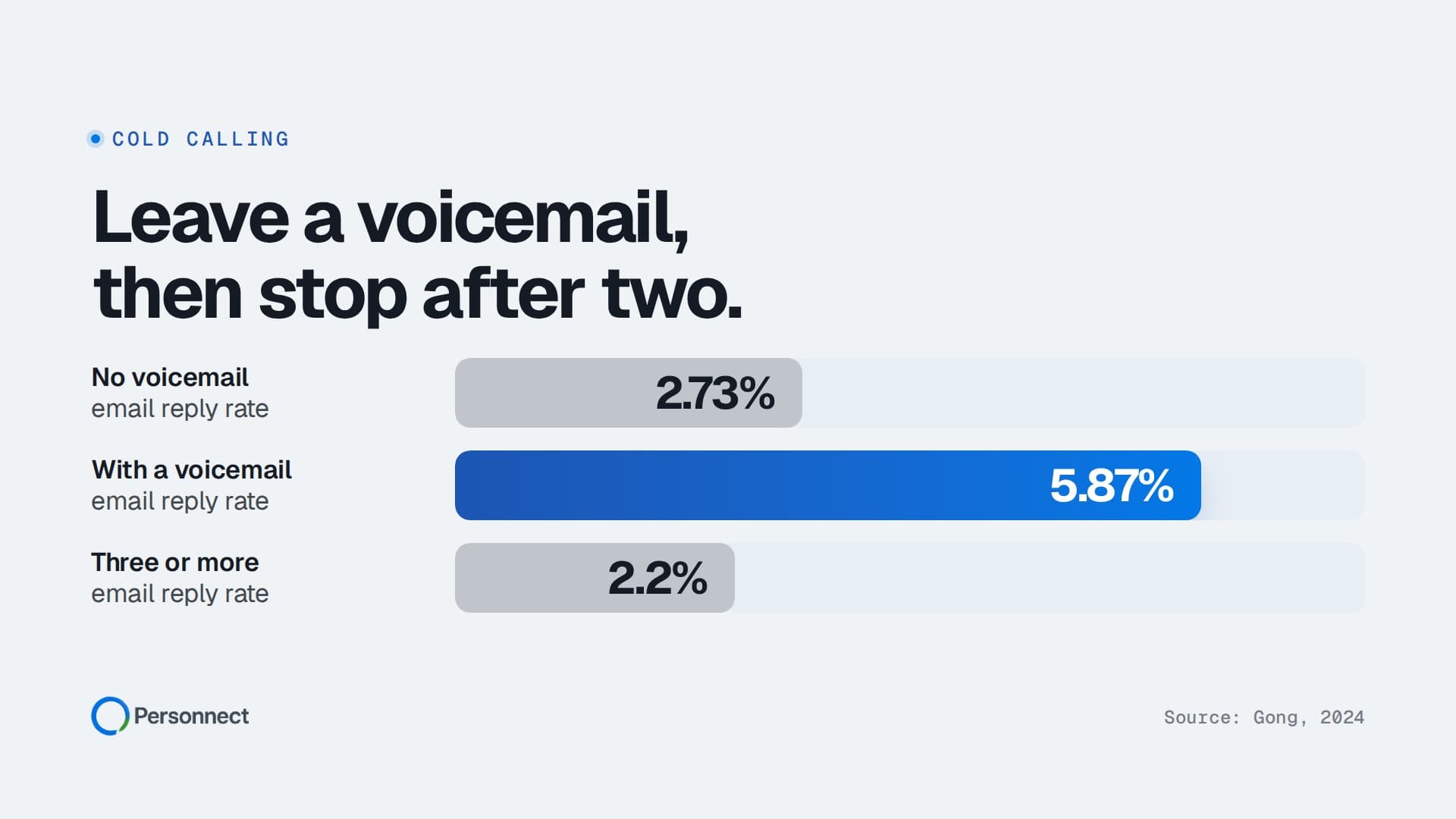
Yes, leave a voicemail on a cold call, but only on the first one or two attempts per prospect, and keep each one under 30 seconds. Its job is to send the prospect to your email, so it belongs inside a multi-touch sequence and should never eat into the time your reps could spend in live conversations. Gong Labs, working through more than 300 million cold calls, found that voicemails lift email reply rates from 2.73% to 5.87% (Gong, 2024). Callbacks, the reason most reps leave them, rarely happen.
Key Takeaways
- Leave a voicemail on the first one or two attempts, then stop: three or more pushed email replies down to 2.2% in Gong's data.
- The payoff of a cold call voicemail is the email reply it prompts, so point the prospect to your inbox instead of asking for a callback.
- Keep the first message around 15 seconds and the second under 30.
- Voicemails cost dial time and can lower future connect rates, so plan them for a short list instead of leaving one on every unanswered call.
- Measure voicemails by email replies per prospect, not by the number left per day.
Should you leave a voicemail on a cold call, or just hang up?
Leave one, on purpose, early in the sequence. Gong's analysis found that prospects who got a voicemail replied to the follow-up email at 5.87%, compared with 2.73% for those who didn't (Gong, 2024). That's more than double the replies from the same email, for about 20 seconds of talking.
The case against voicemail is still real, and the same research backs most of it. Prospects seldom call back, voicemails take time, and they tell the prospect a salesperson is on the line. The practical answer is a small number of short messages, each with one job.
That job is the part most reps get wrong. They leave a voicemail hoping the phone rings back, wait, and judge the whole tactic by a callback rate close to zero. Judge it by email replies and the numbers look very different.
Why do so few prospects call back?
Callbacks are rare because returning a stranger's call costs the prospect effort, and reading an email they already have doesn't. Gong's own summary of the evidence is blunt: you'll rarely get a callback (Gong, 2024). Most people who would ever talk to you on a first call simply pick up.
Cognism's 2026 report points the same way. Reps needed 1.55 calls on average to reach a prospect, and the people likely to answer an unknown number tend to do it on the very first try (Cognism, 2026). A voicemail rarely changes that behavior. It can, however, make your next email feel expected instead of random.
What does a cold call voicemail cost your reps?
Every voicemail takes a slice of the calling block. In the time it takes to leave voicemails, Gong found a rep could make 25% more cold calls (Gong, 2024). Across a two-hour block, that's a meaningful number of dials that never happen.
That time comes out of a week that's already thin. Salesforce's State of Sales research found reps spend just 28% of their week actually selling (Salesforce, 2022). A rep who listens to a full greeting, waits for the beep and talks for half a minute on every unanswered call turns a chunk of that 28% into talking to machines.
The bigger cost is attention. Reps who leave a message on every miss end up in a rhythm of greeting, beep, script, hang up. By the time a real person answers, they sound like the recording they just left.
How does dialing software change the math?
A parallel dialer takes most of the voicemail grind off the rep's plate. Personnect, for example, calls up to five lines at once per rep, detects and skips voicemail, and connects the rep the moment a person answers. Reps spend the block in conversations, and any voicemail a team chooses to leave becomes a planned touch for a specific prospect instead of a reflex on every miss.
How do voicemail and email work together in a sequence?
The voicemail's main job is to raise the reply rate on the email that follows it. Gong's numbers show that phone and email together more than double the chance of a reply compared with email alone (Gong, 2024). The call gets attention, and the email carries the detail.
Calls help email even when nobody answers. In a separate analysis of the same 300 million calls, Gong found that cold calling nearly doubles email reply rates, 3.44% versus 1.81%, even without a live connection (Gong, 2024). Your name showing up on a missed call and then in an inbox the same day is what does the work.
In practice, pair each voicemail with an email sent within the hour. The voicemail names the context and tells them to look for your note. The email repeats the context, adds the specific reason you're reaching out and makes a small ask. If your team works from a written sales cadence, put both touches on the same day so they reinforce each other.
How many voicemails should you leave per prospect?
Two at most. Gong found email reply rates doubled with one or two voicemails, but after three or more the reply rate fell to 2.2%, lower than leaving none at all (2.73%) (Gong, 2024). A third message tells the prospect you're on autopilot.
That fits neatly with how many times you should dial in the first place. If you plan three to five attempts over two to three weeks, as covered in how many times to call a prospect, use the voicemails on attempts one and two or one and three. Stay silent on the rest.
| Attempt | Voicemail? | Pair with |
|---|---|---|
| First call | Yes, 15s | Email same hour |
| Second call | No | Nothing |
| Third call | Yes, 30s | Email with proof |
| Fourth call | No | LinkedIn touch |
| Fifth call | No | Short last email |
Adjust the order to your cadence. The pattern that matters is two messages, spaced apart, each tied to an email.
When should you skip the voicemail altogether?
Skip it when the message would add nothing the email can't. You have no specific reason to call this person, you've already left two, or the prospect is low on your priority list. In those cases, hang up and move to the next dial.
There's a second reason to be selective. Gong's data shows voicemails reveal you're a salesperson and cut connect rates on all future dials by 28%, down to 5.17% after a voicemail (Gong, 2024). Every message you leave makes the next ring a little easier to ignore.
Which prospects deserve a voicemail?
Save voicemails for prospects where a message will be heard by the right person and you have real context to share. A short checklist:
- You've confirmed the number belongs to the person you want.
- You have one specific, recent reason to reach out.
- The account is in your top tier for this quarter.
- An email will go out within the hour.
If two of those are missing, skip it. A voicemail on a wrong number or a generic pitch costs time and gives nothing back.
What about the prospect's caller ID?
What the prospect sees before answering matters more than anything you say after the beep. Personnect calls each contact from a local number in their area code, registered in your company's name with Verizon, AT&T and T-Mobile. A familiar, local caller ID gives the live call a better chance of being answered, which is the outcome a voicemail is trying to make up for.
How long should a cold call voicemail be?
Fifteen seconds for the first one, under 30 for the second. Gong's guidance is that no one listens to long voicemails and anything past 30 seconds wastes your time (Gong, 2024). Short messages also take less of the calling block.
Length follows from purpose. A message that only needs to say who you are, why this person, and where to look for details doesn't need more than three sentences. If yours runs longer, you're pitching, and the pitch belongs in the email.
A 15-second first voicemail
Lead with context about them, name yourself once, and point to the inbox:
"Hi Dana, it's Sam Patel from Northline. I saw your team opened two new warehouses this spring, and I had an idea on staffing the night shift. I've sent you a short email with the details, subject line 'night shift staffing.' Thanks, Dana."
That's about 15 seconds read at a normal pace. It doesn't ask for a callback and it doesn't describe a product.
A 30-second second voicemail
The second message adds a bit of proof, still without a pitch:
"Hi Dana, Sam Patel from Northline again. Last week I mentioned the new warehouses. We help a few logistics teams your size cover night shifts without overtime, and one of them is in Ohio, close to you. I've replied to my earlier email with how they set it up. If a call is easier, my number is 555 0142, that's 555 0142. Thanks."
Saying the number twice helps anyone who does want to call. Keep it at the end so the email remains the main ask.
How should sales leaders measure voicemail?
Measure it by replies, not volume. A rep who leaves 60 voicemails a day looks busy on a dashboard, but the useful number is how many prospects who received a voicemail replied to the paired email. Track that per sequence, then compare it with prospects who got the email alone.
Three numbers cover most of it:
- Email reply rate for prospects with a voicemail versus without.
- Voicemails left per prospect, with an alert above two.
- Share of calling time spent on voicemail versus live conversation.
Unanswered calls carry information too. With Personnect, unanswered calls still verify your contacts, so a dial that ends without a conversation still tells the rep something about the list. Log every outcome in the CRM so the voicemail touches and the email replies sit on the same record.
Use the voicemail as a pointer to the inbox
The data supports a narrow answer to an old argument. Leave a voicemail, and treat it as a short pointer to an email you've already sent. Do it on the first or second attempt, keep it under 30 seconds, and stop after two. Every message beyond that costs dial time, can make the next call easier to ignore, and in Gong's numbers ends up below the reply rate you'd get from staying quiet.
The rest of the week should go to live conversations. That means calling blocks where reps aren't stuck listening to greetings, a contact list you trust, and a cadence that decides in advance which prospects get a voicemail. For a deeper look at how dialers tell a person from a recording, see what answering machine detection is.
Frequently Asked Questions
Should a cold call voicemail ask the prospect to call you back?
No. A callback is the least likely response to a cold voicemail, and asking for one puts the effort on the prospect. Point them to the email you've just sent instead. Gong's research found the reply rate on that email rises from 2.73% to 5.87% when a voicemail comes first (Gong, 2024). You can still leave your number once at the end.
Is it worth leaving a voicemail on the first call attempt?
Usually, yes, if you have a specific reason to call. The first attempt is when your context is freshest and the paired email is most likely to be read. Cognism found most prospects who answer unknown numbers do it on the first call (Cognism, 2026), so a first-attempt voicemail reaches the people who didn't, while your name is still new.
What happens to voicemail greetings when your team uses Personnect?
Personnect detects voicemail and skips it, so reps only get connected when a person answers and don't sit through greetings on any of the up to five lines they dial at once. AI analyzes voicemails as well. Pricing is 8.5 cents per answered minute, and a voicemail pickup counts as answered, while calls that ring out, are busy or fail cost nothing.
Does leaving voicemails hurt your connect rate?
It can. Gong found that voicemails reduce connect rates on all future dials by 28%, because the message tells the prospect a salesperson is calling (Gong, 2024). That's a good reason to cap voicemails at two per prospect and save them for accounts where the paired email is worth the trade.
Sources
- Gong gong.io/blog/should-you-leave-voicemails-when-cold-calling-heres-what-the-data-says
- Cognism cognism.com/reports/cold-calling-report-2026
- Salesforce salesforce.com/news/stories/sales-research-2023
- Gong gong.io/blog/the-hidden-power-of-cold-calling-insights-from-300m-calls