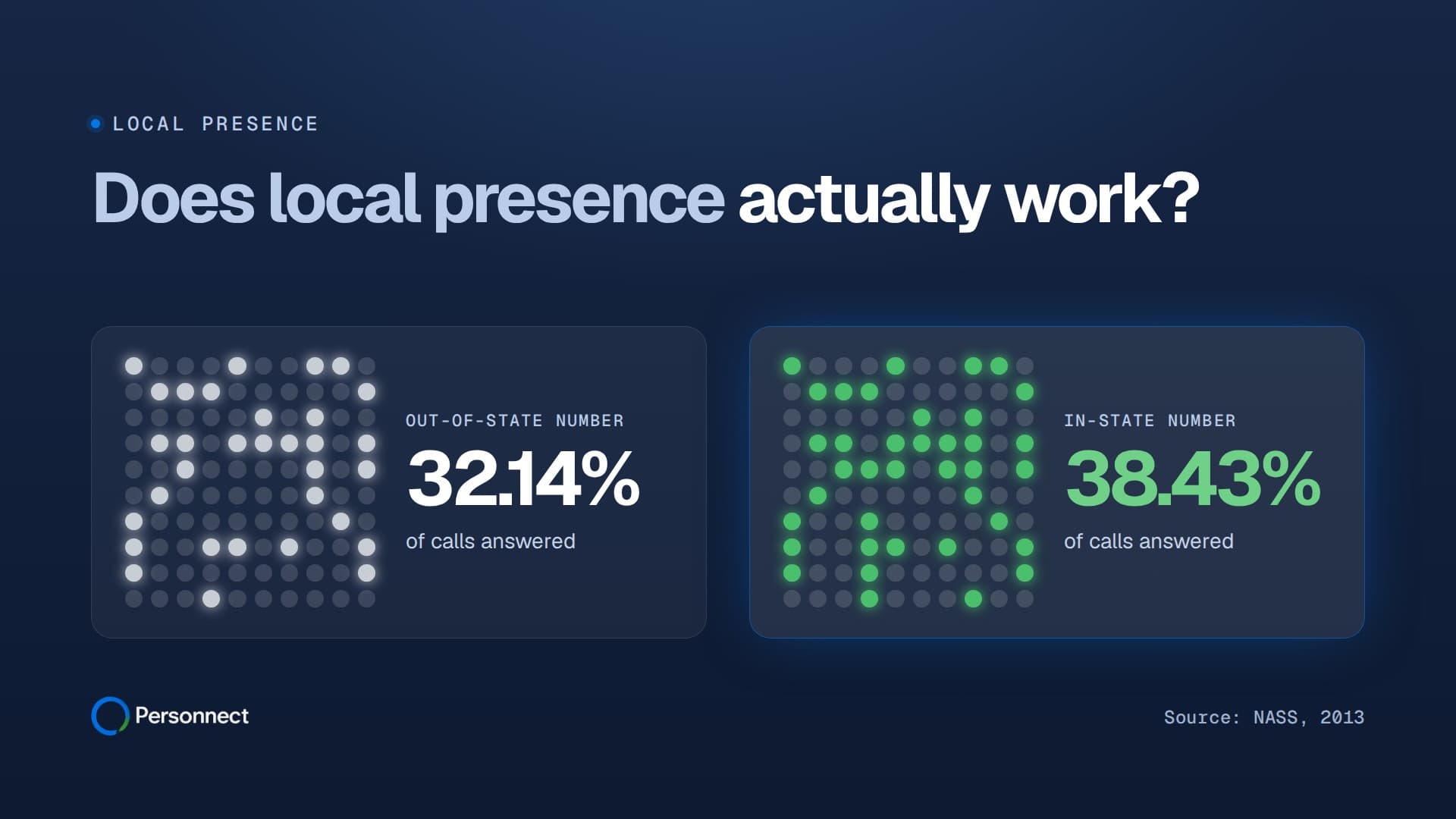
Yes, local presence dialing works, and for teams that call people who screen their phones, it's one of the strongest advantages available. In a controlled test by the USDA's survey arm, calls placed from an in-state area code were answered 38.43% of the time, against 32.14% for calls from an out-of-state number (National Agricultural Statistics Service, AAPOR proceedings, 2013). The skeptics have a point too, though it's a narrower one than they think: prospects have learned to distrust a local number that leads nowhere, and they still answer one that belongs to a real business nearby.
Key Takeaways
- Local presence works: in a federal test, in-state area codes were answered about six points more often than out-of-state ones (NASS, 2013).
- A local number earns the call a look. It can't repair a wrong phone number, a stale list or a number that already carries a spam label.
- It works best with a real local number in the contact's area code, registered in your company's name, with callbacks that reach your team.
- It backfires when the number dead-ends on a callback, comes from the wrong region or keeps getting labeled.
- Judge it on what follows the pickup: matched versus unmatched answers, callbacks, wrong numbers and labeled numbers.
What Does the Research Say About Local Numbers and Pickups?
Local numbers get answered more often, and the best evidence comes from people who had every reason to measure it carefully. Researchers at the National Agricultural Statistics Service called 3,148 farm operators in Minnesota and Ohio, some from a Missouri number and some from an in-state one. Of 2,152 in-state attempts, 38.43% were answered; of 3,653 out-of-state attempts, 32.14% were (NASS, AAPOR proceedings, 2013).
That's a relative lift of roughly 20% in answered calls, from changing nothing but the number on the screen. The same study found that 26% of in-state calls led to a started interview, compared with 20% of out-of-state calls. Fewer of the in-state calls ended up on an answering machine.
Why the caller ID gets a vote
People really do read the screen before they decide. Among respondents with caller ID, 57% said they looked at it before answering the call (NASS, 2013). When the display swayed them, it swayed them toward home: 33% of those who recalled seeing an in-state number said it made them more willing to answer, against 14% of those who recalled the out-of-state number.
What a survey of farmers tells a sales team
A survey call and a sales call aren't the same thing, and nobody should read the 38% as a benchmark for cold calling. The useful part is the mechanism. Both groups got the same survey from the same call center, and the only change was the area code on the display. That's about as clean a look at the prospect's split-second decision as you'll find in public research.
Why Do People Screen Unknown Calls So Hard Now?
Because most of the unknown calls they get are junk. A Pew Research Center survey of 9,397 U.S. adults found that 68% get scam phone calls at least weekly, and 31% get them at least daily, including 21% who get several a day (Pew Research Center, 2025). Anyone fielding that many bad calls learns to ignore numbers they can't place.
Regulators hear about it constantly. The FCC received more than 125,000 unwanted call complaints in 2025 and calls stopping illegal robocalls its top consumer protection priority (FCC, 2026). For a prospect, the safe default is to let anything unfamiliar ring out and sort it out later, if at all.
What the prospect actually sees
Picture a VP of operations in Columbus with a phone face up on the desk. A call comes in from a 614 number. It could be a supplier across town, the accountant, a client's office or the building manager. That's enough to earn a glance and, often, a pickup. The same call from an area code three time zones away reads as a stranger, and strangers get screened.
A familiar area code doesn't persuade anyone of anything. It removes one obvious reason to ignore the call, which is a lot to ask of ten digits, and it's exactly what a cold call needs in the first second.
Are Prospects Wise to Local Numbers Now?
They're wise to fake ones. What prospects have learned to spot is the local-looking number that rings once, leaves no voicemail and goes nowhere when they call it back. A local number that belongs to a real company and gets answered on a callback is simply a nearby business line, and people still pick those up.
Buyers haven't stopped taking calls from sellers either. In RAIN Group Center for Sales Research's Top Performance in Sales Prospecting study, 82% of buyers said they accept meetings with sellers who reach out to them (RAIN Group). Phone reach is still worth fighting for, and the area code is one of the few things a rep controls before anyone says hello.
The "everyone sees through it" claim usually comes from teams whose numbers were burned, shared or untraceable. That's a problem with how the numbers were run, and it shows up in the red flags further down.
Think about how a wary prospect tests a number they half recognize. Some let it ring, then search the digits or call back to see who answers. A real local line that reaches a named company passes that test, and the next call from it gets picked up. A number that reaches nobody fails it, and the prospect remembers. Local presence holds up under scrutiny when there's something real behind the number.
What Can a Local Number Not Fix on Its Own?
A local number gets the call looked at; the rest of the outcome depends on the list, the number's reputation and the rep. The NASS researchers found exactly this. Using an in-state area code led to a small improvement in answered calls, yet it had no effect on the survey's overall response rate (NASS, 2013). The pickup is the start of the job.
A wrong or stale number reaches the wrong person, whatever the area code. A bad list wastes every dial, and data quality is a common weak spot: 76% of CRM users told Validity that less than half of their organization's CRM data is accurate and complete, and 37% reported losing revenue as a direct result of poor data quality (Validity, 2025). And a number already labeled as spam shows the warning, not the city.
The conversation still has to land as well. Gong puts the average cold-call success rate as low as 1.48% (Gong), and a local caller ID can't write a better opening line. Nobody, Personnect included, can guarantee that a number is never labeled. What a team can control is how its numbers are kept, and that's where local presence done well pays off.
| Local presence | Effect |
|---|---|
| Changes | More prospects look at and answer the call |
| Doesn't change | Wrong numbers, stale contacts, a weak opener |
| Can't undo | A spam label already on the number |
| Pair with | A current list and numbers kept in good standing |
What Makes Local Presence Work, and What Makes It Backfire?
It works when the number is real, local to the contact and traceable to your company, and it backfires when any of those breaks. The difference shows up on the prospect's screen, in what happens when they call back, and in whether the number builds a clean history over time.
Signs it's set up to work
- A real local number in the contact's own area code, so the display matches what they recognize.
- Numbers registered in your company's name, so each one has a named owner behind it.
- Callbacks that reach your team, so a prospect who returns the call gets a person.
- A list that is current, so the familiar number reaches the person you meant to call.
This is how Personnect handles it: each contact is called from a local number in their area code, and every number is registered in your company's name with Verizon, AT&T and T-Mobile. New numbers are eased in, calls are spread evenly, and flagged numbers are rested until they're clean.
Red flags that turn it against you
- A number that doesn't call back to anyone. A prospect who returns the call and hits silence, a dead line or an unrelated recording won't answer that number again.
- A random number from the wrong region. A Denver area code on a call to Boston buys nothing and can look like a trick.
- Numbers that keep getting labeled. Once "Spam Likely" sits on the display, the local area code stops helping. Why calls get marked as spam covers the usual causes.
Every one of these red flags shows up in a number's reputation, which is why the upkeep matters as much as the area code itself.
How Can Your Team Tell Whether Local Presence Is Paying Off?
Watch the signals that sit after the dial, not just the answer rate. A change in pickups is the first thing to check, and the NASS data suggests the gap between matched and unmatched area codes is real (NASS, 2013). The signals below tell you whether those extra pickups are turning into conversations with the right people.
- Matched versus unmatched answers. Compare calls where the caller ID matched the contact's area code with calls where it didn't, over the same list and weeks.
- Callbacks. Count how many prospects call back and whether someone picks up. A healthy setup gets callbacks, and every one should reach a rep.
- Wrong-person and dead-number rate. If this is high, the list is the bottleneck, and better caller ID won't move it.
- Labeled numbers. Track how many of your numbers carry a spam label. A rising count wipes out the local advantage.
- Conversations per rep hour. Extra pickups only matter if reps spend the time talking.
Give the comparison a few weeks before reading too much into it. Answer rates swing with the day of the week, the segment and the season, and a short sample can make either side look good. Keep the list, the reps and the calling hours as steady as you can while you watch, so the area code is the main thing that differs.
Two of these are easier to see on a parallel dialer. With Personnect a rep dials up to five lines at once, is connected the moment a person answers, and voicemail is detected and skipped. Unanswered calls still verify your contacts, so the wrong-number rate surfaces from normal calling rather than a separate cleanup project.
Calling at a sensible hour for the prospect matters too. A prospect local time tool helps keep a local area code from arriving at seven in the morning.
Where Local Presence Earns Its Keep
Local presence is a real, measurable edge at the one moment a cold call can't influence any other way: the second the prospect looks at the screen. Public research shows familiar area codes get answered more often, and prospects facing a daily flood of scam calls lean even harder on caller ID to decide. What decides whether the edge lasts is everything around the number. The number has to be local to the contact, registered to your company and answered when someone calls back, and the list behind it has to be current. Get those right and the area code earns more pickups week after week. Let them slip and the prospects who doubt local numbers are proven right. For the basics of how the approach works, see what local presence dialing is.
Frequently Asked Questions
Do local numbers increase answer rates on B2B cold calls?
Yes. Public tests show familiar area codes get answered more often, with one federal experiment recording 38.43% answered for in-state numbers against 32.14% for out-of-state ones (NASS, 2013). B2B results vary by list and market, so measure matched against unmatched calls on your own team.
Is local presence worth it for a small sales team?
Usually, because the cost is low next to the value of an extra conversation. Local numbers on Personnect start at $1 a month across 200+ US metro areas, so a small team can cover the area codes on its list without a large upfront spend. Then watch pickups, callbacks and wrong numbers for a few weeks.
What happens when a prospect calls a local number back?
It should reach someone on your team. A callback that hits a dead line teaches the prospect to ignore that number. On Personnect, callbacks always reach your team, so a returned call becomes a conversation instead of a lost lead.
Can a local number still get labeled as spam?
Yes. Any number can be labeled, and no provider can guarantee it won't happen. Registering numbers in your company's name, easing new ones in, spreading calls evenly and resting flagged numbers until they're clean keeps the risk down and protects the local advantage.
Sources
- National Agricultural Statistics Service, AAPOR proceedings ww2.amstat.org/meetings/proceedings/2013/data/assets/handouts/400257_500718.pdf
- Pew Research Center pewresearch.org/internet/2025/07/31/online-scams-and-attacks-in-america-today
- FCC docs.fcc.gov/public/attachments/DOC-419290A1.pdf
- RAIN Group rainsalestraining.com/hubfs/PDFs/The_5_Ws_of_Connecting_with_B2B_Buyers_Infographic.pdf
- Validity validity.com/resource-center/the-state-of-crm-data-management-in-2025
- Gong gong.io/blog/is-cold-calling-dead