Roughly 33% of all outbound calls get flagged as spam or scam every month (PhoneBurner, 2024). Your reps could be dialing the right people at the right time with the right message, and a third of those calls land on a screen that says "Spam Likely" before a single word is exchanged. That label is the invisible gatekeeper deciding whether your pipeline grows or quietly stalls.
Phone number reputation is the score carriers and call-analytics networks assign to your outbound numbers based on how people and automated filters react to your calls. It's the difference between your number showing up as a real business and showing up as something to avoid. And most sales teams don't even know they're losing.
Key Takeaways
- About 33% of outbound calls are flagged as spam or scam monthly, and 81% of businesses believe they've lost revenue because of it (PhoneBurner, 2024).
- Number reputation is shaped by call patterns, complaint rates, and answer behavior, not just by what you dial.
- A flagged number can drop answer rates fast, and the damage compounds across every rep using it.
- Monitoring reputation continuously beats reacting after the damage is done.
What Is Phone Number Reputation and Why Does It Decide Who Picks Up?
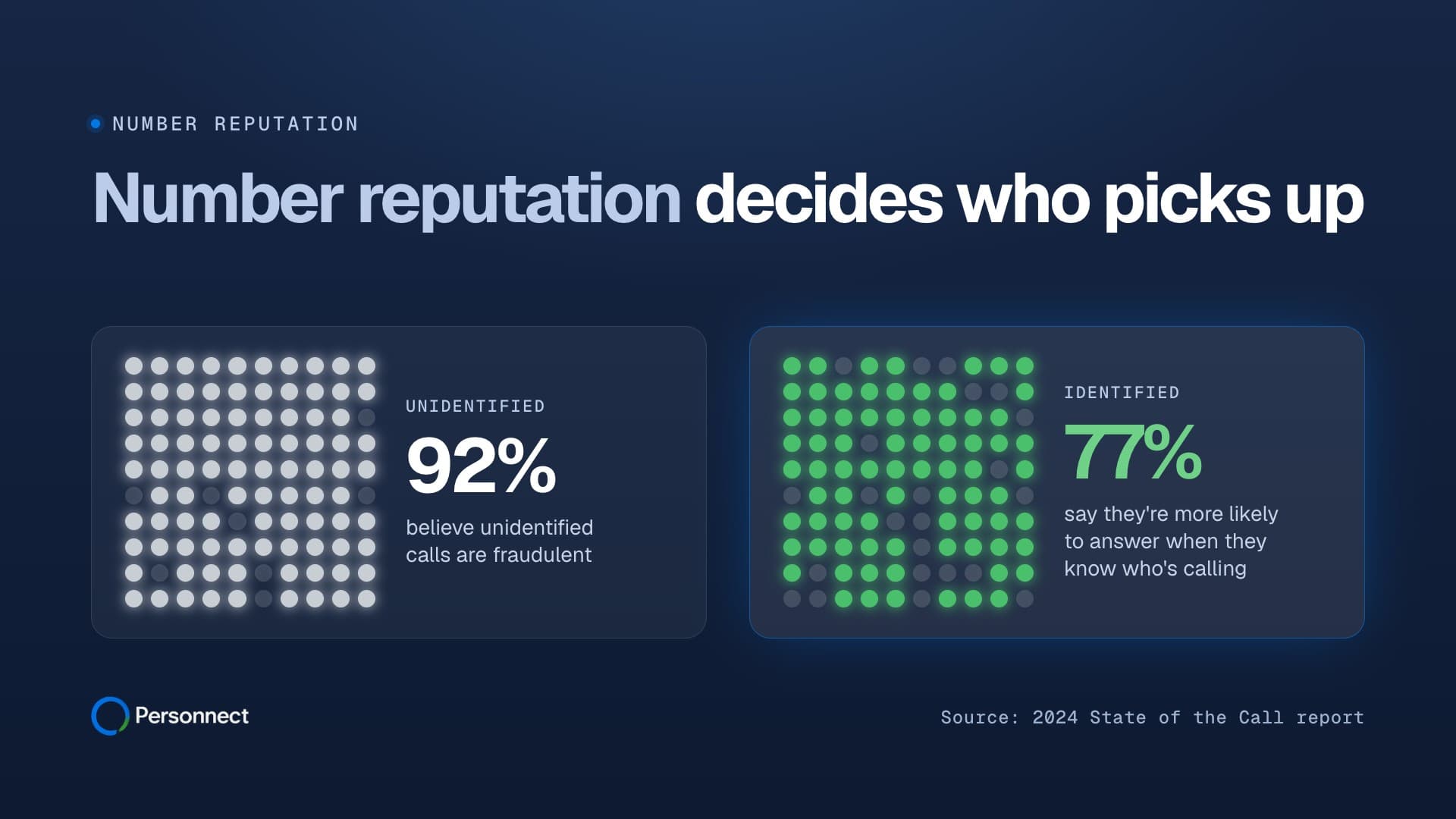
Phone number reputation is a trust score that carriers and third-party analytics networks attach to each outbound number, and it directly governs whether your call rings clean or arrives stamped "Spam Likely." It matters because 46% of unidentified calls go unanswered, while 77% of people say they're more likely to answer when they know who's calling (2024 State of the Call report, 2024).
Who actually assigns the score?
There's no single referee. Carriers run their own analytics, and several independent networks score calls across the ecosystem. They watch signals like how often a number dials, how many calls go unanswered, how long conversations last, and whether people report the number. The score updates constantly, and you rarely get a notification when it drops.
What does the prospect actually see?
A prospect glances at a ringing phone and decides in about two seconds. If the screen reads "Spam Likely" or "Scam Likely," that decision is made for them. Consider that 92% of consumers believe unidentified calls are fraudulent (2024 State of the Call report, 2024). A bad label confirms a suspicion they already hold.
Why does this hit B2B harder than people expect?
B2B reps assume business prospects are different. They aren't. The same screening apps and carrier filters that protect consumers run on the phones of VPs and founders. When 25% of business workers report that scammers have spoofed or hijacked their company numbers (2024 State of the Call report, 2024), trust in unknown business calls erodes for everyone.
How Much Does a Flagged Number Actually Cost Your Sales Team?
A flagged number costs far more than a few missed calls, because the loss compounds across every rep, every dial, and every deal that never starts. In one survey, 81% of businesses believed they had lost revenue due to incorrect spam flags, and 54% noticed their answer rates drop directly because of it (PhoneBurner, 2024).
The connect-rate math nobody runs
Start with benchmarks. Cognism puts generic, unverified lists at a 3 to 5% connect rate and phone-verified mobile numbers at 12 to 18% (Cognism, 2026). Now layer a spam flag on top of an already-thin connect rate. If your number is flagged, even your good data won't ring through, because the call never gets the chance to be answered. The label sits between your reps and the entire opportunity.
Why the cost hides in line items nobody owns
The damage doesn't show up as a single bill. It hides in lower conversation counts, longer ramp times, and pipeline that simply never forms. Gartner pegs the average cost of poor data quality at $12.9 million a year for organizations (Gartner, 2020). Reputation decay is a cousin of that problem: a quiet, ongoing tax that no one line item captures.
The morale tax on your reps
There's a second cost, and it's people. When 78% of businesses report at least one position affected by spam flagging (PhoneBurner, 2024), that's reps grinding through dials that can't connect, blaming their scripts, and burning out on a problem that was never theirs to fix. Nothing kills confidence faster than dialing into a wall.
What Causes a Phone Number to Get Flagged as Spam?
Numbers get flagged when their call behavior looks like the behavior of bad actors, regardless of intent, and the scoring networks can't read your good intentions. The scale of the problem is real: 28% of all unknown calls were spam or fraud in 2023, up from 24% the year before (2024 State of the Call report, 2024). Filters are tuned aggressively, and legitimate callers get swept up.
High volume from a single number
The fastest way to look like a robocaller is to dial like one. Blasting hundreds of calls a day from one number, with most going unanswered, is a textbook spam pattern. Analytics networks weigh that low answer-to-dial ratio heavily. The more your number behaves like a machine, the quicker the score tanks.
Complaints and short call durations
Every time someone declines, reports, or hangs up in the first second, that's a negative signal. A number with lots of two-second calls and no real conversations reads as junk. Pair that with even a handful of spam reports and the label can attach quickly. It only takes a small percentage of recipients to tip the scoring.
Spoofing, recycled numbers, and bad neighborhoods
Sometimes the number was poisoned before you ever touched it. Recycled numbers carry the baggage of their previous owner. Numbers issued from ranges with a history of abuse inherit suspicion. And spoofing campaigns that impersonate your business can drag your real numbers down too. You can dial perfectly and still inherit a bad reputation.
Stale data driving dead dials
Bad data quietly feeds the flag. Cleanlist puts annual B2B contact data decay at roughly 22.5% (Cleanlist, 2026), and about 18% of phone numbers change annually (Apollo, 2024). Dialing dead numbers means more unanswered calls, more disconnect tones, and a worse answer ratio, which is exactly the pattern that triggers a downgrade.
How Do You Protect and Monitor Your Number's Reputation?
You protect reputation by managing the signals you control and watching the score before it cracks, not after. This is becoming a standing discipline: one remediation network completed over 161,440 spam-label fixes in 2025 alone, a 44% jump year over year (Numeracle, 2026). Reputation isn't a set-it-and-forget-it problem. It needs ongoing attention.
Spread call volume across clean, dedicated numbers
A single number carrying all your volume is fragile. Distributing dials across a pool of numbers, each kept within healthy daily limits, keeps any one number from looking like a machine gun. The point is to make your calling pattern resemble a person making calls, not a system blasting them. Personnect builds on this idea: calls are spread evenly across numbers reserved for your company and registered in its name, so another team's behavior can't poison your reputation.
Watch your answer-to-dial ratio, not just dial count
Dial volume feels productive, but it's the wrong number to optimize. The signal that matters is your answer-to-dial ratio, because that's what the scoring networks watch too. A falling ratio is often the first sign a number is slipping. Personnect's approach leans on exactly this: a call nobody answers still verifies the contact, so a missed connect still teaches you something instead of just dragging your ratio down blind.
Verify before you dial to cut dead calls
Cleaning your data is reputation hygiene. The fewer disconnected and reassigned numbers you dial, the higher your answer ratio stays, and the healthier your reputation. With verified mobile data, connect rates run 18 to 22% versus 8 to 12% on generic lists (Cognism, 2026). Part of that cleaning happens as you dial, because on Personnect even unanswered calls verify your contacts. If you also want each lead's title, company and phone checked before anyone dials, that is lead enrichment, priced on its own at 15¢ a lead.
Monitor reputation continuously and remediate fast
Catching a flag early is everything. Many teams only discover a number is burned after weeks of dead dials. Regular checks against carrier and analytics data, plus a remediation path when a number does get flagged, turn a slow bleed into a quick fix. Treat it like uptime monitoring: you want the alert before customers notice, not after.
Is Spam Flagging a Compliance Problem or a Data Problem?
It's both, and treating it as only one is how teams stay stuck. Regulators are active: the FTC received 1.1 million robocall complaints in fiscal year 2024, with more than 253 million numbers on the Do Not Call Registry (FTC, 2024). Compliance keeps you legal, but clean data and call discipline keep you connecting.
Where compliance ends
Following calling-time rules, honoring opt-outs, and respecting the Do Not Call Registry are non-negotiable. But compliance is a floor, not a ceiling. You can be fully compliant and still get flagged, because the scoring networks don't check your legal paperwork. They watch behavior. A clean legal record won't lift a buried number.
Where data quality takes over
This is where most teams have room to improve. Stale lists drive dead dials, dead dials wreck your answer ratio, and a wrecked ratio invites a flag. Verification-first calling closes that loop. When you only dial numbers likely to be live, your behavior naturally looks legitimate, and your reputation stays intact.
Why the two have to work together
Compliance and data quality reinforce each other. Honoring opt-outs reduces complaints, which protects your score. Clean data reduces dead dials, which protects your ratio. Run them together and reputation becomes a byproduct of doing outbound the right way, rather than a fire you keep putting out.
Frequently Asked Questions
How do I know if my business number is already flagged as spam?
Watch your answer rate first: a sudden drop is the clearest early warning, and 54% of businesses noticed answer rates fall directly from spam flagging (PhoneBurner, 2024). You can also check your numbers against carrier and analytics lookups, and have reps confirm how the number displays on different devices.
Can a flagged number be fixed, or do I need a new one?
Often it can be fixed without abandoning the number. Remediation through carrier and analytics channels is now routine: one network logged 161,440-plus label fixes in 2025 (Numeracle, 2026). Fixing the underlying behavior matters most, though, since a fresh number repeats the same pattern will simply get flagged again.
Does calling volume alone get a number flagged?
Volume is a major factor, but it's really the combination of high volume with a low answer rate that triggers scoring. Generic lists connect at just 8 to 12% (Cognism, 2026), so high-volume dialing on weak data produces exactly the unanswered-call pattern that looks like spam to the networks watching.
How does contact verification help my number's reputation?
Verifying contacts means fewer dead and reassigned numbers in your dialing mix, which keeps your answer-to-dial ratio healthy, the single signal that most influences your score. With Personnect, unanswered calls still verify your contacts, so even a missed connect becomes data that protects your reputation rather than eroding it.
Is phone number reputation really a B2B problem?
Yes. The same screening apps and carrier filters that guard consumer phones run on the devices of the executives you're calling. With 92% of people viewing unidentified calls as fraudulent (2024 State of the Call report, 2024), a flagged number undercuts B2B outreach just as hard as it does consumer campaigns.
The Bottom Line on Number Reputation
Your phone number's reputation is doing quiet work on every dial, deciding whether a prospect even gives your rep a chance to speak. With about a third of outbound calls flagged monthly and most people refusing to answer unknown numbers, reputation has become the gatekeeper standing between your team and its pipeline. The good news is that the levers are in your hands. Spread volume across clean numbers, watch your answer-to-dial ratio instead of raw dial counts, verify contacts before you dial, and monitor reputation continuously so you catch a flag before it spreads. Teams like Personnect treat this as core infrastructure rather than an afterthought. Protect the asset that makes all your other outbound work possible, and the connects follow.
Sources
- PhoneBurner phoneburner.com/scam-likely-economic-impact-report
- Cognism cognism.com/blog/cold-calling-statistics
- Gartner gartner.com/en/data-analytics/topics/data-quality
- Cleanlist cleanlist.ai/blog/2026-01-22-b2b-data-decay-statistics
- Apollo apollo.io/insights/whats-the-average-rate-of-data-decay-in-a-b2b-contact-database-and-how-do-i-address-it
- Numeracle numeracle.com/case-study/2025-spam-labeling-remediation
- FTC ftc.gov/reports/national-do-not-call-registry-data-book-fiscal-year-2024