
What Are Spam Flags? Why 88% of Business Calls Never Get Answered
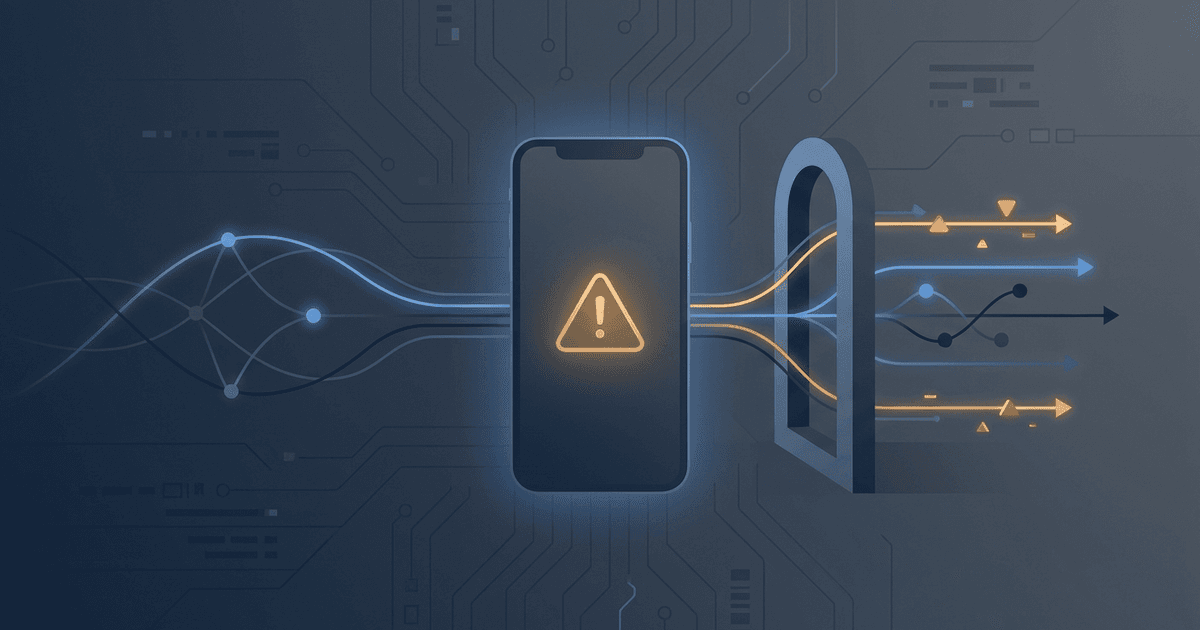
As many as 88% of enterprise calls go unanswered, a figure the FCC cited in its October 2025 rulemaking on caller identification (Federal Communications Commission, 2025). A spam flag is one of the reasons, and it's the one most sales teams never see. Your rep dials. The prospect's screen reads "Spam Likely" where your company name should be. That call was never really placed.
Key Takeaways
- A spam flag is a warning label added by the receiving network or a screening app, not a block, and callers are rarely notified.
- Numbers get labeled on behavior: volume spikes, low answer rates, very short calls, complaints.
- The FCC cites up to 88% of enterprise calls going unanswered (FCC, 2025).
- Blocking has a federal redress path. Labeling does not.
What Is a Spam Flag on a Business Phone Number?
A spam flag is a reputation verdict rendered on your number by whoever terminates the call, displayed to the recipient before they decide to pick up. The FTC notes that all major voice service providers now offer call-blocking and call-filtering products to their consumers (Federal Trade Commission, 2026). Screening is the default, not the exception.
A Label Is Not a Block
Blocking means the call never rings. Labeling means it rings with a warning attached. The second is far more common for legitimate business numbers, and far harder to detect, because your dialer logs the attempt as an ordinary unanswered call. It looks identical to a prospect who stepped away from their desk.
Why "Spam Likely" and "Scam Likely" Aren't the Same Verdict
Different networks use different vocabulary, and the words carry different weight. "Spam Likely" typically signals a high-volume commercial caller. "Scam Likely" implies suspected fraud and often triggers harsher treatment, including automatic diversion to voicemail. Neither is a legal finding. Both are probabilistic guesses produced by analytics reading call patterns.
The Flag Follows the Number, Not Your Company
This trips up teams that assume a good corporate reputation protects them. Reputation attaches to the ten digits in the caller ID field. Buy a recycled number a previous holder burned, and you inherit its history on day one. Your brand and your compliance record are invisible to the scoring system.
How Does a Legitimate Number Get Flagged?
Flags come from behavior, not intent. Analytics score patterns, and outbound sales produces patterns that resemble spam by construction: many dials, few answers, brief conversations. The FCC's own rules historically capped abandoned telemarketing calls at 3% and required callers to wait at least 15 seconds or four rings before disconnecting (Federal Communications Commission, 2025).
Volume Spikes and a Low Answer-to-Dial Ratio
The single strongest signal is calls placed versus calls answered. Belkins' analysis of more than 175,000 dials across 2025 found a per-dial connect rate of 9.9% (Belkins, 2026). That means a normal, well-run team is failing to connect on roughly nine of every ten attempts. Scoring systems see the same shape in a fraud campaign.
Short-Duration Calls
Duration is the second signal, and it's underrated. In that same dataset, calls that booked a meeting ran 3.7 minutes on average, calls ending in rejection were roughly four times shorter, and no-answer calls were about twelve times shorter. A number whose entire history is six-second events looks automated, because most automated traffic is.
Complaints From the People You Call
Recipients report calls, and those reports feed directly into scoring. The FTC received more than 2.6 million Do Not Call complaints in fiscal year 2025, an increase over the prior year, with consumers mostly reporting robocalls rather than live telemarketing (Federal Trade Commission, 2026). It takes very few complaints per thousand dials to move a number's score.
Stale Lists and Recycled Numbers
Bad data creates the exact pattern that gets you flagged. In the Belkins dataset, 13.5% of non-booking outcomes were data quality failures: wrong person, wrong number. Dialing disconnected lines and reassigned numbers manufactures unanswered attempts at scale, which is the primary input to a poor reputation score.
Who Decides That Your Number Is Spam?
No single authority does, and that's the structural problem. Scoring is spread across the networks delivering calls, the analytics partners they contract with, and screening apps on the recipient's phone. Each runs its own model. The FCC calls blocking "a serious and complicated action that must be precisely and judiciously applied to avoid blocking lawful traffic" (Federal Communications Commission, 2025).
Networks and Their Analytics Partners
Terminating providers rarely build scoring themselves. They buy or partner for it, then apply the resulting verdict to calls entering their network. Because each provider chooses its own partner and thresholds, one number can be clean on one network and labeled on another, at the same moment, for the same traffic.
Call-Screening Apps on the Recipient's Phone
A second, independent layer sits on the device. These apps aggregate user reports and apply their own labels regardless of what the network decided. This is why a number can pass every carrier-side check and still display a warning: the app on the prospect's handset made its own call.
Why Caller ID Authentication Doesn't Settle It
Teams often assume authenticated calls are exempt. They aren't. The FCC notes large providers use STIR/SHAKEN on 86% of traffic exchanged between them, yet many calls still arrive unauthenticated because parts of the network haven't moved to IP (Federal Communications Commission, 2025). Authentication proves your number isn't spoofed. It says nothing about whether people want your call.
The Ecosystem Is Getting Stricter, Not Looser
U.S. PIRG Education Fund found only 44% of 9,242 filing providers had fully installed the required authentication technology, down from 47%, while monthly scam and telemarketing volume rose from 2.14 billion to 2.56 billion calls (U.S. PIRG Education Fund, 2025). Analytics respond by getting more aggressive, and legitimate callers absorb the damage.
What Does a Spam Flag Actually Cost a Sales Team?
It costs you the top of the funnel, quietly. Only 19% of Americans say they generally answer their cellphone when an unknown number calls; 67% won't answer but will check voicemail, and 14% ignore both (Pew Research Center, 2020). A spam label pushes an already skeptical recipient further toward the second and third groups.
The Connect Rate Math
Start from a 9.9% per-dial connect rate. A flag that suppresses answers by even a third drops you to roughly 6.6%. Nothing in your process changed. Your reps didn't get worse. Your list didn't decay overnight. Your caller ID just stopped being neutral and started being a warning.
The Pipeline Math
Belkins puts end-to-end efficiency at roughly 370 dials per booked meeting (Belkins, 2026). Apply that same one-third suppression and the requirement climbs above 550. For a team of eight SDRs, that's the difference between hitting a monthly meeting target and missing it, with no diagnosable cause in the CRM.
The Rep Time Math
Salesforce's survey of 4,050 sales professionals found the average seller spends just 40% of their time selling, and 48% say they lack the bandwidth for adequate cold outreach (Salesforce, 2026). Flagged numbers spend that scarce capacity on dials that were pre-rejected before the phone rang.
How Do You Know If Your Numbers Are Flagged?
You usually don't, unless you go looking. There's no notification. The FCC's rules require terminating providers to publish a single point of contact for call blocking error complaints and to provide a status update within 24 hours (eCFR 47 CFR 64.1200, 2026), but nothing obligates anyone to tell you a label was applied.
Track Answer Rate Per Number, Not Per Team
Team-level connect rate hides everything. If two numbers out of thirty are labeled, the aggregate barely moves while those two produce almost nothing. Break the metric down to the individual number, compare each against your own baseline, and outliers surface within a week of normal dialing volume.
Use the Free Lookup Tools the Networks Publish
Major providers and several third-party labeling services publish free reputation lookups where you can check a number's current status and, in most cases, submit a correction request. Checking is manual and per-provider, so most teams either script it or delegate it. Personnect, for instance, runs health monitoring and cleaning on its numbers every few days.
Test on Real Handsets Across Multiple Networks
The only way to see the label your prospect sees is to look at a phone. Keep test devices on different networks, call them from each outbound number on a schedule, and photograph the screen. It's unglamorous, and it's the only ground truth available.
Watch the Shape of Your Call Durations
If a number's duration distribution collapses toward zero over a few weeks while your talk tracks and list stay constant, that's a signal. People are seeing something and hanging up faster, or calls are being diverted before ring. Either way, the number is warning you early.
How Do You Prevent Spam Flags in the First Place?
Prevention is far cheaper than remediation. It comes down to four habits: register your identity, spread volume sensibly, dial accurate data, and give recipients a reason to answer. The FCC reports 73% of consumers will answer if the caller's name is presented, rising to 76% with a logo and 78% when the call reason is included (Federal Communications Commission, 2025).
Register Your Numbers in Your Own Business Name
Unregistered numbers with no verifiable owner are the easiest for analytics to treat as suspicious. Registering each outbound number to the entity that actually uses it gives scoring systems something to attach trust to. Personnect registers every number in the customer's company name rather than assigning from a shared pool, a practical version of the same principle.
Spread Volume Across Enough Numbers, and Isolate Them
Concentration burns numbers. So does sharing them. If your numbers sit in a pool used by other companies, you inherit their behavior and complaints, and callbacks can reach the wrong team. Tenant-isolated pools solve both: your reputation reflects only your dialing, and returned calls land where they should.
Fix List Quality Before You Fix Anything Else
Every dial to a dead number is a deposit into a bad reputation score. Cleaning the list is a reputation control, not just a productivity one. This is why platforms like Personnect treat verification as part of the dial itself rather than a separate data-cleaning step, using what unanswered calls reveal about whether a record still reaches the right person.
Give People a Reason to Pick Up
Branded calling, where a verified business name and sometimes a logo or call reason appear on the handset, is scaling quickly. Juniper Research forecasts branded calling frameworks will verify more than 90 billion calls globally by 2030, up from fewer than 10 billion in 2025 (Juniper Research, 2025). Availability still varies by network and by country.
How Do You Get an Existing Flag Removed?
Slowly, and one provider at a time. Under FCC rules, a terminating provider that receives a credible claim of erroneous blocking and agrees the calls shouldn't have been blocked must promptly cease that treatment, and may not charge the caller for reporting or resolving the complaint (eCFR 47 CFR 64.1200, 2026). Labeling is a different story.
Remediation Is Per-Provider, Not Central
There is no master registry where a correction propagates everywhere. You file with each network and each labeling service separately, provide business documentation, and wait. Expect days, sometimes weeks. Expect to repeat the process if the underlying dialing behavior hasn't changed, because the score will simply rebuild.
The Redress Gap Is Real
Here's the part that catches revenue teams off guard: the FCC declined to extend formal redress requirements to erroneous labeling, encouraging providers and their analytics partners to work in good faith with callers instead. The enforceable remedy covers blocked calls. The far more common problem, a mislabeled call that still rings, sits outside it.
Rest the Number and Clean the Traffic Behind It
A flag lifted without a behavior change comes back. Pull the number from rotation, let its recent history age out, and return it to service against a verified list at moderate volume. Reputation scores respond to trailing behavior, so the fastest repair is a stretch of traffic that genuinely doesn't look like spam.
Frequently Asked Questions
Does a spam flag mean my calls are being blocked?
Usually not. Labeling and blocking are separate mechanisms. A labeled call still rings, just with a warning attached. That distinction matters legally: FCC rules give callers a redress path for erroneous blocking, including a required status update within 24 hours (eCFR 47 CFR 64.1200, 2026), but not for erroneous labeling.
How many dials per number per day is safe?
No published threshold exists, because each provider sets its own. The more useful control is your answer-to-dial ratio against a 9.9% per-dial baseline (Belkins, 2026). If a number sits well below your own average, it's carrying too much volume or too much bad data.
Will local presence dialing prevent spam flags?
No, and it can make things worse. Matching area codes doesn't change the behavioral signals that drive scoring, and spreading volume across many poorly managed local numbers multiplies the surface area. With only 19% of Americans generally answering unknown numbers (Pew Research Center, 2020), the area code isn't the deciding factor.
Can unanswered calls tell me anything useful about my numbers?
Yes. Personnect's approach is built on this: the company reports that 68% of missed calls still produce verified data, since voicemail and ring behavior reveal whether a number is live and whether it still belongs to the intended contact. That same signal doubles as an early warning when a number's answer rate collapses.
How long does it take a flagged number to recover?
Plan for weeks, not days. Formal correction requests are per-provider and vary in turnaround. Given monthly scam and telemarketing volume at 2.56 billion calls (U.S. PIRG Education Fund, 2025), analytics stay conservative, so scores rebuild only after a sustained stretch of clean, answered traffic.
Where Should You Start?
Start by measuring what you currently can't see. Break connect rate down to the individual number, keep a handful of test handsets on different networks, and photograph what your prospects actually see. Most teams discover the problem is concentrated in a few numbers rather than spread across the whole pool, which makes it fixable.
Then fix the inputs. Register numbers to your own entity, keep them out of shared pools, and stop dialing records you can't confirm. Those three habits address the behavioral signals that scoring systems read, which is the only lever you genuinely control. Remediation requests help, but they treat the symptom. With up to 88% of enterprise calls going unanswered already, a spam flag isn't a new problem for your pipeline. It's an existing one made measurably worse, and it's the part you can do something about.