Personnect is a parallel dialer, built to ring up to 5 prospects at the same time for every rep and hand the rep the call the moment someone answers. PhoneBurner describes its sales dialer as helping teams turn more dials into live conversations (PhoneBurner, 2026), and defines a power dialer as software that works through call lists by "placing calls one at a time and automating the manual work around each call" (PhoneBurner, 2026). Both chase the same outcome, and both need it: Cognism's 2024 research puts the median B2B cold-call connect rate at roughly 4.8%. The difference is where each one spends its effort. PhoneBurner's public pages put weight on the moments around a call, with Connect Scores before the dial and its own CRM for follow-up after it. Personnect puts more lines to work during the dial and checks the lead itself.
Key Takeaways
- Personnect rings up to five lines at once for every rep, detects and skips voicemail, and connects the rep the moment a person answers.
- PhoneBurner's power dialer places calls one at a time and puts its strengths around each call: Connect Scores before the dial, and its own CRM for follow-up by call, email and SMS.
- Before the dial they check different things. PhoneBurner scores the number; Michael, the assistant built into Personnect, checks the person behind it, for 15¢ a lead.
- PhoneBurner prices per user per month. Personnect charges 8.5¢ per minute on answered calls, with no seat fees, no platform fee and unlimited users.
- Personnect is built for teams whose reps live on the phone: more live conversations per rep-hour, unanswered calls that still verify your contacts, and a bill that counts only answered minutes.
So the useful question is not which tool is faster in the abstract. It is where your team actually loses conversations: on bad numbers before the dial, on rings and voicemail during it, or on follow-up and stale records after it. This guide walks through those three stages in order and sticks to PhoneBurner's own public pages for every claim about PhoneBurner.
Where Does Each Dialer Put Its Effort?
PhoneBurner pitches itself to sales teams with the line "Making good sales teams unstoppable" (PhoneBurner, 2026), and says its Power Dialer multiplies calls and live connections. Reps can run it in two modes, "pause & preview" for pre-call prep or "power" mode to keep moving (PhoneBurner, 2026). Around that dialer sit two pieces worth knowing about: Connect Scores, which rate numbers before the dial (PhoneBurner, 2026), and PhoneBurner's own CRM, which helps agents manage contacts and follow up via calls, emails and SMS (PhoneBurner, 2026).
Personnect makes a narrower bet. It is a parallel dialer for B2B outbound sales teams: each rep has up to five lines ringing at once, voicemail is detected and skipped, and the rep is connected the moment a person picks up. Before anyone dials, Michael, the assistant built into Personnect, can enrich each lead for 15¢. After every call, the summary, transcript and outcome are logged and synced to HubSpot or Salesforce, and teams without a CRM can upload a list and use Personnect as their outbound CRM.
Put simply, PhoneBurner invests in the moments around each conversation, and Personnect invests in how many dials end with a person on the line. The next three sections follow one call from the list to the follow-up.
Before the Dial: Scoring the Number or Checking the Lead?
PhoneBurner's tool for this stage is Connect Scores, which use real-world carrier signals to score numbers in real time (PhoneBurner, 2026). PhoneBurner says the point is to help reps "prioritize calls that are more likely to result in a live conversation" (PhoneBurner, 2026), and it is one of PhoneBurner's more distinctive features.
Personnect checks something else: the person behind the number. Michael checks each lead's title, company and phone number, and every lead comes back enriched, stale or retired, at 15¢ a lead. That matters because B2B contact data decays at around 22.5% a year (Cognism, 2024). People change jobs, companies reorganize, and a working phone line says nothing about whether the right person still answers it.
The two checks answer different questions. A number score asks whether a line is worth dialing. A lead check asks whether the person you think you are calling is still the person behind it. On older or purchased lists, people have often moved on since the record was made, and that is the gap a lead check is meant to catch.
During the Dial: How Many Phones Ring for Each Rep?
This is the stage Personnect is built for. Roughly 80% of cold calls end up in voicemail (Cognism, 2024), so a rep who dials one number at a time spends a large part of every hour on rings and greetings. Personnect rings up to five lines per rep at once, detects and skips voicemail, and puts the rep on the call the moment a person answers. A rep can place around 500 dials a day this way, and the hour goes to conversations because more lines are working on their behalf.
PhoneBurner says its Power Dialer multiplies calls and live connections (PhoneBurner, 2026), and its own comparison table lists the number of lines as single-line (PhoneBurner, 2026). That is the core difference in this comparison: one line at a time per rep on PhoneBurner, up to five at once on Personnect.
One thing to listen for with any parallel dialer, Personnect included, is a short pause between the prospect's hello and the rep coming on the line. PhoneBurner builds its pitch on avoiding it: "PhoneBurner connections are 100% delay free" (PhoneBurner, 2026). That is the trade in this post's title: PhoneBurner keeps one line per rep to avoid the pause, while Personnect puts five lines to work so reps reach more people in the same hour. A pilot on a slice of your own list shows quickly whether your reps notice the pause.
After the Dial: Follow-Up Workflow or a Cleaner List?
This is where PhoneBurner puts much of its weight. Its own CRM helps agents manage contacts and follow up via calls, emails and SMS (PhoneBurner, 2026). It integrates with Salesforce, HubSpot, Zoho, Zoom and Zapier, and PhoneBurner says it can integrate with virtually any CRM (PhoneBurner, 2026).
Personnect's after-call work is the record itself. The summary, transcript and outcome of every call are logged and synced to the CRM, and recordings are kept for a year. HubSpot and Salesforce connect through native two-way integrations, and any other CRM can exchange records through CSV import and export, with a direct integration added on request. The bigger difference shows up on the calls nobody picks up: unanswered calls still verify your contacts, so even a run of no-answers leaves the list in better shape than it started.
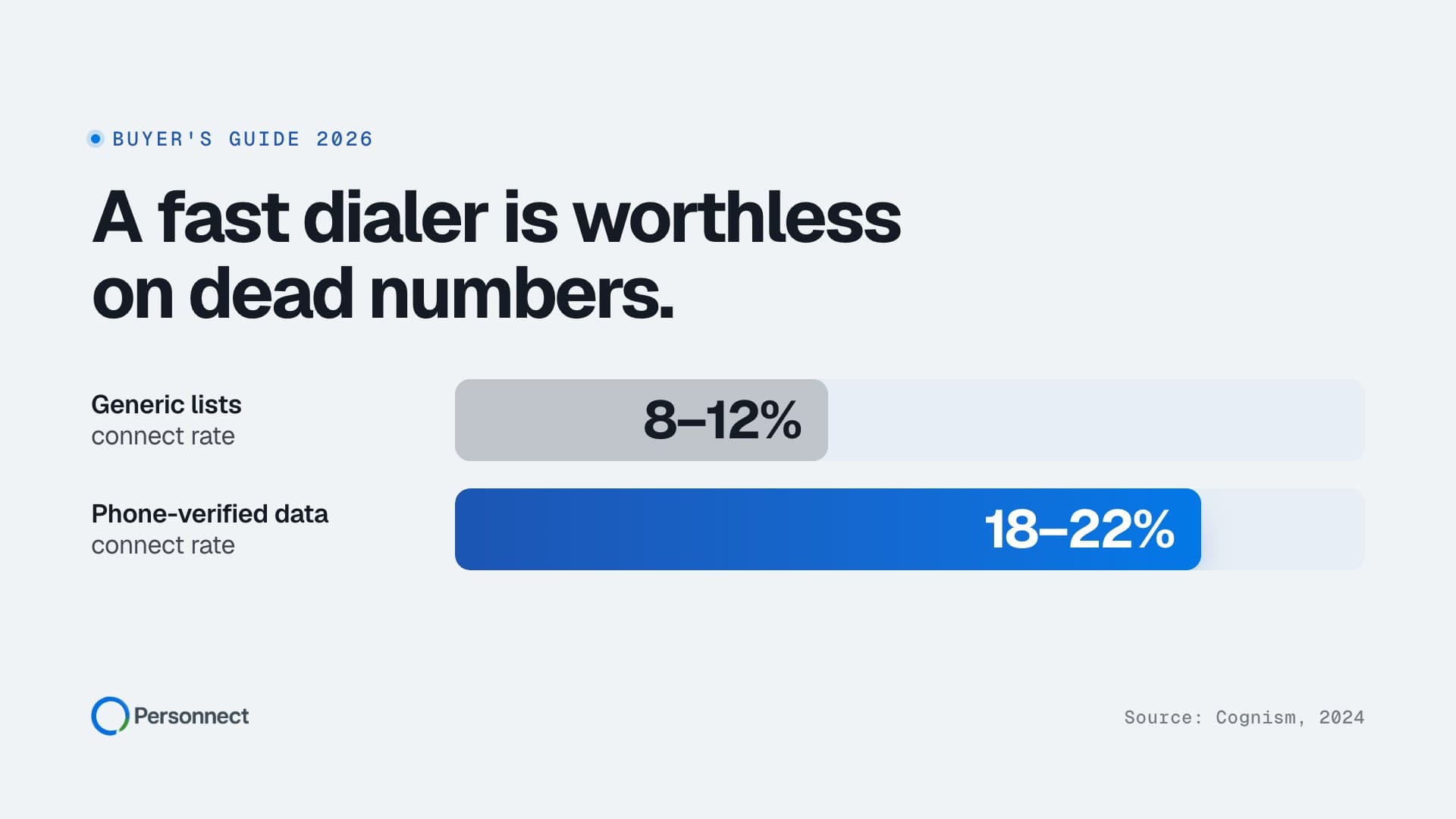
Cognism's 2024 figures show why that matters: generic, unverified lists connect at about 8 to 12%, against roughly 18 to 22% for phone-verified data.
How Do You Keep a Dialing Number From Being Labeled Spam?
Every outbound team carries this risk. Cognism's 2024 research finds about one in three outbound numbers flagged as spam each month, and a "Spam Likely" label can cut answer rates by as much as 80%. A spotless list is worth little when the call gets screened before anyone sees it.
Reputation sits under every stage of the call. Calls go out from a number in the prospect's own area code, with coverage across 200-plus US metro areas, and every number is registered in your company's name with Verizon, AT&T and T-Mobile. Personnect eases a new number in instead of putting it straight to full use, keeps the calling load even across your numbers, and gives a flagged number a rest. Those are habits, not a promise: no one can guarantee a number is never labeled.
Number reputation is a fair topic for a PhoneBurner demo as well: how its outbound numbers are registered, brought into service and handled after a flag.
Per-User Plans or Paying Only for Answered Minutes?
PhoneBurner prices its plans per user per month (PhoneBurner, 2026), so the bill follows headcount. Its power dialer comes "with no contracts or setup fees" (PhoneBurner, 2026), and its trial gives free minutes to test-drive the dialer (PhoneBurner, 2026).
Personnect has no per-user price at all. It bills 8.5¢ for each minute of an answered call; rings nobody picks up, busy signals and failed calls are not charged, and local numbers start at $1 a month. Without a seat or platform fee, any number of users can share the account, and the usage plan carries no contract or minimum term.
That model favors teams whose calling is uneven: part-time callers, founders who dial between meetings, headcount that shifts with the quarter. On a per-user plan, a seat that dials two days a week is still a seat. On Personnect it costs only its answered minutes, and a rep who dials all day is billed the same way: for the minutes that reached a person.
PhoneBurner vs Personnect at a Glance
| Dimension | PhoneBurner | Personnect |
|---|---|---|
| What it is | A sales dialer that helps teams turn more dials into live conversations (source) | A parallel dialer for B2B outbound sales teams |
| Lines ringing per rep | Single-line, placing calls one at a time (source) | Up to five at once, around 500 dials a day per rep |
| Before the dial | Connect Scores, so reps can prioritize calls likely to reach a live conversation (source) | Michael checks the lead and returns it enriched, stale or retired (15¢ a lead) |
| Voicemail | Ask PhoneBurner | Detected and skipped |
| After the call | Its own CRM for follow-up by call, email and SMS (source) | Summary, transcript and outcome logged and synced to the CRM |
| Unanswered calls | Ask PhoneBurner | Still verify your contacts |
| CRM integrations | Salesforce, HubSpot, Zoho, Zoom, Zapier and, it says, virtually any CRM (source) | HubSpot and Salesforce, native and two-way; any other CRM through CSV import and export, or a direct integration on request; no CRM needed |
| Caller ID | Ask PhoneBurner | Local numbers registered in your company's name with Verizon, AT&T and T-Mobile |
| Pricing model | Per user per month (source) | 8.5¢ per minute on answered calls; no seat fees, no platform fee |
| Users | Priced per user | Unlimited |
| Getting started | Trial with free minutes to test-drive the dialer (source); no contracts or setup fees (source) | No contract and no minimum term on the usage plan |
Questions Teams Ask Before Choosing PhoneBurner or Personnect
How does PhoneBurner's Power Dialer compare with Personnect's five lines?
They work differently. PhoneBurner's power dialer places calls one at a time, and its own comparison table lists it as single-line, with two modes, "pause & preview" and "power" (PhoneBurner, 2026). Each Personnect rep gets up to five lines ringing together; voicemail is skipped, and the rep is put through as soon as a person answers. Watch both on the same slice of your list to see which suits your team.
Are Connect Scores the same thing as verifying contacts?
No, they check different things. Connect Scores rate the number, using carrier signals (PhoneBurner, 2026). Personnect checks the lead: for 15¢ a lead, Michael returns each one enriched, stale or retired. Separately, unanswered calls still verify your contacts as part of calling.
Do I need a CRM to use either one?
Not necessarily. PhoneBurner has its own CRM that helps agents manage contacts and follow up via calls, emails and SMS (PhoneBurner, 2026). With Personnect you can upload a list and use it as your outbound CRM, or connect HubSpot or Salesforce through native two-way integrations.
Which CRMs does each one connect to?
PhoneBurner integrates with Salesforce, HubSpot, Zoho, Zoom and Zapier, and says it can integrate with virtually any CRM (PhoneBurner, 2026). Personnect connects to HubSpot and Salesforce through native two-way integrations. On a different CRM, you move records by CSV import and export, or ask for a direct integration.
How do the bills compare for a team with part-time callers?
PhoneBurner prices per user per month (PhoneBurner, 2026), so the plan cost follows the number of users. Personnect has no seat fees and unlimited users; it charges 8.5¢ a minute on answered calls, and calls that ring out, are busy or fail cost nothing. Uneven calling usually favors the second model.
What Personnect Brings to Each Stage of a Call
Walk one call through the three stages again and Personnect's case comes down to three steps:
- Before the dial, Michael returns each lead enriched, stale or retired for 15¢, before anyone spends a dial on it.
- During the dial, up to five lines ring for each rep, voicemail is skipped, and a live answer goes straight to the rep.
- After the dial, the summary, transcript and outcome land in HubSpot or Salesforce, or in Personnect as your outbound CRM, and even the calls nobody answered leave your contacts verified.
If your reps already have a clean list and a follow-up routine, the middle step is where Personnect changes the day most: five lines ringing where one rang before.
Sources
- PhoneBurner phoneburner.com
- PhoneBurner phoneburner.com/power-dialer
- PhoneBurner phoneburner.com/pricing