Local presence dialing is one of the most widely adopted tactics in outbound sales. The premise is simple: show prospects a phone number from their area code, and they are more likely to pick up. Research from Software Advice found that prospects are 4x more likely to answer a call from a local number compared to a toll-free or out-of-state number. With numbers like that, it is no surprise that nearly every sales dialer now offers some version of local presence.
But here is the problem. Most sales teams treat local presence dialing as a checkbox feature, something they turn on and forget about. They assume the area code match alone will carry them to higher connect rates. It will not. The teams that actually see sustained improvement from local presence are the ones who understand the mechanics behind it: number health, registration, rotation, and what happens after the call connects (or doesn't).
At Personnect, we see this pattern constantly. Teams switch on local presence, see a brief lift in answer rates, and then watch those numbers decline within weeks. The issue is almost never the strategy itself. It is the execution.
Key Takeaways
- Local presence works as a system, not a setting: dedicated numbers, proper registration, full coverage, careful rotation and value from unanswered calls.
- A shared number pool is a shared reputation, and you cannot control who else is dialing from your numbers.
- Numbers that are not registered with your business name are far more likely to get caught in carrier spam filters, local area code or not.
- Covering only the big metros misses prospects in mid-size markets; the United States has over 300 area codes.
- An unanswered call still tells you whether the number is active and whether the person still holds the role on file.
The Shared Number Pool Trap
The most common mistake in local presence dialing is using shared number pools. Most dialers maintain a bank of phone numbers that rotate across all their customers. Your team dials from a (312) number. So does another company's team. And another. And another.
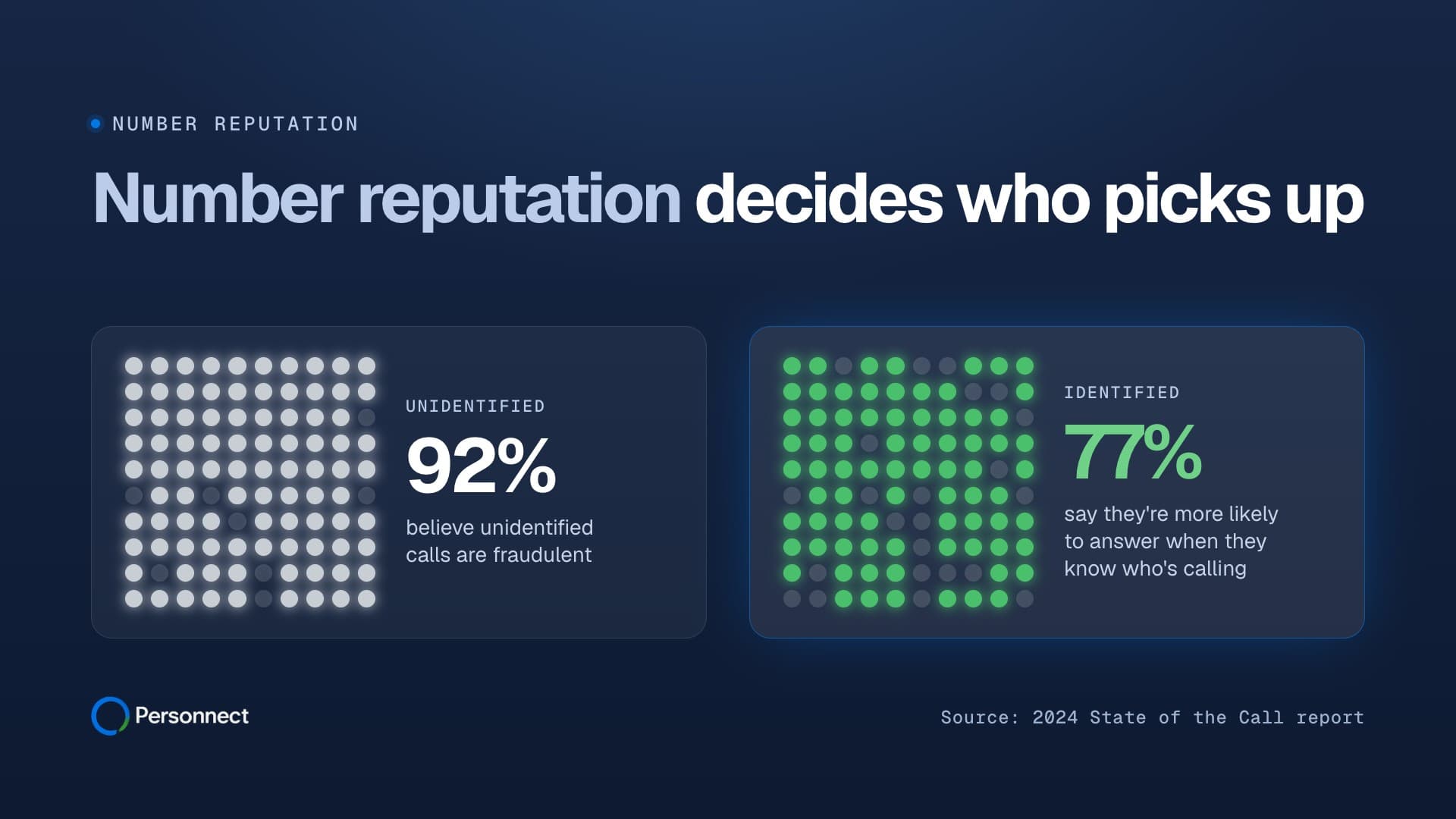
When dozens of organizations blast calls from the same numbers, those numbers accumulate spam complaints fast. According to Hiya's 2024 State of the Call report, 92% of unidentified calls from unknown numbers go unanswered. Carriers like AT&T, T-Mobile, and Verizon use analytics engines (STIR/SHAKEN, Hiya, TNS) to flag numbers based on call volume and complaint patterns. A shared pool is essentially a shared reputation, and reputation degrades quickly when you cannot control who else is dialing from your numbers.
This is exactly why Personnect gives every company numbers of its own, registered in its name with Verizon, AT&T and T-Mobile. No sharing. No crossed wires. Callbacks from prospects always reach your team, not someone else's sales floor. It is a fundamentally different approach than what most dialers offer, and it directly impacts whether local presence actually works for you.
Number Registration and Spam Labeling: The Silent Killer
Even teams that use dedicated numbers often skip a critical step: registering those numbers properly. Carriers increasingly rely on caller ID databases and CNAM records to determine what shows up on a prospect's screen. An unregistered number displays as "Unknown Caller" or, worse, "Spam Likely."
The FCC reported that Americans received roughly 50 billion robocalls in 2023. Carriers responded by tightening spam filters aggressively. If your outbound numbers are not registered with your business name, they are far more likely to be caught in these filters regardless of whether you are calling from a local area code.
Proper registration means your company name appears on caller ID. It signals legitimacy. Combined with local presence, it gives prospects two reasons to answer: the number looks local, and the caller ID shows a real business name.
Personnect handles this automatically. Every number provisioned through the platform is registered in your company's name. New numbers are eased in, calls are spread evenly across them, and a number that gets flagged is rested until it's clean instead of dragging down your connect rate. Most teams do not have the operational bandwidth to manage this manually across 200+ metro areas, which is exactly the scale needed for true national local presence coverage.
What Happens When They Don't Pick Up
Here is where most local presence strategies completely fall apart. A rep dials 80 prospects in a day. Maybe 8 to 12 pick up. The other 68 to 72 calls? Logged as "no answer" and forgotten.
According to Salesforce's State of Sales report, sales reps spend only 28% of their time actually selling. The rest goes to administrative work, data entry, and, critically, chasing contacts who may no longer be at the number on file. When 80% of your outbound calls hit voicemail, treating those dials as zero-value events is a massive waste.
This is a blind spot that local presence dialing alone cannot solve. Getting more people to answer is only half the equation. The other half is extracting value from the calls that go unanswered.
Personnect approaches this differently. Even when they don't pick up, every call generates verified data. The platform's AI analyzes voicemails to confirm whether you have reached the right person, whether the number is still active, and whether the contact's role matches your records. That means a significant portion of "missed" calls still produce actionable intelligence. Your CRM gets updated automatically. No manual logging. No guesswork about whether a number is still good.
Local presence gets more people to answer. But building a system where even unanswered calls produce value is what separates a dialing strategy from a data strategy.
Coverage Gaps Most Teams Never Notice
Another common mistake is assuming local presence means having numbers in the major metros: New York, Los Angeles, Chicago, Dallas. That covers maybe 15 to 20 area codes. The United States has over 300 area codes, and many of them serve mid-size markets where your prospects absolutely live and work.
If your prospect list skews toward manufacturing, healthcare, or financial services, a significant portion of your contacts sit outside major metros. Calling a prospect in Omaha from a (212) New York number defeats the entire purpose of local presence dialing. Yet teams do this constantly because their dialer only provisions numbers in high-volume areas.
True local presence means matching every prospect's area code, not just the top 20. If your dialer cannot support 200+ metro areas with dedicated, registered numbers, you are leaving connect rate on the table.
Rotation Strategy: Why Frequency Matters
The final mistake is dialing too aggressively from the same numbers. Even with dedicated, registered numbers in the right area codes, high call volume from a single number will trigger carrier analytics. The typical threshold varies by carrier, but industry guidance suggests keeping individual number usage below 100 calls per day to avoid flags.
Smart rotation means distributing calls across your number pool so that no single number bears too much volume. It also means monitoring answer rates at the number level, not just the campaign level. A number that suddenly drops from a 12% connect rate to 4% has likely been flagged, and continuing to dial from it wastes every subsequent attempt.
This is an operational burden that compounds as your team grows. A 10-rep team calling into 50 area codes might need 500+ numbers to maintain healthy rotation. Managing that manually, tracking health, swapping flagged numbers, maintaining registrations, is a full-time job.
Automated number health management solves this. The best systems monitor each number's performance, rotate proactively, and clean the pool on a regular cycle. The goal is simple: every time your rep dials, the number that appears on the prospect's phone is healthy, registered, local, and likely to be answered.
Putting It All Together
Local presence dialing works. The data is clear on that. But the teams that see lasting results are the ones that treat it as a system, not a setting. That system includes:
- Dedicated numbers that are not shared with other organizations
- Proper registration so your company name shows on caller ID
- Full geographic coverage across all the markets where your prospects live
- Intelligent rotation to keep every number healthy and unflagged
- Value extraction from unanswered calls so nothing goes to waste
Most dialers give you the first piece and call it local presence. The lasting difference lives in the other four.
Frequently Asked Questions
Does local presence dialing actually increase answer rates?
Yes. Research from Software Advice shows prospects are roughly 4x more likely to answer a call from a local area code compared to an out-of-state or toll-free number. However, the lift depends heavily on number health and registration. A local number flagged as spam performs worse than a clean out-of-state number.
How many local numbers does my team need?
It depends on your call volume and geographic spread. A general rule is to have enough numbers in each area code to keep per-number daily call volume below 100. For a team of 10 reps calling nationally, that can mean 500+ numbers across 200+ area codes.
What is the difference between shared and dedicated number pools?
Shared pools rotate the same numbers across multiple companies. This means you inherit spam risk from other users and cannot control callbacks. Dedicated pools give your organization exclusive use of its numbers; Personnect registers every number in your own company's name. Callbacks always reach your team, and your reputation is entirely in your own hands.
How do I know if my numbers have been flagged as spam?
Look for sudden drops in answer rate on specific numbers. You can also use free number-reputation lookup tools or paid services to check your numbers against carrier databases. Better yet, use a dialer that monitors number health automatically and rotates flagged numbers out of your pool before they impact performance.
Can unanswered calls still provide value?
Absolutely. When a call goes to voicemail, the voicemail itself contains information: whether the greeting matches your contact, whether the number is active, whether the person still holds the role you have on file. Platforms that analyze voicemails automatically can verify contacts on every call, so a "no answer" still tells you something about the record.