Most B2B deals are not lost to competitors. They are lost to silence. A prospect expresses interest, your rep logs the call, and then nothing happens. The follow-up never goes out. The opportunity quietly dies in your CRM, marked as "no response" three months later.
Sales follow up statistics paint a clear picture of this problem. Research consistently shows that the majority of closed deals require multiple touches, yet most sales reps stop after just one or two attempts. The gap between what the data recommends and what teams actually do is where revenue goes to disappear.
This article examines the research behind follow-up failure, quantifies the financial impact, and outlines what high-performing teams do differently. The numbers are uncomfortable. They should be.
Key Takeaways
- 80% of sales require at least five follow-up contacts, but 44% of reps give up after one attempt (Marketing Donut / Brevet Group)
- The odds of qualifying a lead drop 21x if you wait 30 minutes versus 5 minutes to respond (InsideSales/Drift)
- Companies that follow up within five minutes are 100x more likely to connect with a prospect (LeadResponseManagement.org)
- 35-50% of sales go to the vendor that responds first (InsideSales.com)
- Consistent follow-up cadences can increase conversion rates by 70% compared to single-touch outreach (Velocify)
44% of Reps Quit After One Follow-Up
According to research from the Brevet Group, 80% of sales require five or more follow-up contacts after the initial meeting. Yet a study by Marketing Donut found that 44% of salespeople give up after just one follow-up attempt. Another 22% stop after two. Only 8% of reps make it to the fifth touch.
Think about what this means in practice. Nearly half your team abandons a prospect after a single unreturned email or voicemail. Meanwhile, the data says the real conversion window does not even open until the fifth contact. Your reps are leaving the field before the game starts.
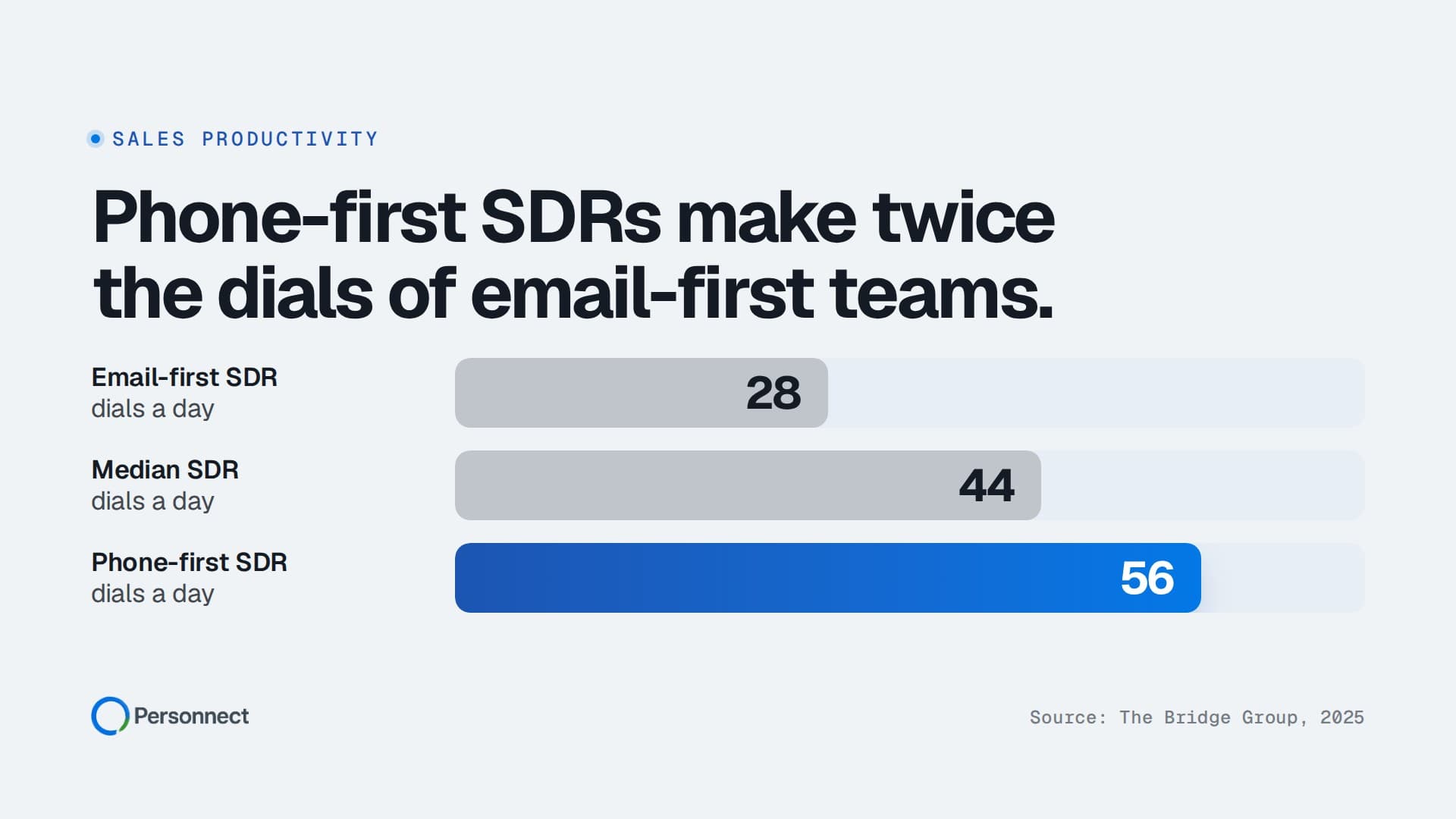
This is not a motivation problem. It is a systems problem. Reps abandon follow-ups because their tools do not remind them, their CRM does not surface the right contacts at the right time, and their managers measure dials per day instead of follow-through per opportunity.
The fix starts with visibility. When every call outcome, including unanswered ones, automatically updates the contact record with disposition data and next-step recommendations, reps do not have to remember who to call back. Platforms like Personnect push AI-generated action items and call dispositions directly to the CRM after every dial. That means the follow-up task creates itself. The rep just has to execute it.
Speed to Lead: The Five-Minute Window
A landmark study by Dr. James Oldroyd at MIT, conducted in partnership with InsideSales.com, found that the odds of qualifying a lead decrease by 21x if the first response takes 30 minutes instead of five. Responding within five minutes makes you 100x more likely to actually connect with that prospect compared to waiting 30 minutes (LeadResponseManagement.org).
Speed matters because buyer attention is finite. When a prospect fills out a form, downloads a whitepaper, or responds to an outbound sequence, they are actively thinking about the problem you solve. Five minutes later, they are still in that headspace. Thirty minutes later, they have moved on to three other priorities. By the next day, you are a vague memory.
The data from Drift's 2021 State of Conversational Sales report reinforces this finding. Their analysis of over 2,500 B2B companies found that the average response time to a new lead was 42 hours. Only 7% of companies responded within five minutes. The gap between best practice and common practice is enormous.
For outbound teams, this translates directly to callback timing. When a prospect returns your call or replies to a voicemail, the clock starts immediately. A power dialer that connects reps to five prospects simultaneously, like the one Personnect offers, reduces idle time between conversations and keeps callback response windows tight. But the dialer is only half the equation. The other half is having accurate contact data so the callback actually reaches the right person.
35-50% of Sales Go to the First Responder
InsideSales.com research found that 35-50% of sales go to the vendor that responds first. This statistic alone should reshape how sales leaders think about follow-up. You are not just competing on product, price, or pitch quality. You are competing on who picks up the phone fastest.
In B2B sales, where buying committees involve three to seven stakeholders and sales cycles stretch across months, the first vendor to engage a prospect sets the frame for the entire evaluation. They define the criteria. They shape the conversation. Every subsequent vendor is responding to a framework someone else built.
First-mover advantage in sales is not about being pushy. It is about being present. The team that responds first demonstrates responsiveness, which buyers interpret as a proxy for how the vendor will treat them post-sale. If you are slow to follow up before you have their money, how will you support them after?
This creates a compounding problem for teams with poor data quality. If your reps spend 30 minutes researching whether a phone number is still valid before calling back, they have already lost the speed advantage. Verification that happens automatically, as part of the dialing workflow rather than before it, eliminates that delay. This is why Personnect's approach of verifying contacts on every call matters beyond just data hygiene. It keeps the follow-up path clear so reps can act fast when timing counts.
The Average Sales Cadence Is Too Short
Research from TOPO (now part of Gartner) found that the most effective outbound cadences include 12-15 touches over two to three weeks, combining calls, emails, and social touches. Yet Velocify's research shows that most reps use cadences of three to five touches, often spread over just a few days.
The result is predictable. Reps burn through their list quickly, mark unresponsive contacts as dead, and move on. The contacts who would have converted on touch seven, nine, or twelve never get the chance.
Cadence length matters because B2B buyers are busy. They are not ignoring your outreach out of disinterest. They are in meetings, traveling, managing their own priorities. A well-timed touch on a Tuesday afternoon might land perfectly when the same message on Monday morning got buried.
The operational challenge is keeping those longer cadences manageable. When reps manually track follow-up sequences across hundreds of contacts, things fall through the cracks. Automated CRM workflows help, but only if the data feeding them is accurate. A follow-up reminder for a contact whose phone number changed two months ago is not a follow-up. It is a dead end.
This is where the connection between data quality and follow-up execution becomes clear. Teams that maintain clean, continuously verified contact records can run longer cadences without the waste. Every touch in the sequence reaches the right person, which means each additional touch has a real chance of converting.
Missed Follow-Ups Cost More Than You Think
By Gartner's estimate, the average organization loses $12.9 million a year to poor data quality. A significant portion of that cost comes from failed follow-ups: callbacks that reach disconnected numbers, email sequences that bounce, and meetings that never get scheduled because nobody closed the loop.
Let's put specific numbers to it. Consider a team of 10 SDRs, each generating 20 qualified opportunities per month. Industry benchmarks suggest a 20-25% close rate on well-followed opportunities. If follow-up failures cause even 10% of those opportunities to go dark prematurely, that is 20 lost opportunities per month across the team.
At an average deal size of $30,000, those 20 lost opportunities represent $600,000 in potential monthly revenue. Over a year, that is $7.2 million left on the table, not because the product was wrong or the pitch was bad, but because nobody called back.
The cost is invisible in most dashboards. CRMs track opportunities that closed and opportunities that were lost to competitors. They rarely flag opportunities that simply faded away due to inconsistent follow-up. The revenue does not show up as a loss. It shows up as a pipeline that never progresses.
Revenue operations teams that want to quantify this should run a simple analysis. Pull all opportunities that moved to a "no response" or "went dark" status in the last two quarters. Count the ones where fewer than five follow-up touches were logged. Multiply by your average deal size. That number is the floor of your follow-up cost, and the real figure is almost certainly higher.
The Psychology Behind Follow-Up Avoidance
A study published in the Journal of Behavioral Decision Making found that people consistently underestimate how positively others view follow-up contact. Sales reps worry about being annoying. Buyers, meanwhile, often appreciate persistence because it signals genuine interest and reliability.
There is a meaningful gap between how reps perceive follow-up and how prospects experience it. Reps imagine the prospect rolling their eyes at another voicemail. In reality, the prospect may not have heard the first three attempts at all. Voicemails get deleted in batches. Emails get buried under 200 others. The message that felt repetitive to the sender was invisible to the receiver.
This psychological barrier is strongest in reps who rely on manual tracking. When a rep has to actively decide to call someone back, each attempt carries emotional weight. When the follow-up is automated, surfaced by the CRM, and supported by verified data showing the contact is still at the company, the decision burden drops. The rep is not choosing to "bother" someone. They are executing a step in a process that data says works.
Reducing follow-up anxiety is not about pep talks. It is about building systems where persistence is the default, not the exception.
What High-Performing Teams Do Differently
Research from the Sales Management Association shows that teams with structured follow-up processes see 23% lower attrition and 33% higher quota attainment compared to teams where follow-up is left to individual discretion.
The patterns are consistent across high-performing organizations. Here is what separates them from the average.
They measure follow-up depth, not just activity. Instead of tracking total dials, they track touches per opportunity. A rep who makes 50 calls across 50 contacts is less effective than one who makes 50 calls across 10 contacts at the right cadence points.
They automate follow-up triggers. After every call, the CRM automatically schedules the next touch based on the call outcome. A "voicemail left" disposition triggers a follow-up call in 48 hours and an email in 24. A "callback requested" triggers an immediate task. None of this requires the rep to remember.
They keep contact data current. Follow-up only works if you can reach the person. Teams that verify contact data continuously, rather than at the point of list purchase, maintain the accuracy needed to sustain long cadences. Personnect's verification engine updates contact records after every call, even unanswered ones, flagging disconnected numbers and job changes so reps never waste a follow-up touch on a dead end.
They coach on follow-through, not just technique. Call recordings and AI analysis give managers visibility into whether reps are executing the full cadence. Sentiment analysis and talk ratios reveal whether the follow-up conversations are substantive or just box-checking.
They align incentives with persistence. Bonus structures reward meetings booked and pipeline generated, not dials made. This encourages reps to invest in fewer, deeper prospect relationships rather than spraying calls across a massive list.
How to Audit Your Team's Follow-Up Performance
Before investing in new tools or processes, measure where your team currently stands. This five-step audit takes about two hours and reveals exactly how much revenue your follow-up gaps are costing.
Step 1: Calculate your average touches per opportunity. Pull the last 90 days of closed-won and closed-lost deals. Count the total touchpoints (calls, emails, meetings) logged against each. If your average is below five, you have a follow-up depth problem.
Step 2: Measure time-to-first-response on inbound leads. Check the timestamp between lead creation and first outbound touch. If the median exceeds 30 minutes, you are losing deals to faster competitors.
Step 3: Audit "went dark" opportunities. Pull all opportunities that moved to a stalled or unresponsive status. How many had fewer than five logged touchpoints? This is your recoverable pipeline.
Step 4: Check follow-up consistency by rep. Some reps naturally follow through. Others abandon prospects quickly. Identify the distribution and compare it to individual quota attainment. The correlation is usually obvious.
Step 5: Test your contact data accuracy. Pull a random sample of 100 contacts from your active follow-up lists. How many have valid phone numbers? How many are still at the company listed in your CRM? If more than 15% are stale, your follow-up problem is actually a data problem.
FAQ
How many follow-ups does it take to close a B2B sale?
Research from the Brevet Group shows that 80% of B2B sales require at least five follow-up contacts after the initial interaction. Some studies suggest the number is even higher for enterprise deals. The key is consistency across multiple channels, not just repeated phone calls, but a mix of calls, emails, and social touches spread over two to three weeks.
What is the ideal response time for a new sales lead?
Studies from InsideSales.com and LeadResponseManagement.org consistently show that responding within five minutes of lead creation produces the highest contact and qualification rates. Leads contacted within five minutes are 100x more likely to be reached and 21x more likely to be qualified compared to those contacted after 30 minutes. Yet the average B2B company takes 42 hours to respond.
Why do sales reps stop following up too early?
The most common reasons are lack of automated reminders, manual tracking fatigue, fear of being perceived as annoying, and misaligned incentive structures that reward activity volume over follow-through. When follow-up depends on individual memory and motivation rather than systematic processes, persistence drops off rapidly after the first or second attempt.
How can I improve follow-up rates without adding headcount?
Focus on three areas: automate follow-up task creation based on call outcomes, maintain clean contact data so every follow-up attempt reaches the right person, and shift metrics from dials per day to touches per opportunity. These changes require process and tool improvements rather than additional reps.
What percentage of sales are won by the first company to respond?
InsideSales.com research shows that 35-50% of sales go to the vendor that responds first. In competitive B2B markets where multiple vendors are being evaluated simultaneously, response speed is one of the strongest predictors of win rate.
Conclusion
The sales follow up statistics are clear: persistence wins deals. Yet most teams systematically under-follow-up, abandoning prospects long before the data says they should. The cost is not hypothetical. It is millions in revenue that quietly disappears from your pipeline every year.
Fixing this does not require heroic effort from individual reps. It requires systems that make follow-up automatic, data that stays accurate over time, and metrics that reward depth over volume. The teams that build these foundations do not just close more deals. They close the deals that everyone else walks away from.