A prospect glances at their ringing phone and makes a decision in under two seconds. They read the number, run a quick gut check, and either swipe to answer or send you to voicemail. By the time you have a chance to say a word, the most important moment of your call has already happened.
That moment matters more than most outbound teams admit. The average US B2B cold call connect rate sits around 8 to 12 percent on generic data, and once a number picks up a "Spam Likely" label its connect rate can drop 70 to 90 percent overnight. The gap between a good calling motion and a struggling one is rarely the script. It is the psychology of that first ring.
This post breaks down what is actually going through a prospect's mind when their phone lights up, and turns that into practical cold call answer rate tips your SDRs can use on Monday. We will cover caller ID trust, timing, persistence, voicemail behavior, and the quiet ways your dialing habits shape whether people pick up at all.
Key Takeaways
- Prospects decide whether to answer in under two seconds, from the number, its location and any label on the screen.
- Caller ID is the biggest lever: local numbers get answered far more often, and a "Spam Likely" tag ends the call before it starts.
- Call mid-morning or late afternoon, midweek, inside the prospect's own time zone, and skip the noon-to-2 lull.
- It takes about 8 attempts to reach a prospect, yet most reps quit after 2; plan around five well-spaced attempts, by which point 98 percent of connected conversations have happened.
- Treat unanswered calls as information: keep the numbers that check out and cut the dead ones.
Why Do Prospects Decide to Answer Before They Hear You Talk?
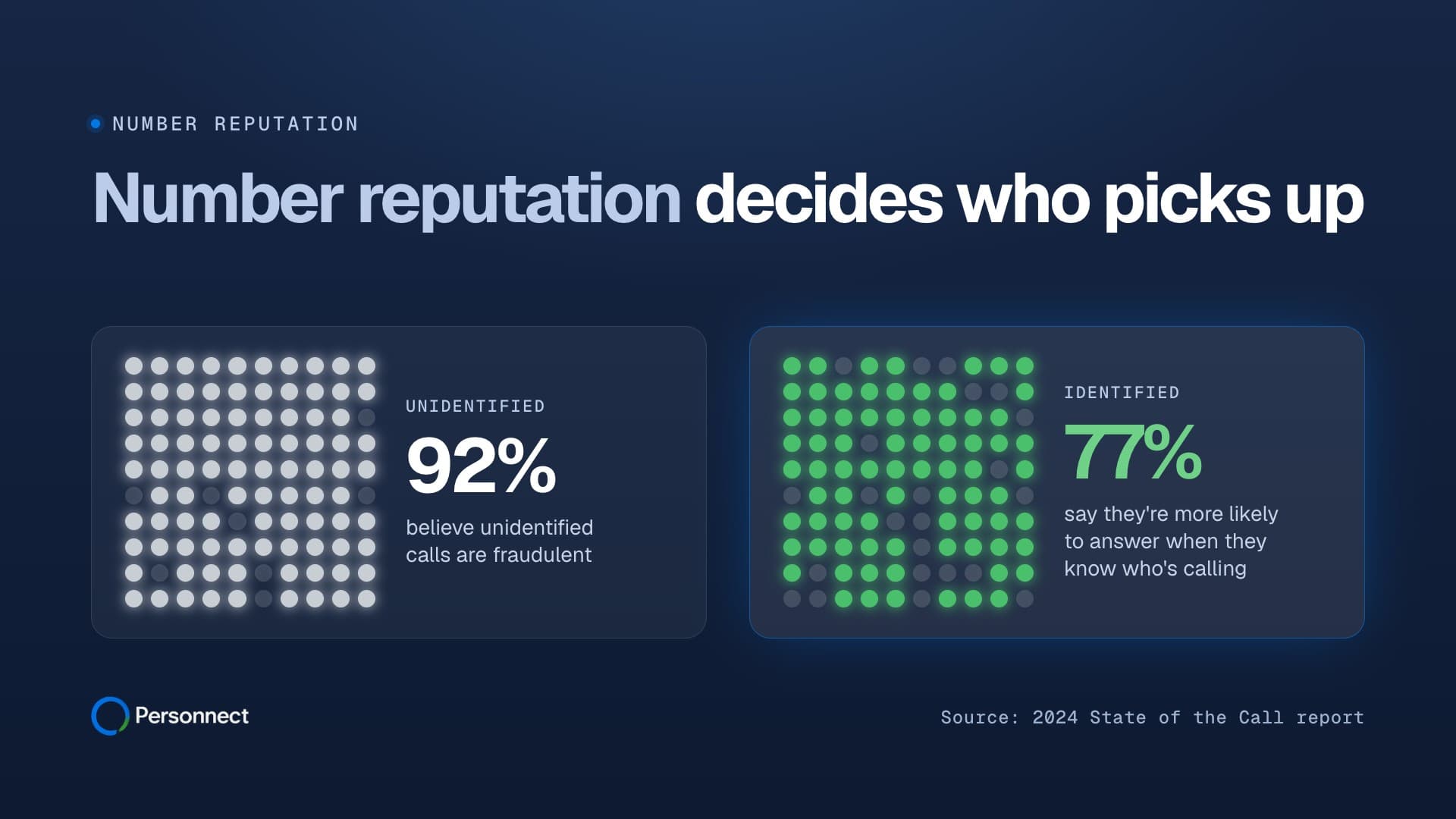
People do not evaluate cold calls. They evaluate ringing phones. The call has not started yet, so the prospect has almost nothing to work with: a number, a location, maybe a label, and their own mood. The decision to answer is made entirely on those signals.
Three quick judgments happen in that window:
- Do I recognize this? A number that looks local or familiar feels safer than an unknown area code from across the country.
- Is this safe? A "Spam Likely" or "Scam Likely" tag ends the conversation before it starts. So does a number that has clearly been used to blast hundreds of calls.
- Is this worth my attention right now? Even a trusted number gets ignored if it rings during a meeting, a commute, or lunch.
Notice that none of these have anything to do with your offer, your pitch, or your company. They are pattern-matching decisions a busy person makes on instinct. If you want to raise your answer rate, you have to win those instincts, not argue with them.
This is also why teams that obsess over scripts while ignoring caller behavior plateau. A brilliant opener delivered to a voicemail box converts no one. The first job of outbound is getting the ring to land as trustworthy.
How Much Does Caller ID Actually Affect Answer Rates?
A lot. Caller ID is the single biggest lever in that two-second decision, and it works on a simple psychological principle: people answer numbers that feel like they belong in their world.
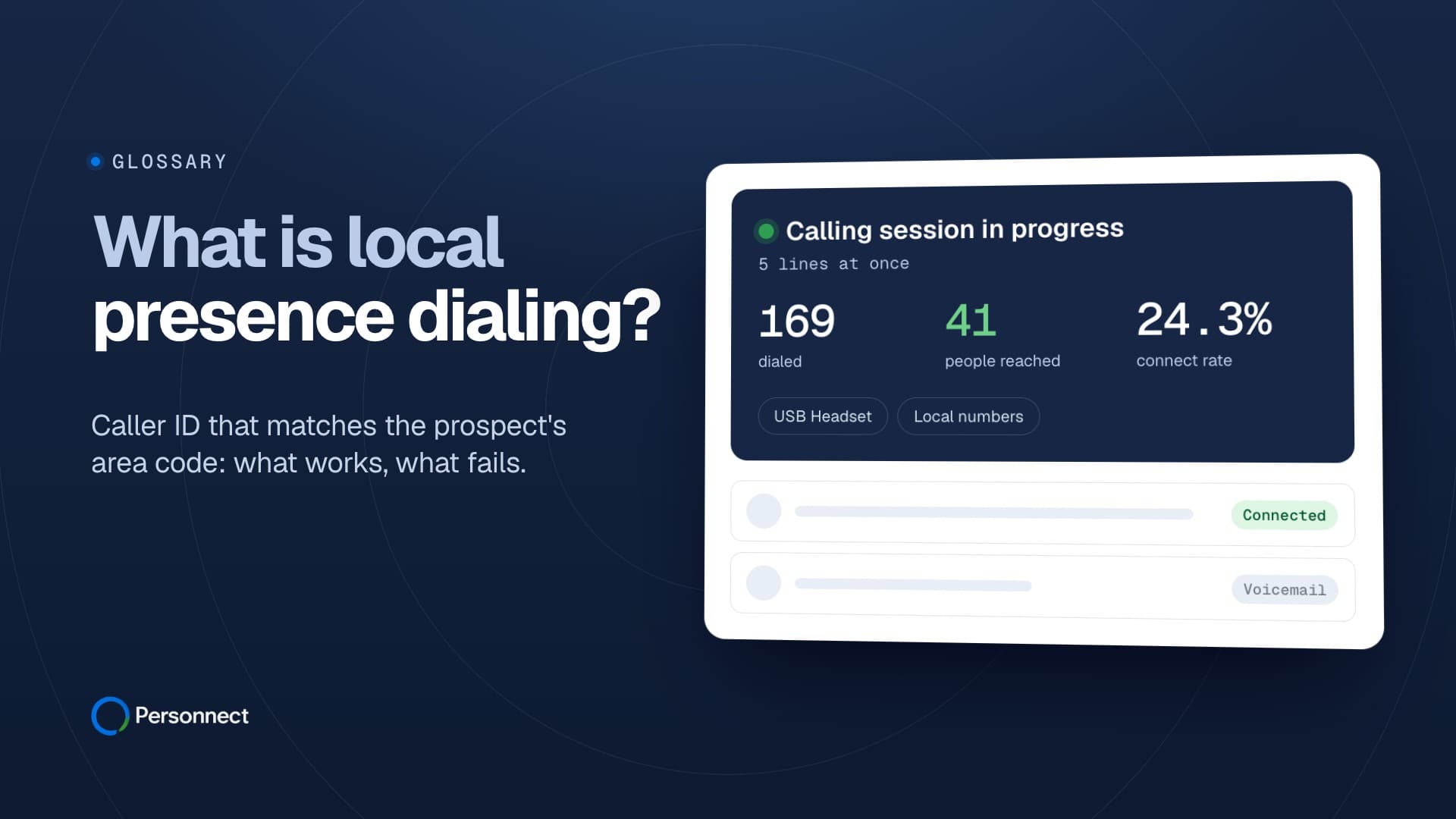
Local presence dialing is the clearest example. Research consistently shows people are roughly four times more likely to answer a call from a local area code, and some teams report local numbers lifting answer rates by several hundred percent. The prospect is not thinking "this is a local business." They are thinking "this could be my kid's school, my doctor, my bank." Familiarity buys you the pickup.
But local presence only works if the number underneath it is healthy. Carrier filtering and spam labels are triggered by predictable behavior: high call volume from a single number, rapid redials, a low answer-to-call ratio, and complaints filed through call-screening apps. About 28 percent of unknown calls analyzed in one large 2023 study were tagged as suspected spam or fraud. If your numbers behave like a spam operation, carriers will label them like one, and no script survives a "Scam Likely" banner.
That is why number management is not an afterthought. It is part of the pitch. A few practical habits help:
- Spread call volume across numbers instead of hammering every dial through one or two lines.
- Match the caller ID to the prospect's region so the number reads as relevant.
- Avoid rapid redials to the same contact, which is one of the fastest ways to get flagged.
- Watch your answer-to-dial ratio as an early warning sign that a number's reputation is slipping.
This is an area where Personnect built its product around the psychology rather than around raw dial count. Their dedicated number approach assigns phone numbers registered under your own company name, so callbacks reach your team directly instead of routing through a shared pool that other companies may have already burned. A clean, owned number is a small thing that quietly protects every call you make through it.
When Is the Best Time to Catch a Prospect Willing to Answer?
Timing is the second-biggest factor, and it is mostly about respecting a prospect's daily rhythm. People answer when they have a pocket of attention to spare. They ignore calls when they are heads-down, in transit, or hungry.
The data lines up neatly with common sense:
- Mid-morning and late afternoon win. Connection rates tend to be strongest between roughly 9 and 11 in the morning and again from about 4 to 5 in the afternoon. Some studies put late-afternoon calls more than 70 percent more effective than calls placed at random times.
- Midweek beats the edges. Tuesday, Wednesday, and Thursday consistently outperform Monday and Friday. In one 2025 survey of sales professionals, 39 percent named Tuesday the best day to call. Friday tends to trail on nearly every metric.
- The lunch dead zone is real. Roughly noon to 2 in the prospect's local time is a low-yield window dominated by breaks and a natural energy dip.
There is a deeper psychological point here. Time-zone discipline matters because 9 a.m. for you might be 6 a.m. for your prospect, and a 6 a.m. call from an unknown number is an instant decline. Calling people inside their own productive hours signals, without a word, that you understand their world. Calling them at a bad hour signals the opposite.
The takeaway for cold call answer rate tips is not "only call at 4 p.m." It is to build your calling blocks around the windows where attention is naturally available, and to protect those windows from meetings and admin work so your reps are actually dialing when prospects are actually answering.
Why Does Persistence Change the Math So Dramatically?
Here is one of the most underused facts in outbound: it takes an average of 8 call attempts to reach a prospect, yet the average salesperson gives up after about 2. That gap is where most pipeline quietly dies.
The psychology behind this is straightforward. A single missed call from an unknown number means nothing to a prospect. It is noise. But people are creatures of pattern. A number that shows up a few times, at sensible hours, without spammy behavior, slowly shifts from "unknown" to "persistent and probably legitimate." You are not annoying them into answering. You are giving their brain enough repetitions to recognize you.
The numbers back this up. Studies suggest 93 percent of connected conversations happen by the third attempt and 98 percent by the fifth, and making five or more attempts to the same prospect can lift conversion potential by up to 70 percent. The returns are real, and they are also bounded: after the fifth attempt, you hit diminishing returns. Persistence is a curve, not an infinite line.
So the discipline is not "call forever." It is "call the right number of times, spaced sensibly, and stop guessing whether anyone is home." Which leads to the most overlooked problem in this whole conversation.
What Happens to the 80 Percent of Calls That Never Connect?
Even with great caller ID, perfect timing, and disciplined follow-up, most of your dials will not reach a live person. Around 80 percent of B2B calls go to voicemail. For most teams, those calls are simply logged as "no answer" and forgotten. That is a quiet, expensive mistake.
Think about the psychology of the rep, not just the prospect. An SDR who makes 50 dials and connects with 5 people feels like the other 45 calls were wasted effort. Morale dips. Activity drops. And the data in those 45 calls, whether the number is even valid, whether it reached the right person's voicemail, whether it is worth another attempt, evaporates.
A smarter approach treats an unanswered call as information rather than a dead end. Did the call reach the correct person's mailbox, confirming the number is good? Did it hit a dead line or a wrong name, telling you to stop wasting attempts? That distinction decides whether your next call is a smart follow-up or a guess.
This is the gap Personnect set out to close. Their platform verifies contacts on every call, even when they don't pick up. By analyzing what happened on unanswered calls, it turns "missed" calls into verified contact data, so reps know which numbers deserve another attempt and which to retire. It reframes the 80 percent from wasted dials into a working list.
Voicemail itself deserves a quick psychological note. About 90 percent of first-time voicemails are never returned, and B2B voicemail response rates sit below 5 percent. A voicemail is not a callback request. At best it is a memory aid that makes your next attempt, or a follow-up email, feel familiar rather than cold. Keep it under 30 seconds, since each second past 30 measurably reduces your chance of connecting, and never build your strategy on the hope of a callback.
How Do You Turn This Into a Repeatable Calling Motion?
Psychology is only useful if it becomes habit. Here is how the ideas above translate into a motion an SDR team can run every day:
- Protect the windows. Schedule calling blocks inside mid-morning and late-afternoon hours in the prospect's time zone, midweek when possible. Keep meetings out of those blocks.
- Guard your numbers. Treat caller ID reputation as a shared asset. Spread volume, match regions, and watch answer-to-dial ratios for early signs of trouble.
- Plan the cadence. Aim for around five well-spaced attempts per prospect before deciding the number is exhausted. Do not stop at two, and do not dial forever.
- Mine the misses. Review what unanswered calls tell you. Keep verified-good numbers in rotation and cut dead ones so reps spend their energy where a person might actually answer.
- Coach the opener separately. Once you reliably get pickups, the script work pays off. Before that, it cannot.
The teams that climb from a single-digit connect rate toward the 18 to 22 percent that verified, well-managed calling can reach are not working harder on the phone. They are working with the prospect's instincts instead of against them.
Frequently Asked Questions
What is a good cold call answer rate for a B2B team?
On generic contact data, average connect rates run roughly 8 to 12 percent. On verified mobile direct-dial data with disciplined timing and clean caller ID, teams commonly reach 18 to 22 percent, and top performers push past 25 percent. If you are below 8 percent, the problem is usually data quality or number reputation, not your script.
Does leaving a voicemail improve my answer rate?
Not directly. Around 90 percent of first-time voicemails are never returned. A voicemail's real value is making your next call or follow-up email feel familiar rather than cold. Keep it short, under 30 seconds, and do not build your strategy around callbacks.
How many times should I call the same prospect before giving up?
The data points to around five well-spaced attempts. About 93 percent of connected conversations happen by the third attempt and 98 percent by the fifth, with clear diminishing returns after that. Most reps quit after two attempts, which is far too early.
Why do my numbers keep getting flagged as spam?
Carrier filtering responds to behavior: high volume from one number, rapid redials, a low answer-to-call ratio, and complaints through call-screening apps. Spreading volume across numbers and avoiding repeated rapid dials to the same contact helps. Personnect addresses this with dedicated numbers registered under your company name, so your line's reputation is yours alone rather than inherited from a shared pool.
What can I learn from calls that go unanswered?
More than most teams realize. An unanswered call can still confirm whether a number is valid and whether it reached the right person. Personnect's platform verifies contacts on every call, even when they don't pick up, so reps know which numbers are worth another attempt and which to retire.