Up to 5 prospects ring at once for each rep on Personnect, a parallel power dialer for B2B outbound teams, and whoever answers is put straight through to the rep. Salesloft calls itself "the Predictive Revenue System" (Salesloft, 2026), and its Cadence product is, in its own words, "Sales Engagement Software To Power Pipeline" (Salesloft, 2026). That makes this an unusual comparison. One product is a dialer. The other is a layer that plans outreach. Teams end up weighing the two when the phone starts deciding the quarter and they wonder whether calling needs a tool of its own.
Key Takeaways
- Personnect is a parallel dialer: each rep gets up to five lines ringing together, voicemail is detected and skipped, and the call goes to the rep the moment a person picks up.
- Salesloft calls itself the Predictive Revenue System, sells Cadence as its sales engagement software and says it includes built-in dialing. It and Personnect sit at different layers of the stack, so the real choice is which problem you are solving: orchestrating outreach or reaching more people by phone.
- Beyond dialing, Personnect looks after the contact record: unanswered calls still verify your contacts, and Michael can enrich each lead for 15¢.
- Personnect bills only answered minutes, with no seat fees, no platform fee and unlimited users, so it can run next to an existing SEP without adding seats.
- Before deciding, put to Salesloft the same questions Personnect answers below: lines per rep, what an unanswered call does to the record, whose name the numbers carry, and how calling is billed.
The rest of this guide works through that choice in order: which problem you have, what a parallel dialer adds, what happens to your data and your numbers, what it costs, and whether running both makes sense. Where a detail about Salesloft matters, you get the question to put to Salesloft rather than a guess at the answer.
Which Problem Are You Trying to Solve: Orchestration or Connection?
Orchestration is about coordinating many touches across many channels for many accounts: who gets an email today, who gets a call, what happens after a reply. Salesloft describes sales engagement software as a platform that "helps sales teams manage, automate, and optimize their prospecting across multiple channels" (Salesloft, 2026), and says "Cadence helps teams execute across every channel, with AI agents that research accounts, identify the right buyers, and keep prospects engaged through every stage of the pipeline" (Salesloft, 2026). Connection is about getting a person on the phone. Both are real problems, but they rarely bind at the same time. About 80% of cold calls go to voicemail (Cognism, 2024), so for teams where the phone carries the pipeline, connection is usually the expensive one.
Orchestration is the job Salesloft describes. Connection is the job Personnect takes on, and its math is simple: the number of live conversations a rep can reach in an hour is capped by how many lines are working for them, and that is the number Personnect is built to raise.
Last month's activity usually tells you which one you have. If reps worked their sequences on time but conversations stayed flat, the problem is connection. If conversations happened but follow-up slipped, it is orchestration.
What Does a Parallel Dialer Add to an SEP Stack?
A parallel dialer changes the unit of work from one call to several. Personnect rings up to five lines per rep at once. Voicemail is detected and skipped, and the rep is connected the moment a person answers, so the rep's time goes to people rather than to rings and greetings. That is how a single rep reaches around 500 dials a day. With Cognism putting the median B2B cold-call connect rate near 4.8% in 2024, the share of an hour that ends in a real conversation is small to begin with, and more lines in flight is a direct way to grow it.
Salesloft does include calling. It says that, "combined with built-in dialing, meeting scheduling, and mobile access," Salesloft gives sellers what they need to run a complete prospecting cadence without toggling between tools (Salesloft, 2026). The pages we checked give no lines-per-rep figure, so ask Salesloft how many lines its built-in dialing runs at once for one rep, and compare that with Personnect's five.
Parallel dialing has one drawback worth checking for yourself: a short pause can occur between a prospect's hello and the rep joining the call. Put your reps on part of the list for a few sessions and ask them whether they notice it.
Personnect also calls each contact from a local number in their area code, across more than 200 US metro areas, and logs the summary, transcript and outcome of every call, syncing them to HubSpot or Salesforce. Recordings are kept for a year.
What Happens to Your Contact Data Between Touches?
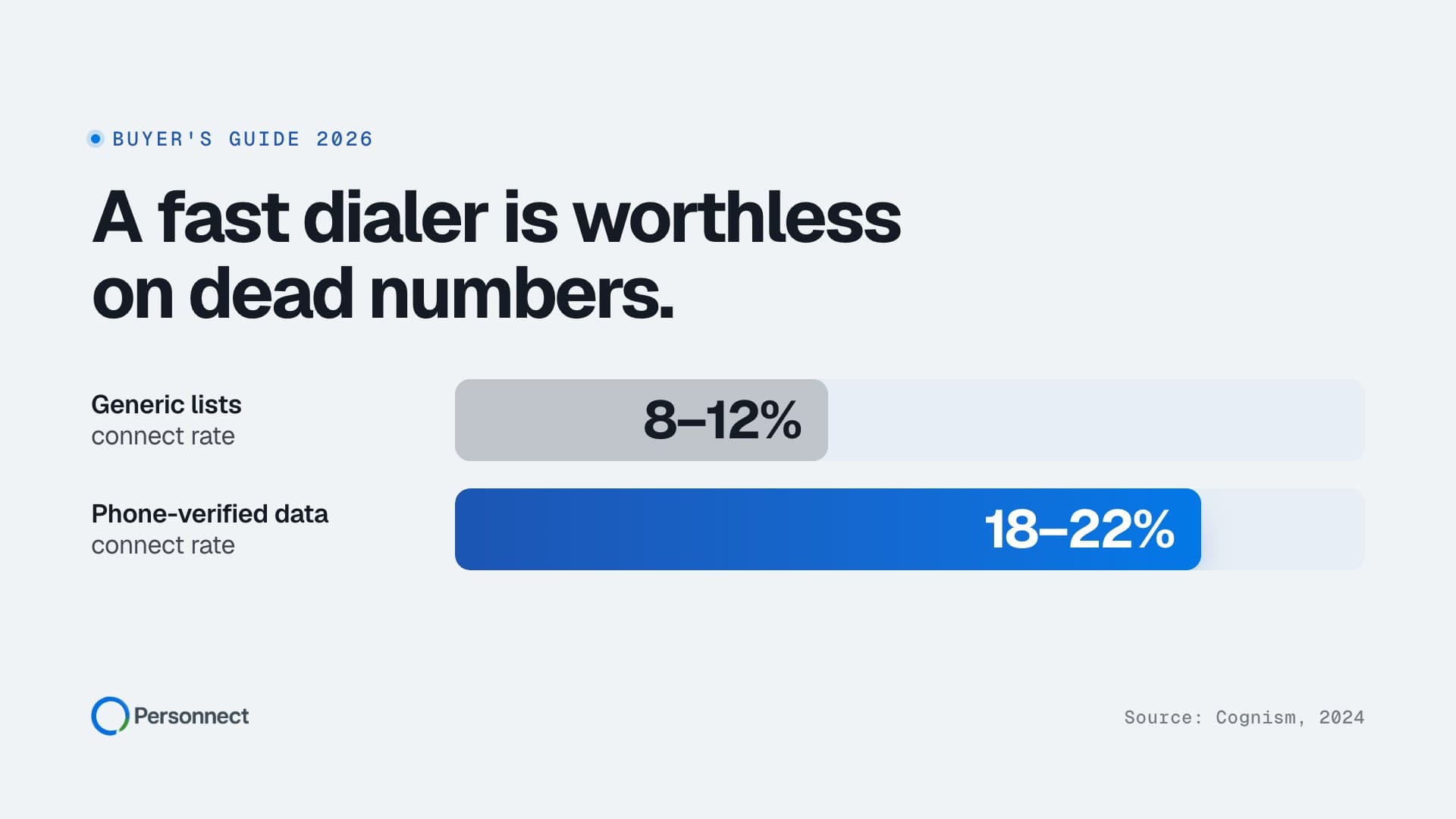
Sequences assume the contact on step four is still the person you added on step one. B2B contact data says otherwise: Cognism's 2024 research finds it decays by roughly 22.5% a year, so every month a list sits, more of it points at the wrong person. Cognism also finds that phone-verified data connects at about 18 to 22%, compared with 8 to 12% for generic, unverified lists. Cognism measured data quality across the market rather than inside any one product, and the numbers make a plain point: the record deserves as much attention as the sequence.
Personnect works on the record as it calls. Michael, the assistant built into Personnect, looks at three things on each lead (title, company and phone number) and sends it back marked enriched, stale or retired; that costs 15¢ a lead. Unanswered calls still verify your contacts, so a day of no-answers still tells you who is reachable.
Ask Salesloft what happens to a contact record when a call goes unanswered, and whether anything in the platform checks titles, companies or numbers before a step fires.
Whose Name Is on the Number Your Prospects See?
A sequence step that ends on a "Spam Likely" screen is a wasted step. Cognism's 2024 research found roughly a third of outbound numbers get flagged as spam every month, and once flagged, answer rates can fall by up to 80%.
When a sequence reaches its call step, the prospect sees a number from their own area code, and that number is registered in your company's name with Verizon, AT&T and T-Mobile. Personnect brings new numbers up slowly, keeps calls balanced across them and rests any that get flagged. It cannot promise a number will never be labeled; nobody can.
The table further down carries the matching question for Salesloft, so caller ID gets settled alongside lines per rep and billing.
How Is Calling Billed on Each Side?
Salesloft does not list prices on its site. Its pricing link leads to a sales page that asks you to "Book time with us" (Salesloft, 2026). In that conversation, ask how calling is billed in your plan: per seat, per minute, bundled with the platform, or some mix. The answer shapes how a calling-heavy team's costs grow.
Next to an SEP, Personnect adds a usage line rather than a seat line. The only per-call charge is 8.5¢ a minute once someone answers; a call that rings out, hits a busy signal or fails is not charged. Numbers run from $1 a month each, there is no platform fee, and the usage plan has neither a contract nor a minimum term. Because any number of users can log in, you can put three reps or thirty on the phone and pay for the conversations they have rather than the logins they hold.
Can You Use Both Together?
Yes, and for phone-heavy teams it can be the more sensible setup than choosing one. The SEP keeps planning the outreach; Personnect takes the calling where volume and live conversations matter most.
Plan the handoff through your CRM. Personnect's native two-way integrations are with HubSpot and Salesforce, and it logs the summary, transcript and outcome of every call there. Other CRMs work through CSV import and export, with a direct integration available on request. Check with Salesloft how it picks up call activity that another tool logged in your CRM, so reps see one history per contact. Teams without a CRM can upload a list straight into Personnect and use it as their outbound CRM for the calling side.
Start with one segment, such as a single territory or a single list, and compare live conversations per rep-hour against the same segment worked the old way. You keep everything you already run; you are only adding a calling layer of its own.
What to Ask Salesloft, and How Personnect Answers
| Question to settle | Personnect | What to confirm with Salesloft |
|---|---|---|
| What is it? | A parallel dialer for B2B outbound sales teams | Cadence, its sales engagement software, part of what it calls the Predictive Revenue System (source) |
| How many lines ring per rep? | Up to five at once; around 500 dials a day | Includes built-in dialing (source); ask how many lines run at once per rep |
| What happens when someone answers? | The rep is connected that moment | How quickly the rep joins a live answer |
| What happens on voicemail? | Detected and skipped | Whether voicemail is detected and skipped |
| What does an unanswered call do? | Still verifies your contacts | What an unanswered call changes on the record |
| Who checks the lead? | Michael, at 15¢ a lead; each comes back enriched, stale or retired | Whether anything checks titles, companies or numbers before a step |
| Which number does the prospect see? | A local number in their area code, registered in your company's name with Verizon, AT&T and T-Mobile | Whose name outbound numbers are registered in |
| How is calling billed? | 8.5¢ per minute on answered calls; no seat fees, no platform fee | Prices are not published; ask sales (source) |
| How many users? | Unlimited | How users are counted |
| Is there a contract? | None on the usage plan, and no minimum term | Contract length and minimums |
| Where do call records go? | HubSpot or Salesforce, native and two-way; other CRMs through CSV or a direct integration on request; no CRM needed | How call activity logged in your CRM shows up |
Salesloft and Personnect: Questions From Revenue Teams
Does Personnect replace Salesloft?
No, and it is not trying to. Salesloft's Cadence is sales engagement software for managing, automating and optimizing prospecting across channels (Salesloft, 2026); Personnect is a parallel dialer that rings up to five lines per rep and connects the rep the moment someone answers. If your problem is planning outreach across channels, keep your SEP. If it is reaching people by phone, Personnect adds what a dialer is built for.
How do call results get from Personnect into the rest of my stack?
Through your CRM. Personnect logs the summary, transcript and outcome of every call and syncs them to HubSpot or Salesforce over native two-way integrations. A team on another CRM moves records through CSV import and export, or gets a direct integration on request. Ask Salesloft how it shows call activity that another tool logged in that CRM.
Which teams get the most from adding a parallel dialer?
Teams where the phone carries the pipeline. Since roughly four in five cold calls reach voicemail (Cognism, 2024), a rep on one line spends much of the hour waiting. Personnect keeps up to five lines ringing per rep and skips voicemail, so more of the hour is spent talking.
What happens to a contact when a Personnect call goes unanswered?
It still counts. Unanswered calls still verify your contacts, and every lead Michael checks comes back enriched, stale or retired. With contact data decaying around 22.5% a year (Cognism, 2024), that steady checking keeps your list pointed at people who are still there.
What does Personnect cost on top of an SEP?
Usage only: answered minutes at 8.5¢, numbers from $1 a month, and 15¢ a lead if you use enrichment, with no seats to buy. Your Salesloft plan stays as it is.
Whose name are Personnect's numbers registered in?
Your company's, registered with Verizon, AT&T and T-Mobile, and each prospect sees a local number from their own area code. The section on numbers above covers how new and flagged numbers are handled.
Where Personnect Earns Its Place Next to Salesloft
Personnect runs alongside Salesloft as the calling layer, with the handoff going through your CRM, and it pays off for each part of the team. Reps get up to five lines each, voicemail skipped, and the live answer handed over the second it happens. Sales leaders get live conversations, rather than touches, as the number they manage, on a bill built from answered minutes with no seats to add. Revenue ops gets a record that improves while the team calls: dials nobody picks up still confirm the contact, and Michael returns each lead enriched, stale or retired.
Salesloft keeps planning the outreach, Personnect does the calling next to it, and every call's record lands in your CRM.