Your SDR team dialed 1,000 numbers last week. How many turned into real conversations? On generic B2B lists, the connect rate now sits between 8% and 12% (Skipcall, 2026), which means most of those dials reached voicemail, a wrong person, or a number that no longer works. Parallel dialers were built to fix the math by placing several calls at once, and they do raise live conversations per rep. Both Personnect and Nooks are high-volume parallel dialers in this category. The question for a sales leader evaluating the two is not who dials faster. It is what each dial is actually worth.
That distinction is where this comparison lives. Nooks has built a strong reputation around team energy and rep coaching. Personnect approaches the same volume from a different angle, treating every call, answered or not, as a chance to verify contact data. Below is an honest, sourced look at how the two compare.
Key Takeaways
- Personnect and Nooks are both high-volume parallel dialers; the real difference is the quality of the data each dial runs against.
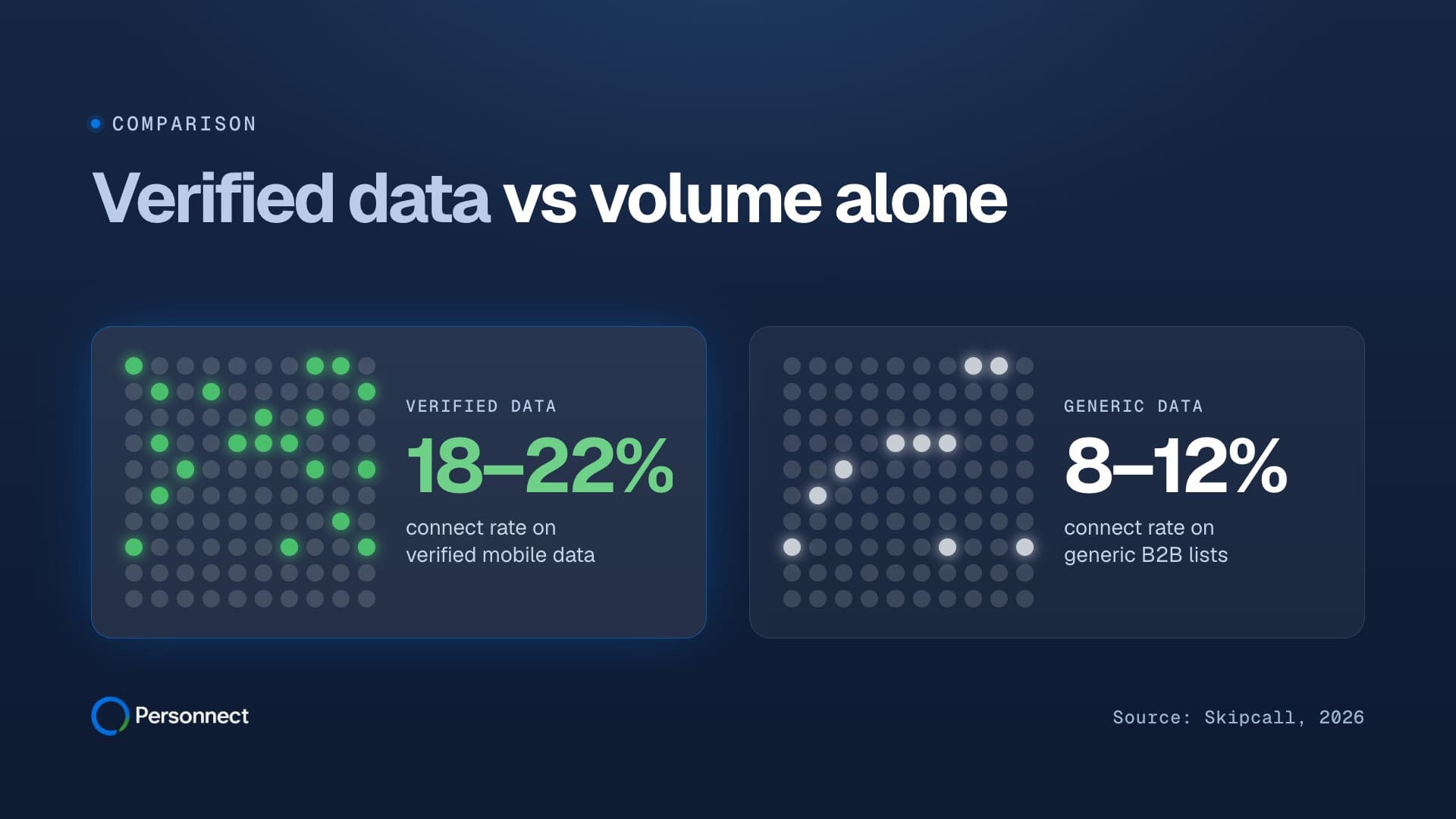
- Connect rates run 8-12% on generic data but 18-22% on verified mobile direct-dial data (Skipcall, 2026).
- Nooks leads on coaching culture and its virtual salesfloor; Personnect leads on per-call verification and usage-based pricing.
- Nooks runs roughly $5,000 per user per year (MarketBetter, 2026); Personnect charges $0.085 per minute with no seat fee.
- Volume only compounds when the underlying list is reachable, since B2B data decays about 22.5% a year (Cognism).
What Do Personnect and Nooks Actually Have in Common?
More than most comparisons admit. Both are parallel dialers that call multiple prospects at once, and both let a rep place hundreds of dials in a day, the kind of volume that took a full bullpen a decade ago. Nooks users report jumping from 50 to 60 dials a day to 150 to 200 and beyond (MarketBetter, 2026), and Personnect runs the same multi-line model, calling up to five prospects simultaneously.
That shared foundation matters because it removes the lazy framing. This is not a story about a high-volume tool versus a low-volume one. Both clear the volume bar that teams care about. Both connect a rep the instant a real person picks up. Both log call outcomes automatically so reps spend less time typing and more time talking.
So if raw dialing capacity is roughly even, the decision comes down to everything that happens around the dial: the quality of the list you are calling, what you learn from calls that do not connect, how the tool protects your phone numbers, and what you pay for all of it. Those are the dimensions where Personnect and Nooks diverge.
A quick note on a real tradeoff that applies to any parallel dialer, including both of these. Connection lag, the brief pause a prospect hears when they answer a parallel call, is the single most common complaint about the category (TitanX). It is a physics problem more than a vendor problem, and it is worth testing live with any tool you evaluate.
What Is Nooks and Where Does It Win?
Nooks is an AI sales engagement platform built around an agent workspace that combines dialing, sequencing, and coaching in one interface. Its parallel dialer claims to connect reps with up to 3x more prospects, and it pairs that with spam protection, automatic phone-tree detection, and AI note-taking (Nooks). For phone-heavy teams, the package is genuinely strong.
Where Nooks earns its reputation is culture and coaching. Its signature feature is the virtual salesfloor, a shared digital space where reps dial together, listen to live calls, and celebrate wins in real time. Reviewers describe it as Discord for cold callers, and it is the feature users call out most often as the reason they stay (MarketBetter, 2026). For a remote or hybrid SDR team that lost the energy of an in-person bullpen, that is a real problem solved well.
Coaching and rep development
The coaching layer is equally serious. Nooks offers AI roleplay for training, battlecards for objection handling, performance scorecards, and automated conversation analysis that surfaces feedback after every call. For a manager trying to ramp new reps quickly, this is a meaningful toolkit.
Multichannel sequencing
Nooks also reaches beyond the phone. Its AI sequencing coordinates calls, emails, and social touches, with personalization that adapts as account data changes. That breadth across channels, all run from one workspace, is a genuine strength.
The honest caveat
The flip side is cost and focus. Nooks is priced around $5,000 per user per year, billed annually and quote-based (MarketBetter, 2026). For a smaller or more variable team, a per-seat annual contract is a heavier commitment than the dialing itself requires.
What Is Personnect and Where Does It Win?
Personnect is a parallel dialer built on a simple premise: every call should produce verified data, even the ones nobody answers. That is an unusual position for the category: a missed call is not a dead end, because on Personnect unanswered calls still verify your contacts. Given that roughly 80% of cold calls reach voicemail, salvaging value from that pile is a different starting point than most dialers take.
The mechanics are worth understanding. When a call goes unanswered, Personnect captures the voicemail and its AI checks whether you reached the right person, whether the number is active, and whether the role still matches, then updates the CRM accordingly. A dial that a traditional dialer logs as "no answer" instead confirms or corrects a contact record. Over a week of high-volume dialing, that quietly rebuilds list accuracy as a byproduct of the calling you were already doing.
Number health and dedicated numbers
Personnect also leans into reachability, not just data accuracy. It registers each phone number in your company's name rather than a shared pool, monitors number health, and cleans numbers regularly to reduce spam flags. This matters because about 29% of unknown calls now get flagged as unwanted (Hiya, 2024), and a valid number that displays "Spam Likely" never gets a conversation. Each contact is called from a local number in their area code, drawn from numbers that are yours alone, so callbacks reach your team.
Coverage analysis and CRM sync
Before dialing, Personnect's coverage analysis maps where your contacts are located so you can match local numbers to markets. On the back end, it integrates natively with HubSpot and Salesforce, and contact data from your calls flows straight to your CRM. Checking a lead's title, company and phone before the first dial is lead enrichment, a separate 15¢ per lead.
Usage-based pricing
The pricing model is the clearest contrast with Nooks. Personnect charges $0.085 per minute with numbers from $1 per month, with no seat fees, no contract and no minimum term. That structure changes who can adopt a parallel dialer. A team that dials seasonally, or a startup that cannot justify a five-figure annual seat commitment, pays for what it uses instead of pre-buying capacity.
Why Does Verified Data Decide Whether Volume Pays Off?
Because volume is a multiplier, and a multiplier only helps when the thing it multiplies is good. Dialing twice as fast into a list that is 25% wrong simply reaches the wrong people twice as fast. Cognism puts annual B2B contact data decay at roughly 22.5%, so a list bought at the start of the year is carrying a lot of dead weight within months.
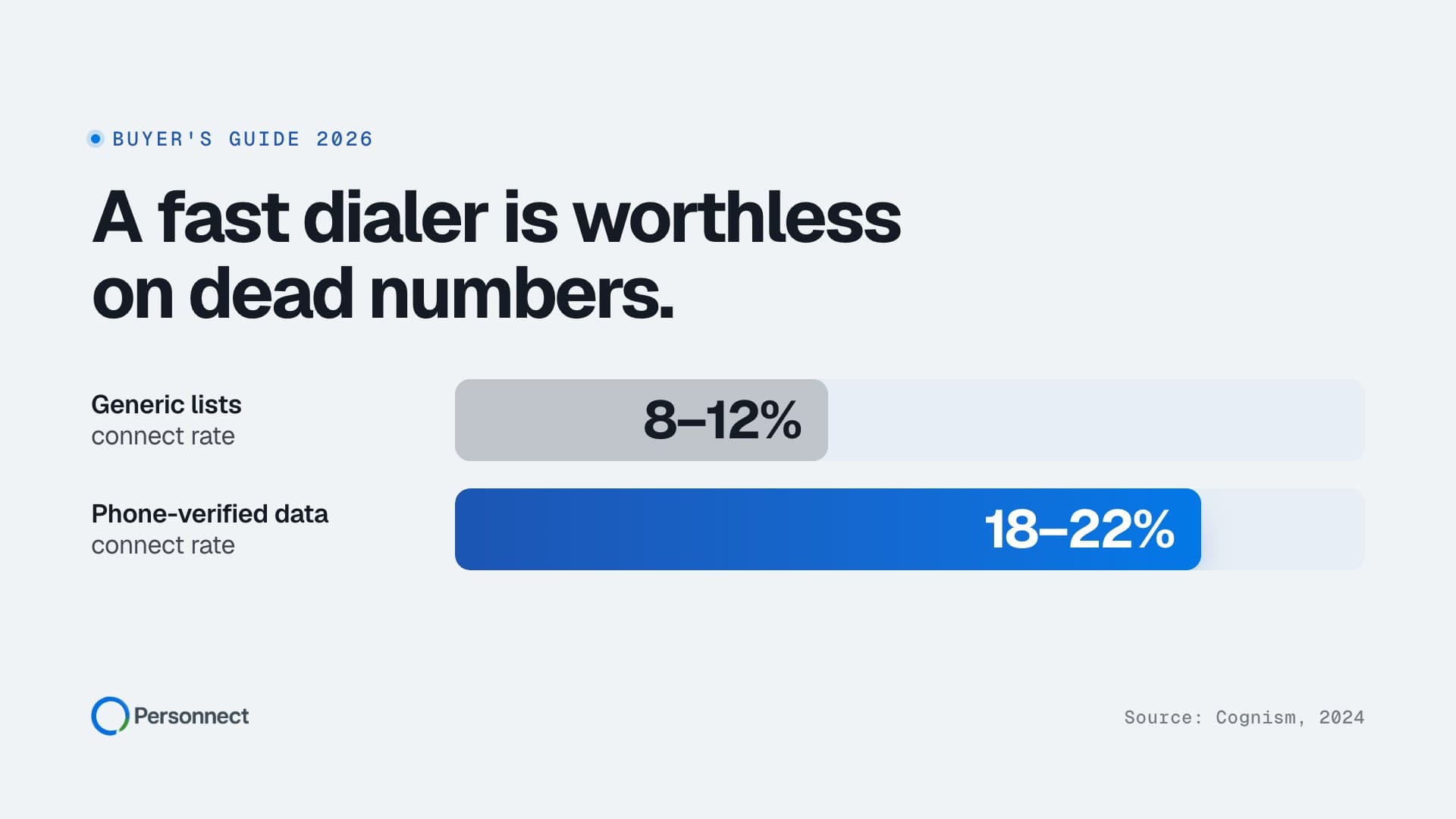
The gap shows up directly in connect rates. On generic data, connect rates sit at 8-12%, but on verified mobile direct-dial data they climb to 18-22% (Skipcall, 2026). That is not a rounding difference. It is the difference between a rep having two conversations an hour and four. The Bridge Group's benchmark shows the median SDR makes around 44 dials a day but holds only about 4.1 quality conversations, a reminder that activity and outcomes are not the same metric.
This is the practical reason Personnect built verification into the dialer rather than treating it as a separate data-cleaning step. Coaching makes a rep better at the conversations they get. Verified, reachable numbers determine how many conversations they get in the first place. Both matter. They are just different levers, and a sales leader should be clear about which problem is currently costing more.
There is a cost angle too. The average organization absorbs $12.9 million a year in costs from poor data quality (Gartner, 2020). In outbound, that cost compounds, because every day you dial a stale list it gets staler. Verifying at the moment of each dial is one way to stop the compounding.
How Should You Choose Between Personnect and Nooks?
Start with how many live conversations your reps actually get. Coaching sharpens the conversations a rep already has, and Nooks has built a lot of it. Personnect works on the number of conversations in the first place: per-call verification keeps the list reachable, so skilled reps spend less of the day on numbers that were never going to answer.
Team shape points the same way. A lean team, a team whose calling volume moves with the season, or any team that wants to protect its caller ID reputation and rebuild list accuracy as it dials gets the most from Personnect's model, and usage-based pricing means it never pays for an idle seat.
A simple side-by-side
| Dimension | Personnect | Nooks |
|---|---|---|
| Core dialer | Parallel, up to 5 lines | Parallel, up to 3x connects |
| Daily dial volume | Hundreds per rep | 150-200+ per rep |
| Verification on every call | Yes, including unanswered | Partial |
| Voicemail intelligence | Yes | Limited |
| Number health and registration | Registered in your name | Partial |
| Coverage analysis | Yes | Partial |
| AI call analysis | Yes | Yes |
| Virtual salesfloor and coaching | Limited | Yes, signature strength |
| Multichannel sequencing | Phone-focused | Yes |
| CRM integrations | HubSpot & Salesforce (native, two-way); any other CRM by CSV import and export, or a direct integration on request | Yes |
| Pricing | $0.085/min, no seat fee | ~$5,000/user/yr (MarketBetter, 2026) |
The cleanest way to decide is to run both against the same dirty list for a week and compare not dial counts but conversations per hour and CRM records corrected. Volume will look similar. The downstream data will not.
Frequently Asked Questions
Is Personnect a high-volume dialer like Nooks?
Yes. Personnect runs up to five lines at once per rep and supports hundreds of dials per rep per day, the same volume tier as Nooks and Orum. The difference is not capacity. It is that Personnect also verifies contact data on every call, so volume runs against a cleaner list (Skipcall, 2026).
What happens to unanswered calls in Personnect?
They become data. Roughly 80% of cold calls reach voicemail, and most dialers log those as wasted. Personnect captures the voicemail and its AI confirms whether you reached the right active person, then updates the CRM. That is the core of its approach: unanswered calls still verify your contacts.
How does Nooks pricing compare to Personnect?
Nooks runs about $5,000 per user per year, billed annually and quote-based (MarketBetter, 2026). Personnect uses usage-based pricing at $0.085 per minute with numbers from $1 per month, no seat fees, no contract and no minimum term, so cost scales with how much you actually dial.
Does Nooks have better coaching than Personnect?
Coaching and team culture are where Nooks has invested most. Its virtual salesfloor and AI roleplay are widely praised as its standout features (MarketBetter, 2026). Personnect invests in reach instead, with verification, number health, and every dial turned into data, so more of the dialing day produces something useful.
Why does data quality matter more than dial volume?
Because volume multiplies whatever it touches. B2B data decays about 22.5% a year (Cognism), and connect rates jump from 8-12% on generic data to 18-22% on verified data (Skipcall, 2026). Dialing faster into a bad list just reaches the wrong people faster, which is why verification changes the return on every dial.
Will my numbers get flagged as spam on either platform?
Spam labeling is a real risk for any high-volume dialer, since about 29% of unknown calls are flagged as unwanted (Hiya, 2024). Both tools offer spam protection. Personnect goes further by registering numbers in your company's name with Verizon, AT&T and T-Mobile, easing new numbers in, and resting any that get flagged, to keep them reaching live phones.
The Bottom Line
Personnect and Nooks are not opposites. They are two capable parallel dialers that have invested in different things. Nooks built a coaching and culture engine that helps reps get better at the conversations they have, and its virtual salesfloor is the best in the category for team energy. Personnect built verification into the dialer so that high-volume calling rebuilds list accuracy instead of burning through it, and its usage-based pricing lowers the bar to adopt.
Personnect goes after the supply of reachable conversations, and the underlying math shows why. With connect rates of 8-12% on generic data and data decaying 22.5% a year, the list you dial decides whether all that volume turns into pipeline or just into activity.